

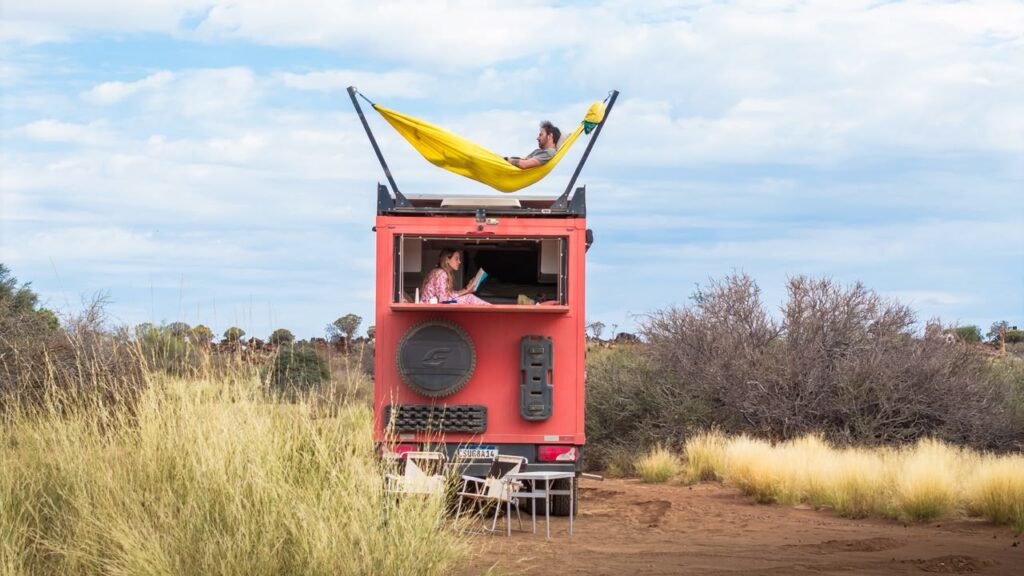
A motorhome that traveled through 10 African countries needed to connect to the grid only about three times during a journey lasting approximately one year. This level of energy independence enabled Brazilian couple Alessandro De Franceschi, known as “Alê,” and Maria Eduarda Cardoso, known as “Duda,” to operate two air conditioners, two refrigerators, an electric stove, and satellite internet equipment, even in remote areas without access to conventional electricity infrastructure.
The couple, who document their travels on social media under the name Getoutsidebr, use a system combining rooftop solar panels, lithium batteries, and charging from the vehicle’s alternator while driving. The system features equipment from Victron Energy, supplied with the involvement of Kamell Comércio Global, and illustrates how integrating solar generation, battery storage, and energy management can increase the autonomy of mobile power systems.
According to Alê, the African expedition began in August 2025. The couple traveled through 10 countries in their motorhome and visited four others without the vehicle. The combination of solar power, battery storage, and alternator charging allowed them to maintain their usual electricity consumption without regularly relying on external power connections.
Solar power generation and charging on the move
The motorhome’s electrical system relies on two main energy sources. The first is solar power, generated by rooftop photovoltaic modules that supply electricity to onboard appliances and recharge the batteries during the day.
The second source is the vehicle’s alternator. While the motorhome is moving, a Victron Energy Orion DC-DC charger draws power from the vehicle’s electrical system to recharge the lithium batteries.
The combination enables the motorhome to operate in locations without grid access. The batteries store electricity for later use, while monitoring equipment allows the couple to track the state of charge and power supplied by the different sources.
The system powers a range of appliances beyond basic travel necessities, including an electric stove and oven, an air fryer, two refrigerators, two air conditioners, a television, lighting, and Starlink satellite internet equipment. Water can also be heated electrically, although a diesel-powered option is available.
“Today, we’re able to maintain a daily routine very similar to that of a conventional home, even when we’re far from urban infrastructure,” said Alê.
Battery bank and energy management
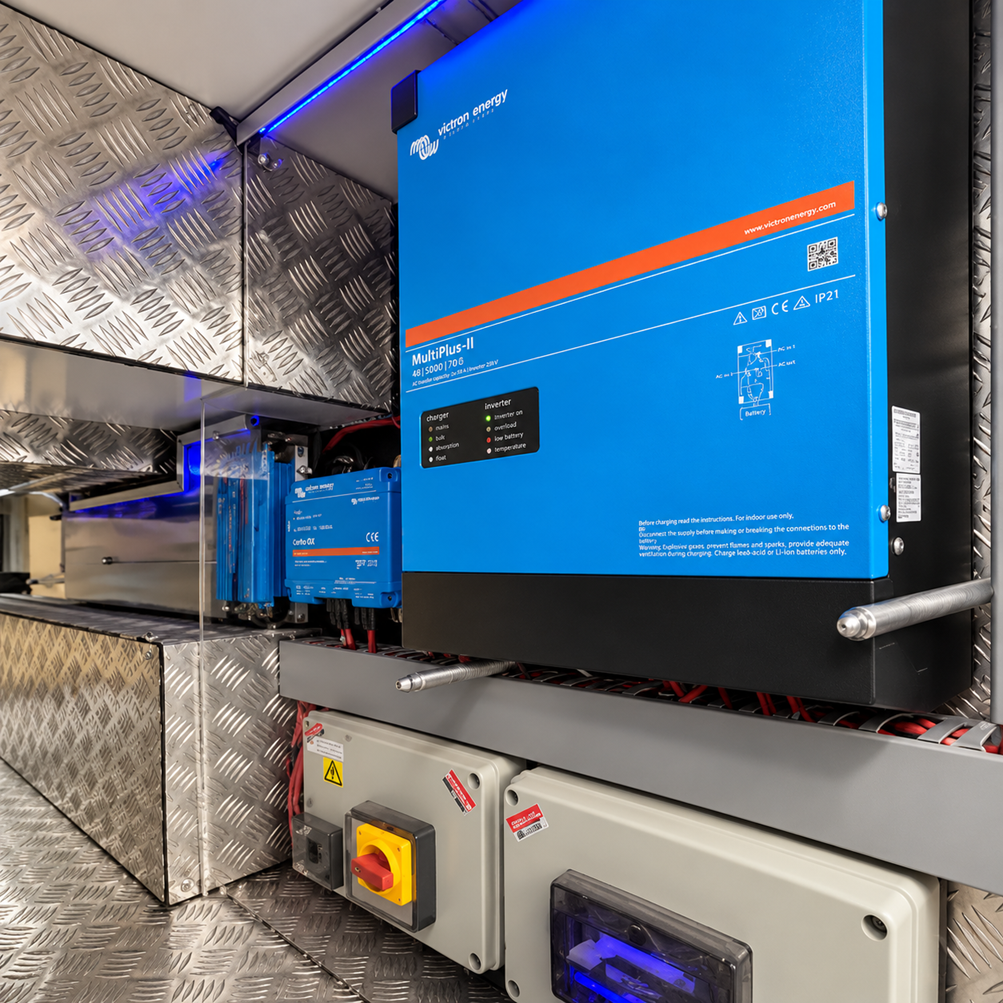
The motorhome’s electrical system includes three Victron Energy lithium batteries, each rated at 25.6 V and 200 Ah. Based on their nominal specifications, the batteries provide a combined storage capacity of approximately 15.36 kWh, before accounting for discharge limits and conversion losses.
Power conversion is handled by a 24 V, 5,000 VA MultiPlus-II inverter. The system also includes a SmartSolar MPPT 100 V/50 A solar charge controller, Orion charging units, a 500 A SmartShunt battery monitor, a Cerbo GX communication and control hub, and a GX Touch 70 display.
The components work together to manage solar generation, battery charging, DC-to-AC power conversion, and system monitoring.
The motorhome’s energy autonomy depends not only on battery capacity but also on solar generation, electricity consumption, and charging conditions. Running air conditioners, electric cooking appliances, and other equipment simultaneously can significantly increase power demand. The system’s performance therefore depends on the integration of energy sources, battery storage, and energy management rather than installed storage capacity alone.
Remote monitoring tracks solar generation
The system allows the couple to monitor battery state of charge and track electricity supplied by the solar panels and the vehicle’s alternator. The information is available through a display inside the motorhome and can also be accessed remotely via a smartphone.
According to Alê, remote monitoring has proved particularly useful when the couple leaves the motorhome parked while traveling to other destinations by plane. It allows them to check the system’s status remotely and identify fluctuations in solar generation, including those caused by shading on the panels.
In off-grid applications, remote monitoring can help users identify changes in electricity generation and battery charge levels, enabling them to adjust consumption and reduce the risk of power shortages.
However, energy autonomy remains dependent on factors such as solar irradiation, shading, parking duration, and onboard electricity demand. During periods of reduced solar generation or high consumption, the amount of energy available for use may decline.
From legal careers to life on the road
Alê, 41, from the Brazilian state of Rio Grande do Sul, and Duda, 33, from Espírito Santo, previously lived in São Paulo and worked as lawyers before deciding to travel across the Americas. Their original plan was to drive from Brazil to Ushuaia, in southern Argentina, before continuing north to Alaska.
What began as a road trip eventually became a way of life. The couple has been traveling for nearly seven years and estimates that they have visited around 30 countries. They document their experiences through their Getoutsidebr social media project, which has attracted approximately 500,000 followers.
Their experience highlights the potential of solar power and battery storage for mobile off-grid applications. By combining onboard electricity generation, energy storage, and battery charging while driving, the motorhome reduces its reliance on external power connections and provides greater flexibility when traveling through remote areas.
The couple also announced in September 2026 that they were expecting their first child, Martin, marking a new chapter in their life on the road. Maintaining a reliable electricity supply and managing energy consumption will remain important considerations as they prepare to travel as a family.
The post Couple travels through 10 African countries in solar-powered motorhome with battery storage appeared first on pv magazine Global.


