Which Countries Have the Best Computing Skills?
Key Takeaways:
- Eight of the world’s top 10 education systems for computational problem-solving are in Asia.
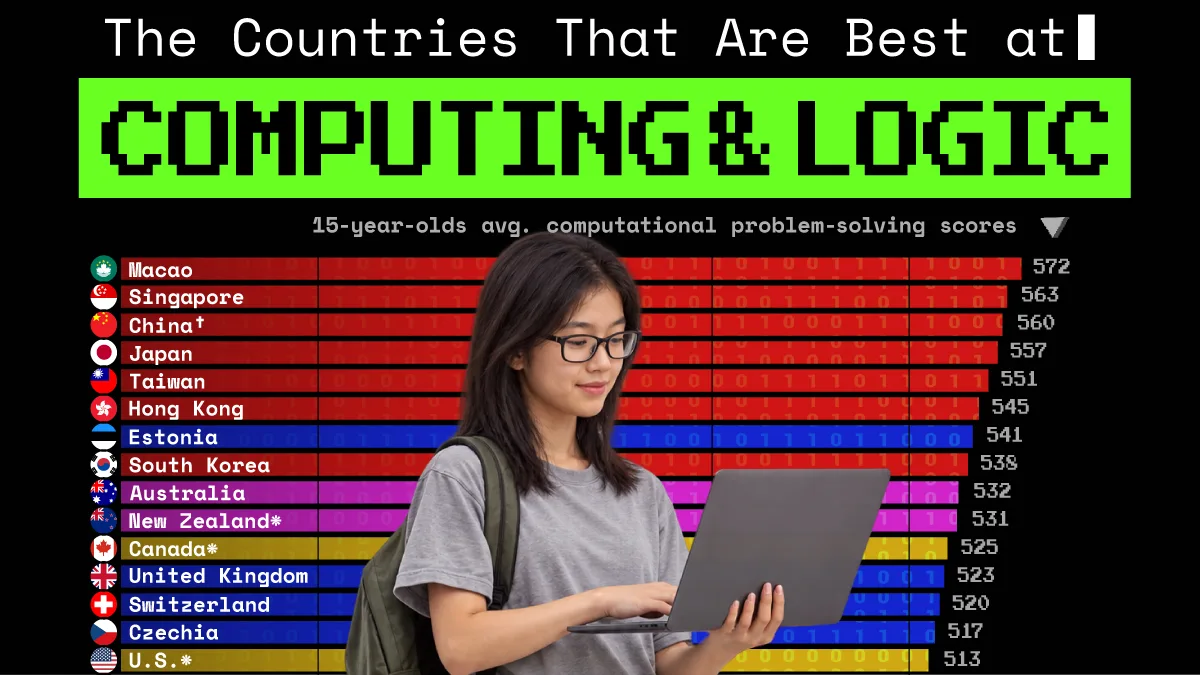
- Macao leads with 572 points, followed by Singapore (563) and China’s Beijing, Shanghai, Jiangsu, and Zhejiang regions (560).
- The United States ranks 15th with 513 points, above the OECD average of 500.
As artificial intelligence reshapes the workplace, students’ ability to solve problems using logic and computational thinking is becoming increasingly valuable.
This visualization ranks countries and economies by the computational problem-solving performance of their 15-year-old students, using the OECD’s PISA 2025 results, published in September 2026.
The assessment evaluates skills such as logical reasoning, modeling, and algorithmic thinking rather than simply knowing how to use a computer.
Ranking Countries by Computing Skills
The following table shows average computational problem-solving scores from PISA 2025. Scores represent assessment points, not the percentage of students who are computer literate.
| Rank | Country / Economy | Mean Score (PISA points) |
|---|---|---|
| 1 |  Macao (China) |
572 |
| 2 |  Singapore |
563 |
| 3 |  B-S-J-Z (China) |
560 |
| 4 |  Japan |
557 |
| 5 |  Chinese Taipei |
551 |
| 6 |  Hong Kong (China) |
545 |
| 7 |  Estonia |
541 |
| 8 |  South Korea |
538 |
| 9 |  Australia |
532 |
| 10 |  New Zealand* |
531 |
| 11 |  Canada* |
525 |
| 12 |  United Kingdom |
523 |
| 13 |  Switzerland |
520 |
| 14 |  Czechia |
517 |
| 15 |  United States* |
513 |
| 16 |  Lithuania |
512 |
| 17 |  Ireland |
511 |
| 18 |  Austria |
509 |
| 19 |  Belgium |
508 |
| 20 |  Latvia |
507 |
| 21 |  Poland |
507 |
| 22 |  Finland |
507 |
| 23 |  Netherlands* |
506 |
| 24 |  Denmark |
506 |
| 25 |  Luxembourg |
506 |
| 26 |  Sweden |
503 |
| 27 |  Portugal |
501 |
| 28 |  Spain |
499 |
| 29 |  Germany |
498 |
| 30 |  France |
497 |
| 31 |  Slovak Republic |
497 |
| 32 |  Brunei Darussalam |
496 |
| 33 |  Hungary |
495 |
| 34 |  Norway* |
491 |
| 35 |  Italy |
490 |
| 36 |  Iceland |
490 |
| 37 |  Slovenia |
486 |
| 38 |  Malaysia |
484 |
| 39 |  Ukrainian regions (17 of 27) |
478 |
| 40 |  Thailand |
476 |
| 41 |  United Arab Emirates |
476 |
| 42 |  Türkiye |
473 |
| 43 |  Chile |
466 |
| 44 |  Croatia |
464 |
| 45 |  Malta |
463 |
| 46 |  Uruguay |
462 |
| 47 |  Viet Nam |
461 |
| 48 |  Greece |
461 |
| 49 |  Mexico |
453 |
| 50 |  Moldova |
452 |
| 51 |  Qatar |
452 |
| 52 |  Costa Rica |
452 |
| 53 |  Kazakhstan |
449 |
| 54 |  Israel |
444 |
| 55 |  Mongolia |
443 |
| 56 |  Romania |
442 |
| 57 |  Serbia |
437 |
| 58 |  Albania* |
437 |
| 59 |  Peru |
436 |
| 60 |  Philippines |
434 |
| 61 |  Colombia |
432 |
| 62 |  Cyprus |
427 |
| 63 |  Indonesia |
427 |
| 64 |  Saudi Arabia |
426 |
| 65 |  Bulgaria |
425 |
| 66 |  Montenegro |
423 |
| 67 |  Ecuador |
422 |
| 68 |  Georgia |
413 |
| 69 |  Jordan |
408 |
| 70 |  Brazil |
406 |
| 71 |  Argentina |
403 |
| 72 |  Uzbekistan |
402 |
| 73 |  El Salvador |
401 |
| 74 |  Palestinian Authority |
393 |
| 75 |  North Macedonia |
389 |
| 76 |  Azerbaijan |
388 |
| 77 |  Kyrgyzstan |
388 |
| 78 |  Dominican Republic |
379 |
| 79 |  Morocco |
374 |
| 80 |  Guatemala |
369 |
| 81 |  Kosovo |
359 |
| 82 |  Lebanon |
358 |
| 83 |  Armenia |
354 |
| 84 |  Paraguay |
352 |
| 85 |  Kenya |
278 |
Note: China refers to Beijing, Shanghai, Jiangsu, and Zhejiang. An asterisk indicates sampling limitations. Scores are averages for participating education systems.
Japan, Taiwan, and Hong Kong round out the top six, while Estonia leads Europe with 541 points. Australia and New Zealand also rank among the top 10, highlighting strong performance beyond East Asia.
Why Does Asia Dominate the Rankings?
East Asian education systems also perform strongly in international mathematics rankings, suggesting that foundational mathematical reasoning may complement computational problem-solving.
Educational expectations, curriculum design, and sustained investment in technical education may help explain the pattern. A Brookings analysis also highlights the importance of academic culture and domestic STEM talent development in China’s technological advancement.
However, these rankings do not establish which educational policies directly contribute to stronger results.
Does Better Internet Access Mean Better Computing Skills?
Widespread internet access does not automatically translate into stronger computational problem-solving skills.
For example, the UAE has internet penetration exceeding 99%, according to internet access statistics, yet scores 476 points in this assessment.
The OECD also finds that moderate educational technology use is associated with stronger academic performance, while excessive use and digital distractions are associated with weaker outcomes.
Ultimately, computational proficiency depends not just on access to technology, but on how it supports learning, alongside foundational skills such as mathematics and reading comprehension.
Learn More on the Voronoi App
For another perspective on global education, see Comparing Education Levels Across 45 Countries, which explores educational attainment across countries worldwide.