
Sudden death syndrome is one of the most significant challenges facing soybean growers.
Widespread in Ontario, sudden death syndrome (SDS) is caused by Fusarium virguliforme and several closely related fusarium species.
Owen Wally and Lori Phillips, Agriculture and Agri-Food Canada researchers, are exploring how soil suppressiveness, recreated through natural microbial communities, could lead to practical, sustainable disease management strategies for SDS and soybean cyst nematode (SCN).
Wally said research found that SDS symptoms decrease after four years of continuous soybean cropping.
“The pressure initially increases but then steadily decreases and the yields within the continuous plots surpass that of corn/soy rotation after this time, with most of the yield increases associated with reduced SDS,” he said, noting an abundance of several potentially beneficial microbes in continuous soybean plots.

Although soils at the two research sites had different microbial communities and identified beneficial microbes differed, Wally said the organisms performed similar functions.
“These included nematode parasites, which feed on nematodes, and fungi involved with production, with toxic metabolites to SDS,” he said.
Researchers in the United States and China have reported similar findings of lower SDS and SCN levels with four or more years of soybean cropping.
Beneficial organisms
Wally said Ontario soils are more suppressive for SDS and SCN than soils elsewhere, noting microbial suppression, likely a result of the combination of organisms present in the soil, is influenced by soil type, organic carbon, nutrient management and cropping history.
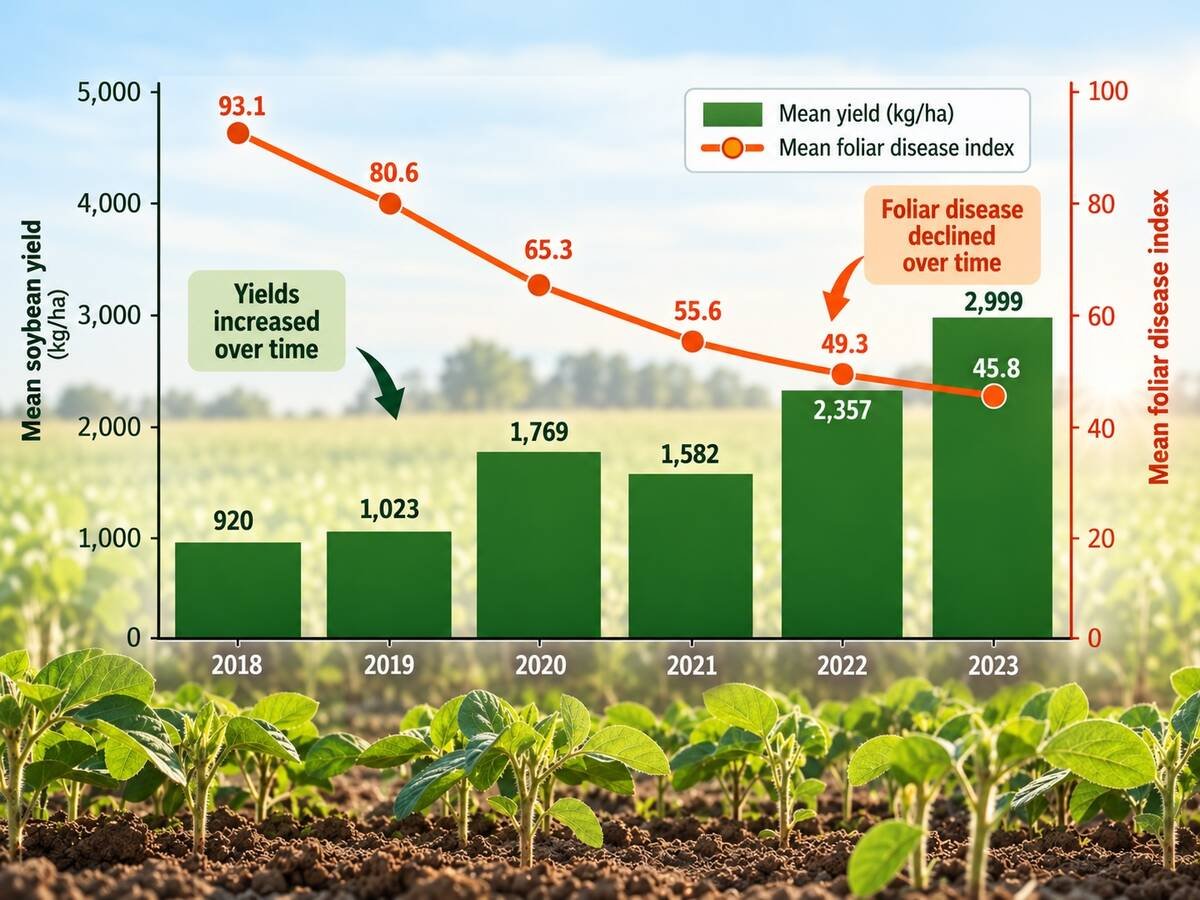
In two experimental trials and two commercial fields, researchers identified cropping history, particularly continuous or near-continuous soybean planting, as a factor contributing to disease suppression.
“Interestingly, in one of the commercial fields, the grower had a clean line in a section where they had grown soybeans for 20 years and where they rotated with corn and wheat,” Wally explained. “When both sections were grown in soybean in 2024, the continuous section had no SDS symptoms, where the rotational side was heavily diseased.”
SCN egg parasites
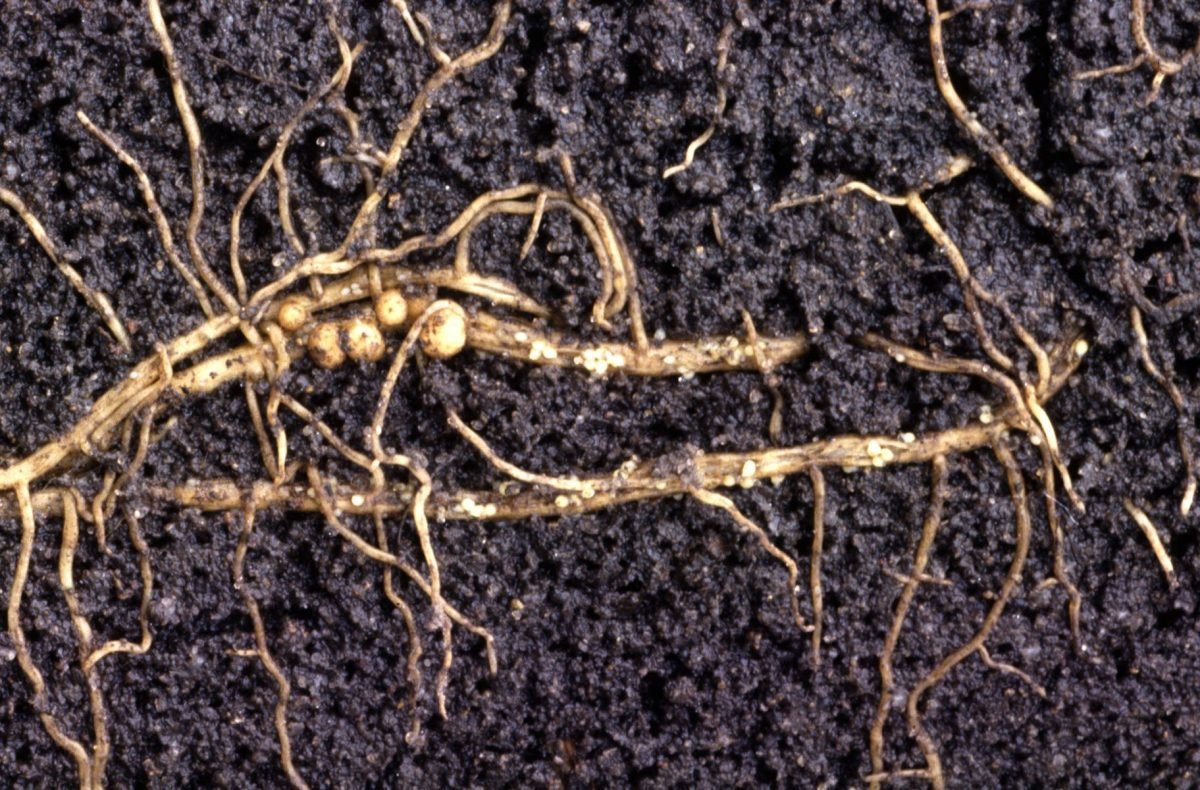
Researchers observed an increase in SCN egg parasites in continuous soybean plots, although these parasites did not reduce final SCN densities; Wally said they may have reduced nematode damage.
“Similarly, in our longer-term continuous field, more fungal mycoparasites or site competitors were found. Similar to what is found elsewhere, the suppression is biological and seems to be enhanced by continually growing a soybean crop,” he said.
Wally added that changes in soil and root-zone chemistry attract pathogens, which attract more pathogen parasites, eventually reaching equilibrium.
Continuous monocropping has measurable drawbacks and should be avoided unless no alternatives exist. Researchers noted the suppression lacks durability, with significant disease suppression loss after the second corn crop.
Soil microbes
“Enhancing the appropriate soil microbes via other means is a better option. We were able to isolate several SDS-suppression-associated organisms from soil/roots in the continuous soybean fields, and these have some inhibition of the SDS fungi in vitro,” he said.
Wally believes these organisms could potentially be used in seed treatments or soil amendments, although further research is needed.
Researchers are investigating management practices, including crop rotation, cover crops, tillage and organic amendments, that could build or maintain beneficial microbial communities.
“We have a couple of project proposals in various stages of submission to investigate just this. Working on rotations, cover crops and amendments and how that affects disease levels. The ideal solution would be a product that, when applied, would maintain this disease suppression,” he said.
The research could change how Ontario growers manage SDS and SCN, potentially reducing reliance on chemical and other control products, particularly if beneficial soil microbes can replace continuous soybean planting.
SCN resistance
“Currently, the main control of SCN and SDS is through genetic resistance, with mostly quantitative resistance available for SDS,” Wally said. “As these are soil-borne pathogens, seed treatment fungicides do show efficacy at low pressure levels, though once both SCN and SDS are at a high/moderate level they do not show consistent effect.”
He noted that SCN populations are adapting to the two available resistant sources throughout soybean-growing regions, including Ontario, and becoming more damaging. Saying that additional management strategies could ease pressure on existing genetic resistance, extending its effectiveness.
Wally expects research to support broader recommendations within the next five years.


