
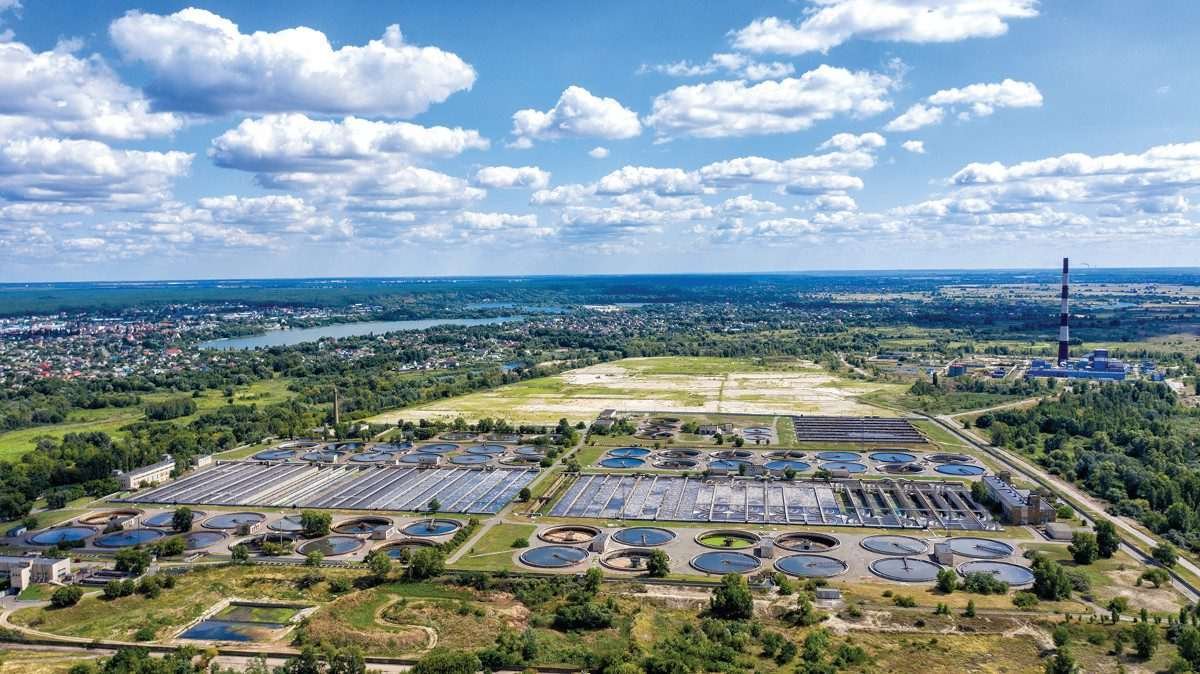
As water utilities pursue net zero, there is clearly an appetite for acquiring a better grasp of the quantities of greenhouse gases being released by treatment processes and sewer networks. Envirotec reviews monitoring guidance and other relevant developments on display at the recent IWA World Water Congress.
When it comes to GHGs, biological processes within treatment plants and sewer networks release mainly methane (CH₄) and nitrous oxide (N₂O). Wastewater emissions inventories have often relied on emission factors, applying estimated values to quantities of wastewater treated or nitrogen removed. Such calculations provide a basis for reporting, but may obscure differences between individual installations and variations in operating conditions.
The issue came up for attention at the International Water Association’s World Water Congress & Exhibition in Glasgow in October, where research presentations addressed greenhouse gas monitoring across water infrastructure, including sewer networks.
One poster, presented by Hamish Todd of Scottish Water, titled “A novel measurement and mitigation solution for nitrous oxide”, explored approaches to making N₂O monitoring more practical for utilities.
Nitrous oxide is associated particularly with biological nitrogen removal. Its production can be influenced by dissolved oxygen concentrations, nitrite accumulation, changing nitrogen loads and the activity of different microbial populations.
In September 2026, the IWA published Good Practice in Nitrous Oxide Monitoring, guidance intended to help utilities move beyond fixed emission factors towards measurement-based assessments.1
A new international technical protocol published in October provides practical guidance on monitoring and quantifying nitrous oxide emissions at wastewater treatment works. Drawing on 30 case studies from ten countries, it covers gas-phase and liquid-phase monitoring, equipment selection, sensor placement and emissions calculations.2
Measurement methods
Monitoring the N₂O coming from wastewater presents a number of potential difficulties, not least being the question of how to collect it. Gas-phase measurements can use collection hoods or other arrangements to quantify emissions leaving the water surface. Alternatively, submerged sensors measure dissolved N₂O, from which emissions may be estimated using information about gas transfer and operating conditions.
A 2025 study proposed a decision-making framework to help utilities select appropriate methods, considering factors including monitoring duration, cost and technical complexity.3
The challenge is not simply obtaining a reading, but determining whether measurements adequately represent the plant’s overall emissions.
Beyond the treatment works
Sewer networks are another potential source of greenhouse gases, particularly methane generated under anaerobic conditions.
A 2025 study of an urban community sewer network in China attempted to quantify the problem.4
Researchers investigated a network extending approximately 4.77km and receiving around 750m³ of domestic sewage daily. Measurements of gas concentrations and emission fluxes were undertaken at 248 and 151 locations respectively.
Total emissions were estimated at 763g CO₂-equivalent per hour, with methane accounting for 99.4% of the calculated climate impact.
Septic tanks within the investigated system accounted for 92.5% of emissions, while sewer pipes contributed the remainder.
The results don’t permit a simple extrapolation to conventional UK sewer networks, particularly because the studied system included septic tanks, which are not normally a feature of public sewerage systems in the UK. Nevertheless, they demonstrate how emissions can be concentrated at particular locations and influenced by things like the wastewater temperature, and ventilation.
Combining different methods
A separate study published in 2026 investigated greenhouse gas emissions from wastewater treatment operations using drones, flux chambers and measurements at individual emission sources.5
The researchers found that methane estimates derived from drone measurements were lower than totals calculated using chambers and point-source monitoring.
The comparison illustrates the difficulty of obtaining a complete emissions inventory using any single technique.
Different methods capture different aspects of emissions behaviour, while results may be affected by weather, operating conditions, sampling frequency and the distribution of emission sources.
Combining measurement approaches can therefore help identify discrepancies and improve confidence in plant-wide estimates.
Monitoring is becoming more than an academic exercise. In October, Yorkshire Water awarded a £1.8 million contract for liquid-phase N₂O monitoring equipment covering 13 wastewater treatment sites.6
The equipment is intended to support continuous data collection, establish emissions baselines and assess operational performance.
Such deployments could eventually allow operators to connect GHG emissions with process-control decisions, including aeration and nitrogen removal strategies.
However, reducing emissions requires understanding the trade-offs. Changes intended to lower N₂O production must also maintain treatment performance, effluent compliance and energy efficiency.
The snapshot of recent research afforded by the IWA Congress suggested progress towards making greenhouse gas emissions routinely measurable operational parameters, rather than quantities inferred largely from estimates.
Notes
[1] International Water Association, Good Practice in Nitrous Oxide Monitoring, September 2026.
[2] IWA Publishing, A Practical Protocol to Monitor and Quantify Nitrous Oxide (N₂O) Emissions, 2026.
[3] “A systematic decision-making framework for selecting nitrous oxide quantification methods in water utilities”, Water Research X, 2025.
[4] “Assessment of methane and nitrous oxide emissions from urban community sewer networks: Field quantification and insights into environmental factors”, Water Research X, 2025.
[5] “Multi-scale UAV, flux-chamber, and point-source measurement framework for facility-wide greenhouse gas and air pollutant emissions assessment from wastewater treatment operations”, Water Research, 2026.
[6] “Yorkshire Water awards £1.8 million contract for N₂O liquid phase monitoring devices”, Water Briefing, October 2026.


