How Much Work Does It Take to Afford Netflix in Europe?
Key Takeaways:
- In Iceland, Norway, and Slovenia, average workers can earn enough for a monthly Netflix subscription in under 20 minutes.
- Ukrainians need to work over two hours to afford Netflix, highlighting Europe’s streaming affordability gap.
- Higher wages make Netflix relatively affordable in much of Northern and Western Europe, despite higher subscription prices.
A monthly Netflix subscription can represent a small expense in one European country and several hours of work in another.
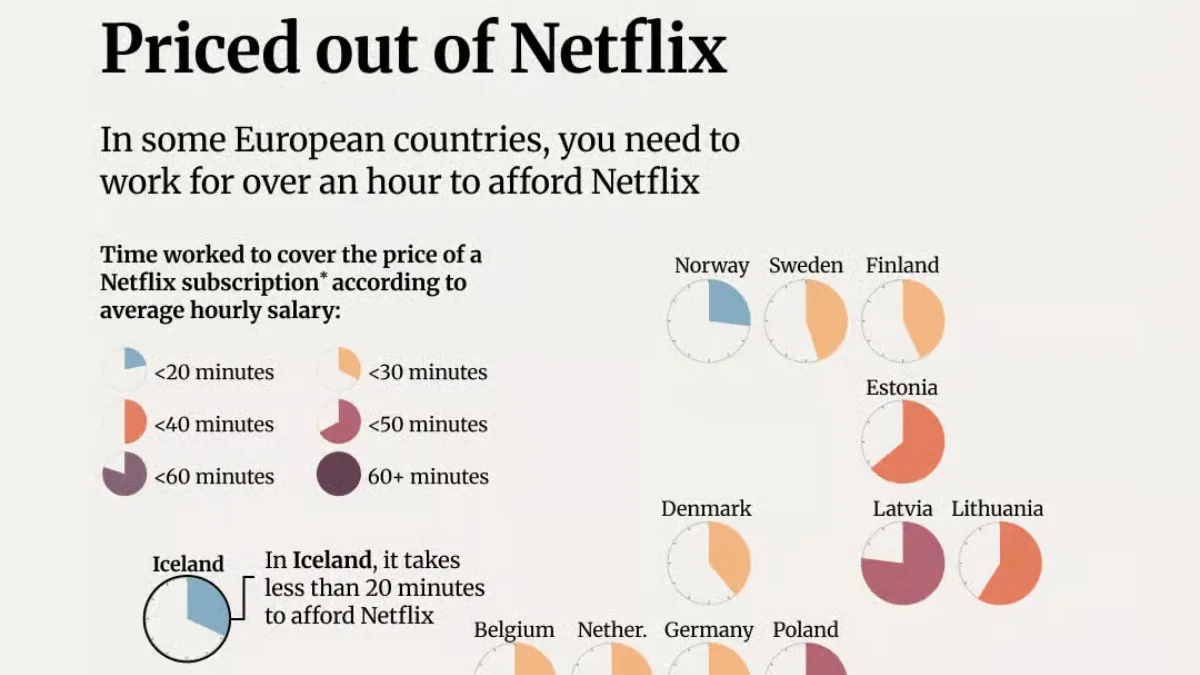
This visualization by The European Correspondent compares monthly Netflix Standard subscription prices with average hourly wages across Europe, showing how streaming affordability changes when measured in working time rather than money.
Where Is Netflix Most Affordable in Europe?
The following table shows the working time needed to afford Netflix across European countries, based on The European Correspondent’s analysis of subscription prices and Eurostat wage data.
| Country | Time worked category (minutes) | Notes |
|---|---|---|
 Iceland |
Under 20 | |
 Norway |
Under 20 | |
 Slovenia |
Under 20 | |
 Sweden |
20–29 | |
 Finland |
20–29 | |
 Denmark |
20–29 | |
 Ireland |
20–29 | |
 Belgium |
20–29 | |
 Netherlands |
20–29 | |
 Germany |
20–29 | |
 France |
20–29 | |
 Luxembourg |
20–29 | |
 Switzerland |
20–29 | |
 Austria |
20–29 | |
 United Kingdom |
30–39 | |
 Estonia |
30–39 | |
 Lithuania |
30–39 | |
 Italy |
30–39 | |
 Croatia |
30–39 | |
 Latvia |
40–49 | |
 Poland |
40–49 | |
 Slovakia |
40–49 | |
 Spain |
40–49 | |
 Malta |
40–49 | |
 Serbia |
40–49 | |
 Bulgaria |
40–49 | |
 Cyprus |
40–49 | |
 Czechia |
50–59 | |
 Portugal |
50–59 | |
 Hungary |
50–59 | |
 Romania |
50–59 | |
 Bosnia and Herzegovina |
50–59 | |
 Greece |
50–59 | |
 Ukraine |
60+ | Over 120 minutes (graphic annotation) |
 Moldova |
60+ | |
 North Macedonia |
60+ | |
 Albania |
60+ | |
 Türkiye |
No data | No data shown |
 Kosovo |
No data | No data shown |
 Montenegro |
No data | No data shown |
Slovenia stands out as one of Europe’s most affordable countries for Netflix, joining wealthier economies such as Iceland and Norway in the under-20-minute category.
Meanwhile, workers in Moldova, Albania, and North Macedonia need more than an hour to cover a monthly subscription.
The comparison illustrates how Netflix’s affordability depends not just on its monthly price, but also on average earnings in each country.
Why Are Some European Countries Paying More?
The disparity largely reflects differences in earnings rather than subscription prices alone.
According to Eurostat salary data reported by Euronews, average monthly gross salaries ranged from €1,125 in Bulgaria to €6,755 in Luxembourg in 2023.
That nearly sixfold difference helps explain why even relatively modest subscription fees can require much more working time in lower-wage countries. It also reflects the broader divide in European household incomes.
How Do Netflix Price Increases Affect Affordability?
Netflix has repeatedly increased subscription prices as it invests in content and seeks to boost revenue and profitability. In March 2026, its U.S. Standard plan increased to $19.99 per month from $17.99, according to TheStreet.
While the U.S. increase is separate from the European data shown here, it highlights an important consideration: subscription affordability can deteriorate when prices rise faster than wages.
For households in lower-wage economies, even a relatively small monthly increase can translate into significantly more working time.
With streaming platforms competing for viewers worldwide, the relationship between subscription prices and local earnings could become increasingly important.
Learn More on the Voronoi App
Explore How the Cost of Netflix Has Increased Over Time to see how subscription prices have changed over the years.