
Greenhouse growers in the Essex Region Conservation Authority watershed can access cost-share funding for environmental projects, including multi-species buffer strips and water treatment equipment modifications.
The Essex Region Conservation Authority’s “Greenhouse and Horticulture Water Quality Improvement Program” comes as the greenhouse acres in the Leamington and Kingsville area continue to expand, and nutrient concentrations in greenhouse-heavy watercourses remain far above those found outside greenhouse zones.
WHY IT MATTERS: Long-term studies have strongly linked a significant rise in waterway nutrient pollution to Essex County’s greenhouse expansion. New programming aims to improve the sector’s environmental impact.
The program is part of a broader government-funded effort under the Canada–Ontario Lake Erie Action Plan to reduce phosphorus loading and protect both Lake Erie and Lake St. Clair from harmful algal blooms.
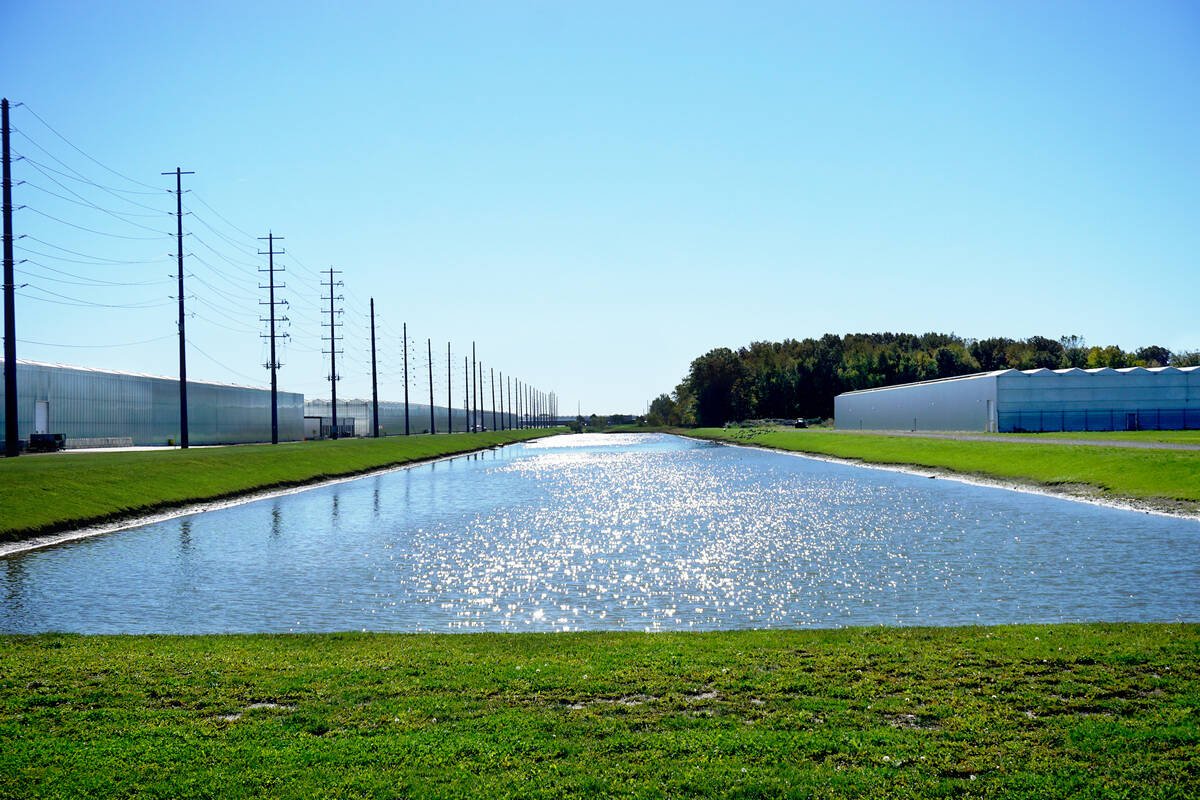
Some of the Essex Region Conservation Authority’s greenhouse water quality improvement program categories pertain specifically to spent, nutrient-rich feedwater. Photo: Matt McIntosh
Stewardship programs
The conservation authority’s pre-existing stewardship programs, including tile drainage, cover crop, nutrient planning and other cost-share categories, have proven popular with field crop growers in the region.
Authority staff hopes the same will be said of its greenhouse-specific programs, developed in consultation with Bill Bauerle, an Ohio State University greenhouse researcher, and researchers from Agriculture Agri-Food Canada’s Harrow research station. Shawn Palichuk, Essex Region Conservation Authority’s water stewardship technician, also provided grower expertise within large vertically integrated hydroponic greenhouses.
Program categories include perennial vegetation establishment for nutrient fluid or crop residue disposal sites, soil sampling and crop nutrient planning [for crop residue disposal sites], greenhouse equipment modifications, infrastructure projects and other “innovative actions” that could help improve the industry’s environmental impact.
The most significant cost-share funding, 75 per cent of cost, or up to $40,000, is available to growers interested in upgrading fertigation and water treatment systems, as well as cover crop and crop residue application equipment modifications.
Management practice program
“There’s no other best-management practice program for greenhouses. This is the first kick at the can. We’ve done our best and are open to change if people know how we could improve and do things different,” said Katie Stammler, Essex Region Conservation Authority water quality scientist and source water protection manager.
Stammler said a few growers have expressed interest since the program went live in October. Ontario Greenhouse Vegetable Growers welcome the program and are sharing it with members, stated executive director Richard Lee via email.
“It is a practical extension of regional efforts to reduce phosphorus loss and protect Lake Erie,” wrote Lee. “The program supports a useful range of projects, including nutrient planning, fertigation monitoring, water treatment, equipment modifications, vegetated buffers and erosion controls. This cost-shared funding can help growers adopt effective technologies and make investments that improve nutrient-use efficiency and water quality.”
“Future iterations should continue to incorporate grower input and provide longer-term, predictable funding to support investment planning and ongoing environmental improvements.”
Industry impact
The authority’s greenhouse-specific programming is a result of greenhouse production density within its jurisdiction and a long-standing link between that and nutrient-related water quality problems.
In 2012, an Ontario Ministry of Environment report noted drains through greenhouse-heavy areas near Leamington had nutrient concentrations several orders of magnitude higher than the healthy waterway baseline. The ministry subsequently concluded the watercourses in question were “the most polluted in the province of Ontario with respect to phosphorus and nitrate,” and that it could not support further greenhouse development in either watershed “without appropriate treatment technology in place.”
A 10-year Essex Region Conservation Authority study found similar results, with phosphorus loading in Leamington tributaries ranging from 100 to 200 times higher than the provincial target. A multi-year extension of the study, published in September of 2026, reiterates that greenhouse-influenced streams contained significantly higher phosphorus concentrations than comparison streams. Significantly increased nutrient levels were also observed in a watercourse where greenhouse development has been expanding upstream since 2019.
Stammler said four greenhouse-influenced monitoring sites have shown significant declines in phosphorus levels. This, however, is likely due to expanded access to municipal wastewater infrastructure at those sites.
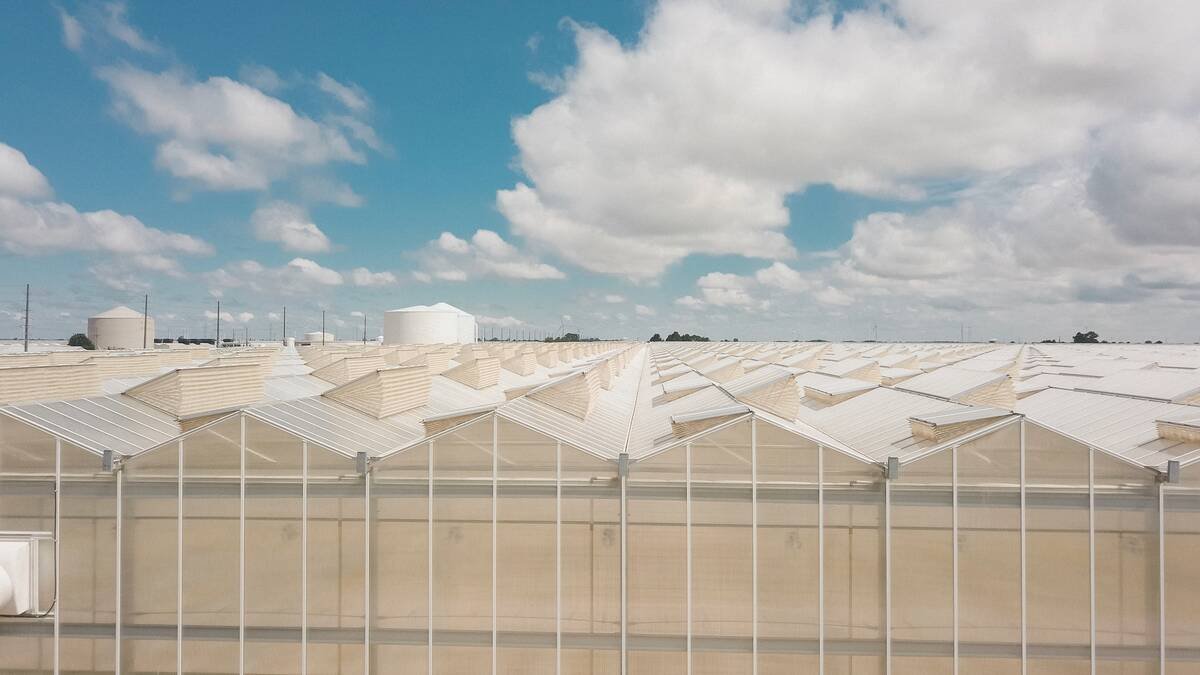
Greenhouse acres continue to grow in southern Ontario. Photo: Courtesy of Ontario Greenhouse Vegetable Growers
Identifying sources
There are several sources of nutrients in greenhouse systems, and different ways in which those sources can become environmental pollutants.
Unmarketable produce, vines and other vegetative waste, and even the growing mediums in which fruit and vegetables are produced, disposed of via land application, can be a potential nutrient source. For this reason, the Essex Conservation Authority included categories for cover cropping and soil sampling within the new programs.
However, greenhouse nutrient feedwater, a general term for the solution of water, nutrients, and other chemicals or additives used to feed and protect plants, is the main target.
As detailed in the conservation authority’s 2026 nutrient project extension study, used feedwater is collected, cleaned and recirculated for use again. Sometimes, however, the nutrient-rich leachate cannot be reused. This includes situations involving equipment failures, end-of-season deep cleaning, or when the recirculation system is overloaded or out of balance with a specific nutrient or element. The 2026 water monitoring report adds, “there are also numerous points in the recirculation system where (greenhouse feed water) can enter into the floor/tile drains and/or be directly released to the environment.”
Sewer access
Where sewer access is available, spent leachate can be discharged to municipal water treatment facilities; where it’s not, it can be held in a holding tank for shipment and disposal, or land-applied.
While efforts have been made to expand a sanitation line north of Leamington, a project long sought after by town officials and Ontario Greenhouse Vegetable Growers, Stammler noted diverting leachate water to municipal infrastructure also brings additional costs to local government.
It can help reduce nutrient pollution by providing greenhouse operators a more efficient and cost-effective means of disposal, provided access and capacity to handle increased water volumes are possible.
Illegal dumping and other acts of non-compliance with regulations are also a problem. The province has handed down several non-compliance convictions in recent years, including a combined fine of $450,000 levelled at AMCO Farms and operator Fausto Amicone in October 2026, for a slew of violations over 2.5 years.
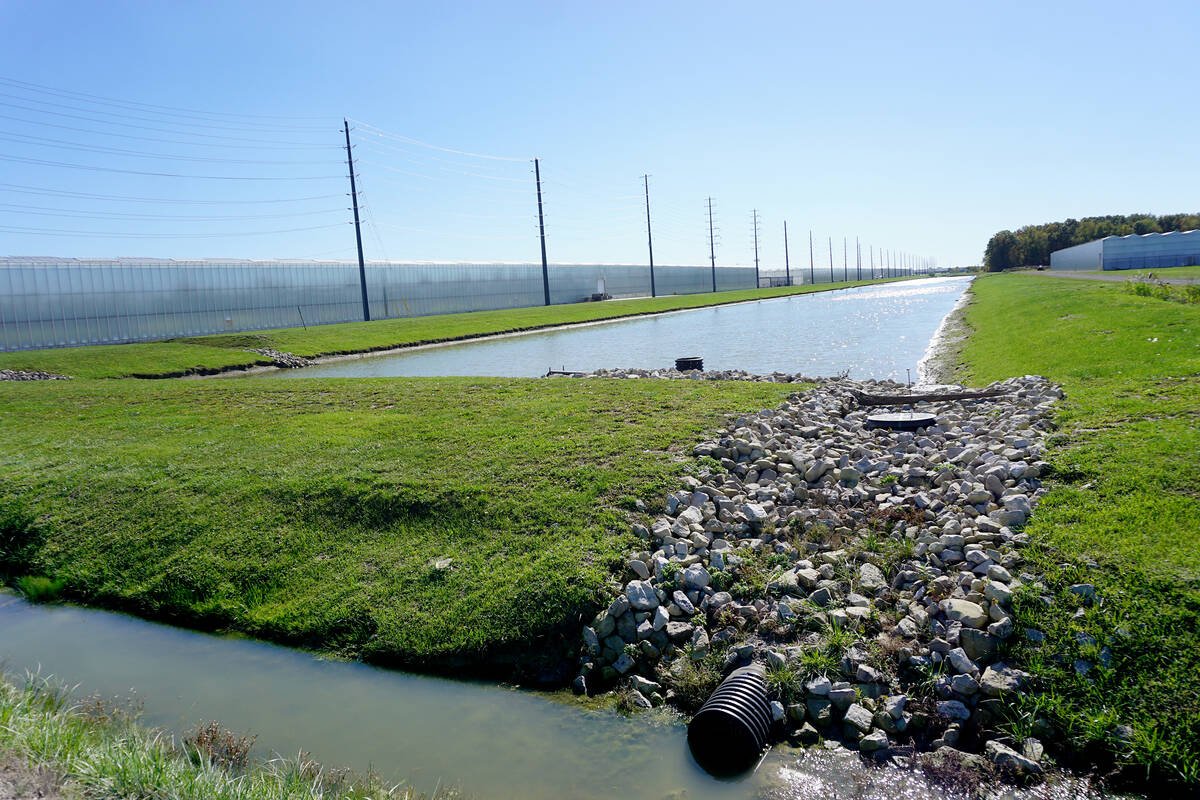
Other categories of the Essex Region Conservation Authority’s program focus on pollinators, biodiversity, and other forms of water management infrastructure outside the greenhouse, such as this stormwater retention pond near Leamington. Photo: Matt McIntosh
Water quality concerns
Essex Region Conservation Authority’s 2026 nutrient report points to concerns within the broader community, as well:
“It is not uncommon for (conservation authority) staff to be approached in the field or at outreach events by residents who are concerned about water quality downstream of greenhouses. Many residents have described situations where they have observed discharge to ditches either directly from a greenhouse or via a tanker truck.… While these situations are only occurring in a few locations, it must be noted as a complication to mitigation. Most greenhouses are operating within the requirements of their permits and are willing to take actions to further ensure that the environment is not negatively impacted.”
Stammler and her colleagues reiterated that the release of nutrient feedwater is, in most cases, a result of technical limitations in conventional fertigation systems, not grower intent.
Positive impact
She was hopeful the new greenhouse-specific water stewardship programming will help alleviate some of the technical limitations. But promising new technologies, such as a “single-element, parts-per-million nutrient injection system,” require significant investments. The conservation authority is continuing its work with Ohio State’s Bill Bauerle to set up a demonstration greenhouse in Leamington to showcase the technology. As of early October, funding and a greenhouse operator willing to participate as the demonstration site have yet to be secured.
“There’s a lot of potential to have a positive impact,” said Stammler. “But it’s the same as best management practices for other agriculture. You still need the early adopters to try something and build that trust.”


