When Have U.S. Wages Kept Up With Inflation?
Key Takeaways
- U.S. wage growth outpaced inflation in 22 of the 30 years between 1996 and 2025.
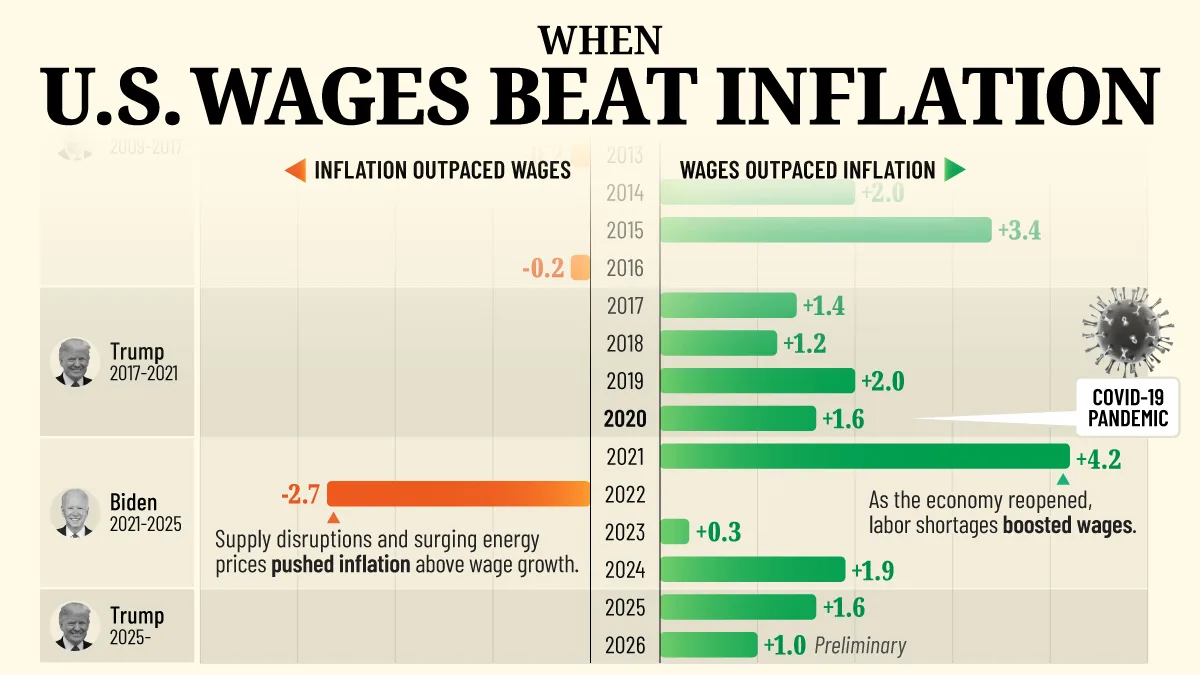
- The largest positive gap occurred in 2021 (+4.2 percentage points), while 2022 recorded the largest shortfall (-2.7 points).
- From 1996 to 2025, wage growth outpaced inflation in 12 of 17 years under Democratic presidents and 10 of 13 years under Republican presidents.
For many Americans, the cost of living remains a major concern. Even as inflation has cooled from its recent highs, prices for everyday essentials remain elevated, putting continued pressure on household budgets.
Against that backdrop, U.S. wage growth has outpaced inflation in most years over the past three decades. But a growing paycheck doesn’t necessarily translate into a greater sense of financial security.
This visualization compares annual U.S. wage growth and inflation from 1996 through 2026, showing when earnings gained ground against rising consumer prices and when they fell behind.
Wage data comes from the Social Security Administration’s National Average Wage Index, while inflation figures come from the Federal Reserve Bank of Minneapolis.
The chart measures the difference between nominal wage growth and annual average consumer price inflation in percentage points, rather than the exact inflation-adjusted change in wages.
The Late 1990s Delivered Consistent Wage Gains
Between 1996 and 2000, wage growth consistently outpaced inflation, supported by strong economic expansion and relatively stable consumer prices.
| Year | President | Party | Wage Growth | Inflation | Difference (pp) |
|---|---|---|---|---|---|
| 2026P | Donald Trump | Republican | 4.5% | 3.5% | 1.0 |
| 2025 | Donald Trump | Republican | 4.2% | 2.6% | 1.6 |
| 2024 | Joe Biden | Democrat | 4.8% | 2.9% | 1.9 |
| 2023 | Joe Biden | Democrat | 4.4% | 4.1% | 0.3 |
| 2022 | Joe Biden | Democrat | 5.3% | 8.0% | -2.7 |
| 2021 | Joe Biden | Democrat | 8.9% | 4.7% | 4.2 |
| 2020 | Donald Trump | Republican | 2.8% | 1.2% | 1.6 |
| 2019 | Donald Trump | Republican | 3.8% | 1.8% | 2.0 |
| 2018 | Donald Trump | Republican | 3.6% | 2.4% | 1.2 |
| 2017 | Donald Trump | Republican | 3.5% | 2.1% | 1.4 |
| 2016 | Barack Obama | Democrat | 1.1% | 1.3% | -0.2 |
| 2015 | Barack Obama | Democrat | 3.5% | 0.1% | 3.4 |
| 2014 | Barack Obama | Democrat | 3.6% | 1.6% | 2.0 |
| 2013 | Barack Obama | Democrat | 1.3% | 1.5% | -0.2 |
| 2012 | Barack Obama | Democrat | 3.1% | 2.1% | 1.0 |
| 2011 | Barack Obama | Democrat | 3.1% | 3.2% | -0.1 |
| 2010 | Barack Obama | Democrat | 2.4% | 1.6% | 0.8 |
| 2009 | Barack Obama | Democrat | -1.5% | -0.4% | -1.1 |
| 2008 | George W. Bush | Republican | 2.3% | 3.8% | -1.5 |
| 2007 | George W. Bush | Republican | 4.5% | 2.9% | 1.6 |
| 2006 | George W. Bush | Republican | 4.6% | 3.2% | 1.4 |
| 2005 | George W. Bush | Republican | 3.7% | 3.4% | 0.3 |
| 2004 | George W. Bush | Republican | 4.7% | 2.7% | 2.0 |
| 2003 | George W. Bush | Republican | 2.4% | 2.3% | 0.1 |
| 2002 | George W. Bush | Republican | 1.0% | 1.6% | -0.6 |
| 2001 | George W. Bush | Republican | 2.4% | 2.8% | -0.4 |
| 2000 | Bill Clinton | Democrat | 5.5% | 3.4% | 2.1 |
| 1999 | Bill Clinton | Democrat | 5.6% | 2.2% | 3.4 |
| 1998 | Bill Clinton | Democrat | 5.2% | 1.6% | 3.6 |
| 1997 | Bill Clinton | Democrat | 5.8% | 2.3% | 3.5 |
| 1996 | Bill Clinton | Democrat | 4.9% | 2.9% | 2.0 |
The largest gap during this stretch came in 1998, when wages increased 5.2% while inflation stood at just 1.6%, producing a 3.6 percentage point advantage.
However, the balance shifted in 2001 and 2002, when inflation narrowly exceeded wage growth following the dot-com downturn.
The 2008 financial crisis marked another difficult period, with inflation exceeding wage growth by 1.5 percentage points.
Conditions remained challenging in 2009, when average wages fell 1.5%, compared with a 0.4% decline in consumer prices.
The sharpest reversal came between 2021 and 2022. After wages recorded their largest advantage over inflation in 2021, surging consumer prices pushed inflation 2.7 percentage points above wage growth the following year.
Pandemic-related supply disruptions, rising energy costs, and the economic fallout from Russia’s invasion of Ukraine contributed to the inflation surge.
The Pandemic Rebound and Recent Wage Growth
In 2021, average wage growth reached 8.9%, compared with inflation of 4.7%, producing a 4.2 percentage point advantage.
The unusual labor market conditions of the pandemic recovery, including widespread worker shortages, contributed to the sharp increase in average wages.
Average wage growth moved back ahead of inflation in 2023, 2024, and 2025, although this did not mean consumer prices were falling. Instead, prices continued rising, just at a slower pace than wages.
The gap between wage growth and inflation reached 1.9 percentage points in 2024 before narrowing to 1.6 points in 2025.
Preliminary figures for 2026 suggest another positive gap of 1.0 percentage point, although final annual data is not yet available.
Crucially, a lower inflation rate doesn’t undo earlier price increases. A household can see its wages rise faster than inflation in a given year while still facing a much higher cost of living than it did before the pandemic.
These figures also represent national averages rather than the experience of a typical worker. Changes in housing, food, healthcare, and other household expenses can mean individual workers experience very different changes in purchasing power.
Learn More on the Voronoi App
If you enjoyed today’s post, check out Ranked: U.S. Cities With the Highest Cost of Living on Voronoi.