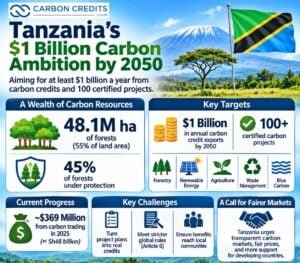
Tanzania wants to earn at least $1 billion a year from carbon credit exports by 2050. Its long-term development plan also aims to establish at least 100 certified carbon projects across forestry, renewable energy, agriculture, waste management, and blue carbon.
The government reportedly received about Sh48 billion (about US$369 million) from carbon trading by 2025. That is an important start, but it also shows the distance between current results and the country’s billion-dollar annual target.
Tanzania must now turn its large project pipeline into verified carbon reductions and removals. The African nation must also make sure the money reaches local communities and supports the country’s energy transition.
Tanzania’s Carbon Wealth Could Be a $1 Billion Export Market
Tanzania’s Long-Term Perspective Plan 2026/27–2050/51 targets at least $1 billion in annual carbon credit export revenue by 2050. It also aims to develop 100 or more certified projects.
The country’s forests offer a strong starting point. Data from the Tanzania Forest Services Agency show that forests cover about 48.1 million hectares, or 55% of the country’s land area. Around 45% of this forest area is under protection, according to the agency.
These resources could support projects that protect forests, restore degraded land, and conserve mangroves. Other opportunities include renewable energy, waste management, and sustainable farming.
The opportunity is significant, but the country faces two major challenges.
- First, many registered projects have yet to become operational.
- Second, tighter international rules could reduce the number of carbon credits some projects can sell.
Tanzania still needs to turn project proposals into working businesses. According to data from the National Carbon Monitoring Centre (NCMC), the country had registered 117 carbon projects, but only six had reached implementation and generated revenue.
The government also needs stronger data and project oversight. A 2025 audit by the National Audit Office found that outdated emissions data, slow project reviews, and weak coordination had held back carbon trading. The $1 billion goal will depend on fixing these problems, not just registering more projects.
Global Standards and Stricter Carbon Rules Could Cut Credit Supply
New rules under Article 6 of the Paris Agreement are changing how countries measure and trade carbon credits. Article 6 allows countries to work together to reduce emissions.
One country can support a climate project in another and use the resulting emissions reductions toward its climate target. But the system requires clear accounting to prevent both countries from claiming the same reduction.
Projects must also show that their claimed climate benefits are real and measurable. Stronger methods can change how many credits a project is allowed to issue.
Ms Risper Koyi, Director of Legal Services at the NCMC, stated in an interview that a project once expected to produce 10 tonnes of carbon credits could generate only four to six tonnes under revised methods.
That change could affect project income and investor returns. It could also reduce the money available for local communities and conservation work.
Still, fewer credits do not always mean a weaker market. Buyers need confidence that each credit represents a real climate benefit. Projects that meet stronger standards may attract more interest, especially when they also protect biodiversity and support local livelihoods.
Tanzania’s challenge is to help developers meet these rules while keeping projects financially viable.
Tanzania Calls for Fairer Carbon Markets at COP31
Tanzania’s concerns are part of a wider debate about fairness in global carbon trading. At COP31 in Antalya, President Samia Suluhu Hassan called for transparent carbon markets under Article 6.
She said they should provide fair carbon prices, protect environmental integrity, and ensure that host countries and local communities receive a fair share of the benefits. She also called for more grants, low-cost loans, technology transfer, and training to help developing countries respond to climate change.
The need is clear. Hassan estimated that climate shocks cost Tanzania 2% to 3% of its gross domestic product each year. Droughts, changing rainfall, and rising sea levels threaten farming, water supplies, and infrastructure.
Carbon markets could help bring more money into climate projects. But Tanzania wants a fair return for the natural resources and emissions reductions that it provides to the global market.
The country’s forests alone cover about 48.1 million hectares. They offer opportunities for forest protection and restoration projects, but these projects must also respect local land rights and provide clear benefits to the people who manage and depend on the land.
Can Carbon Revenue Reach the Communities Protecting Tanzania’s Forests?
Carbon projects often rely on local communities. Forest protection projects, for example, need people to help manage land, prevent illegal clearing, and protect trees. If communities do not receive a fair share of the income, projects may struggle to gain local support. This can also put their long-term results at risk.
Carbon Tanzania offers one example of how carbon income can support local development. Its CEO, Sally Capper, noted that the organization had directed more than Sh65 billion (about US$499 million) into community development through carbon revenue. She remarked:
“These credits will be fewer as the methodologies change, as the international markets are looking more at the integrity and credibility of carbon credits.”
Capper also described a revenue-sharing arrangement under which local government authorities receive 8% of project revenue. Some of this money supports forest protection and community oversight.
The impact of stricter carbon rules will also reach communities. If a project issues fewer credits, it may have less money to share. Higher prices could help offset lower volumes, but that is not guaranteed. Clear payment rules and public reporting can help communities understand how much money projects earn and how it is used.
Banks Step In to Finance Tanzania’s Clean Energy Transition
Carbon projects need money before they can generate credits. Developers must pay for equipment, land work, monitoring, audits, and community programmes. Banks and investors can help cover these costs.
A recent sustainability workshop organized by NMB Bank, FMO, and Financing Motion highlighted the role of financial institutions in Tanzania’s energy transition. There is already evidence that local banks can mobilize significant funding.
NMB Bank reported that it had mobilized Sh621 billion (about US$4.77 billion) in sustainable financing since 2022. The funds have supported renewable energy, climate-smart agriculture, cleaner transport, and women-led businesses.
Clean cooking is another major opportunity. Tanzania’s National Clean Cooking Strategy aims for 80% of the population to use clean cooking solutions by 2034. Yet the government’s strategy reported that only 6.9% of Tanzanians had access to clean cooking in 2021, based on World Bank data.
The challenge is large. Around 82% of households rely mainly on firewood or charcoal for cooking, according to figures cited by the UONGOZI Institute.
Cleaner cooking fuels and technologies can reduce pressure on forests and improve household health. Projects that replace traditional cooking methods may also generate carbon credits if they can prove and measure the emissions savings.
Banks can help finance cleaner stoves, fuel distribution, and other energy services. Carbon revenue may provide an additional source of income, but projects should not depend on credit sales alone.
Strong Governance Will Decide Whether Tanzania Reaches Its Goal
Tanzania has already created a legal framework for carbon trading through its 2022 Environmental Management (Control and Management of Carbon Trading) Regulations and later amendments.
The government has since highlighted the need to strengthen the National Carbon Monitoring Centre and improve the systems used to register and monitor projects. These steps will matter as international buyers demand stronger proof and clearer records.
Tanzania has the forests, energy resources, and development needs to build a larger carbon market. Still, its $1 billion ambition will require more than a large project pipeline.
The country must develop projects that meet international standards, attract long-term funding, and deliver fair returns to communities. Stricter rules may reduce the number of credits available, but they can also help build a market that buyers trust.
The real test is whether Tanzania can turn its carbon wealth into lasting climate and economic benefits.
The post Can Tanzania Achieve Its $1 Billion Carbon Revenue Target by 2050? appeared first on Carbon Credits.