How Much Water Do the World’s Oceans Hold?
Key Takeaways
- The Pacific Ocean holds more water than the other four oceans combined, accounting for 50.2% of the world’s ocean water.
- The Atlantic Ocean ranks second, holding 74.5 million cubic miles of water.
- The Arctic Ocean is the smallest by volume, accounting for just 1.4% of the global total.
We often think of the world’s oceans in terms of the vast distances they span, but their size beneath the surface tells another story.
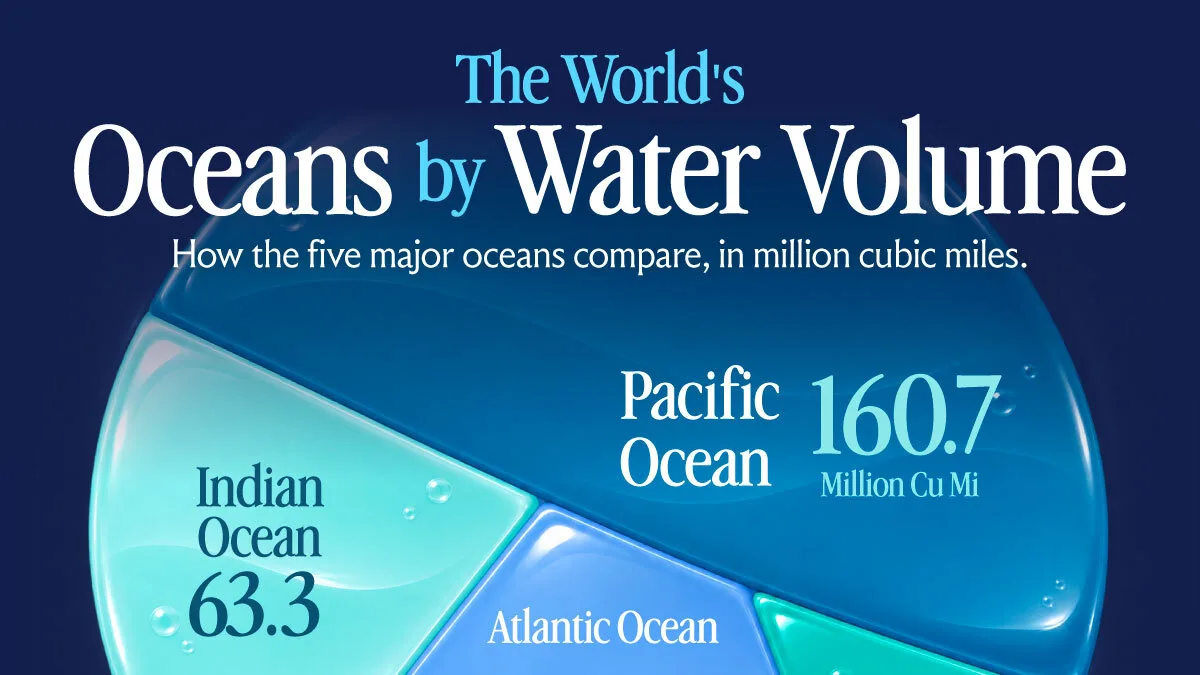
This visualization ranks the world’s five oceans by water volume, using data from WorldAtlas. Volumes are measured in millions of cubic miles.
The Pacific Ocean Holds Half of the World’s Ocean Water
The Pacific Ocean contains approximately 160.7 million cubic miles (669.9 million cubic kilometers) of water.
To put that into perspective, this single ocean holds an estimated 49% of all water on Earth, including freshwater, groundwater, and water stored in glaciers and ice caps.
The table below compares the five oceans by water volume and their respective shares of the global total:
| Rank | Ocean | Water Volume | Share of Global Ocean Volume (%) |
|
|---|---|---|---|---|
| Million Mi³ | Million Km³ | |||
| 1 | Pacific Ocean | 160.72 | 669.88 | 50.2 |
| 2 | Atlantic Ocean | 74.46 | 310.41 | 23.3 |
| 3 | Indian Ocean | 63.34 | 264.00 | 19.8 |
| 4 | Southern Ocean | 17.23 | 71.80 | 5.4 |
| 5 | Arctic Ocean | 4.50 | 18.75 | 1.4 |
Despite its immense size, the Atlantic Ocean holds less than half as much water as the Pacific.
Together, these two oceans account for nearly three-quarters of the world’s ocean water.
How the Other Oceans Compare
The Indian Ocean ranks third, holding approximately 63.3 million cubic miles of water, or about 85% as much as the Atlantic.
There is a much sharper drop to the Southern Ocean. Together, the Southern and Arctic oceans contain just 6.8% of the world’s ocean water.
For perspective, the Pacific Ocean holds nearly 36 times as much water as the Arctic Ocean.
How Depth Contributes to Water Volume
An ocean’s water volume is determined by both its surface area and average depth.
Not only is the Pacific the largest ocean by area, but it is also home to the deepest known point in the world’s oceans, located in the Mariana Trench nearly seven miles below sea level.
While traditional maps show how much of Earth’s surface each ocean occupies, measuring water volume adds a third dimension to our understanding of the planet’s geography.
Learn More on the Voronoi App
If you enjoyed today’s post, check out Visualized: Exploring the Ocean’s Future on Voronoi.