
Despite wistful thinking, some numbers indicate that the amount of North American farmers using manure as fertilizer has been in decline in recent years.
In the United States, the USDA’s most recent Census of Agriculture showed an overall decline of 13 percent in the number of farms using manure to fertilize their fields between 2017 and 2022. The situation was most pronounced in states like North Dakota and South Dakota were usage declined by 22 percent. In Canada, while manure numbers have remained relatively static overall, there has been a marked declined in some regions of the country.
But with chemical fertilizer prices soaring as a result of steep increases in the costs of the ingredients used to produce them, and the ongoing threats of tariffs and counter-tariffs resulting from the Canada-U.S. trade war, could that impact manure usage on both sides of the border? Could this be a ‘moment’ for manure, during which it enjoys a resurgence in usage?
Manure Manager recently spoke with a handful of industry experts to get their take on the situation and whether recent events could lead to renaissance for manure. Here’s what they had to say.
As mentioned, chemical fertilizer prices have been climbing for some time. In some cases, prices have risen by 15 percent or more over the past few years. Several factors have contributed to those price increases including rising demand, supply chain disruptions such as the war in Ukraine, increased transportation costs and the aforementioned tariff threat.
With chemical fertilizer prices rising, it’s only natural that some agricultural producers may want to take a look at what other options are available to them, including manure, right?
Deanne Meyer, an extension specialist in livestock waste management at the University of California, Davis, says that’s certainly a possibility. And she would know. Meyer has been studying the production, collection, storage and utilization of manure for 33 years and jokingly says she has “spent most of my life at the back end of a cow.”
However, Meyer says it’s difficult to say definitively whether or not manure usage will suddenly increase as a direct result of current circumstances.
For one thing, manure is far less simple to use than chemically based fertilizer and the resulting boost to crops can often be much less predictable.
“Manure is not a guarantee for NPK (nitrogen, phosphorus, potassium). You have to actually sample it to understand what’s in it and how it can be valuable for a crop. That requires some thought and energy,” she says.
“The liquid material is going to have different agronomic value than the solid material, especially when it comes to nitrogen and the availability of nitrogen for the crop. When somebody puts on commercial fertilizer they have a pretty good idea from the day they put it on when it’s going to be available to the crop. When you put on manure … it has to mineralize before its plant available. What per cent of that is going to be available next week versus next month is going to vary depending on where a person is.”
Megan Dresbach helps run W.D Farms LLC in Circleville, OH along with her father Eric. Their business has been hauling dairy manure for neighboring farms since 1987 and the pair have witnessed first-hand the many ebbs and flows in manure usage that have occurred during that time.
Dresbach believes manure could become a more attractive alternative to chemical fertilizer as a result of rising prices and tariff threats. However, she says there’s no guarantees and the situation has the potential to change quickly, as it has many times before.
“I think it goes up and down,” she says.
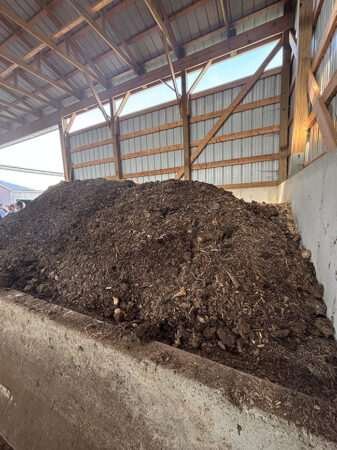
Solid manure at an Ohio farm, where it is transported to nearby operations.
“When fertilizer is high, they look at us. When it’s cheap, they ignore us. It’s just a cycle. Right now the question is carbon sequestration and all these other things. ‘Maybe we need an organic fertilizer because that’s going to help our numbers.’ So really, who knows what kind of difference (the current situation) is going to make.”
Graham Gilchrist is the founder of Gilchrist Consulting and Investigations and a member of the Canadian Agricultural Economics Society. He’s worked as an agricultural economist in Alberta for more than 30 years.
Gilchrist expects some farm operations may take a closer look at using manure if the current situation doesn’t change anytime soon. However, he suggests farmers will have to crunch their numbers to determine whether or not it makes economic sense for them. In some cases, it simply won’t.
“If you don’t have livestock of any type and you want to look at manure, if somebody’s giving it away, great. It’s free,” he says.
“But if you’re starting to pay for it, then you’ve got to take it down to a dry matter basis. It’s no different than buying and selling hay on a dry matter basis because then you’re moving water and a lot of bulk material in order to get that 10 kg of nitrogen and that gets expensive.”
Eric Dresbach is not convinced that the constant threat of tariffs coming from the White House will significantly move the needle as far as manure use in the U.S. Unlike car parts which can be bought and stored, he says most farmers don’t have the storage facilities to purchase manure and hold onto it.
“Trump’s very good at pushing things far to the right, getting everybody in an uproar and then whoever he’s pushing has a tendancy to decide maybe I should work with them and … things get better,” he says.
“There’s a lot of uncertainty right now. But in the long run I don’t think it’s going to move [things] a whole lot one way or the other.”
So, the question that must be asked is: is it realistic to expect there to be a boom in the manure business amid the uncertainty the Dresbachs mentioned? If so, what can livestock producers do to capitalize on this moment?
As far as the second question, Meyer says one of the most important things producers can do to boost this potential revenue stream is to ensure they have a consistent product to offer.
She uses the example of manure obtained from replacement heifers versus organic fertilizer produced by lactating cows. Lactating cows are typically fed a much more nutrient dense diet than replacement heifers and each will produce a manure with a much different composition than the other. As a result, those two products may need to be stored and sold separately.
Different bedding products such as wood chips or straw can likewise have an impact on the physical and chemical composition of manure. That means those materials will be handled differently by application equipment and will also impact how the manure gets incorporate in the soil, something livestock producers should keep in mind if they are selling their manure off, Meyer adds.
Gilchrist’s advice to livestock producers is to get the manure produced on their farm tested so that they have a better idea of what they are selling to customers. He also recommends cooking and composting it so that any unwanted elements are eliminated and it can be transported cheaper and easier.
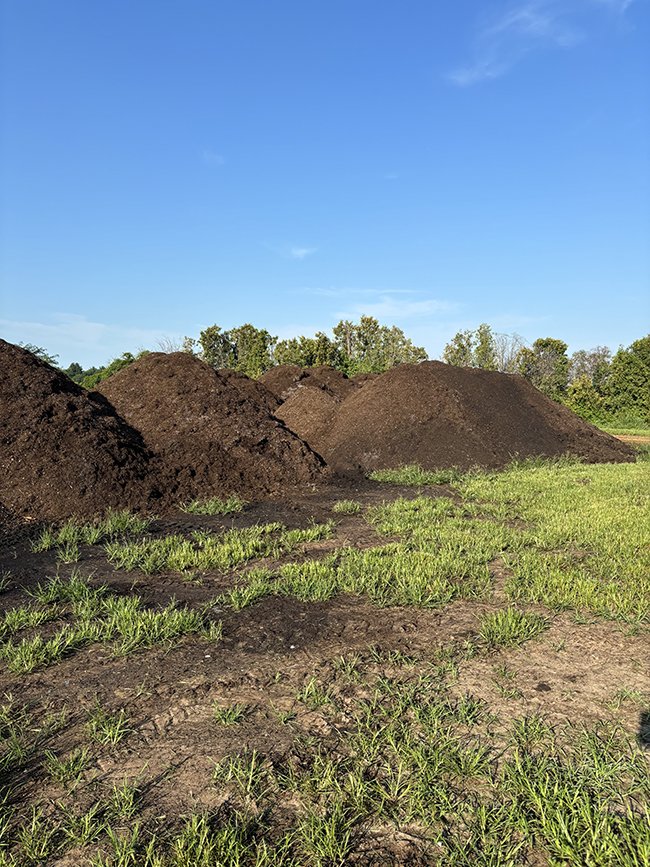
Composted manure combined with local food waste at a U.S. composting facility, which some consider a full-circle option.
“This way, you are selling a consistent product with a somewhat consistent nutrient level. That has value to it,” he adds.
Any boost in manure use would likely come as welcome news for livestock producers as manure is still considered underutilized here in North America. According to data from the USDA’s Economic Research Service, manure was applied to only eight percent of the 240.9 million acres of the seven major U.S. field crops in 2020.
Eric Dresbach believes a big reason why manure isn’t used more often to fertilize crops is the prevailing attitude towards it. He says too many farmers view it as a waste product that needs to be disposed of. That’s why he and his company have been working with producers to test the manure on their farms and provide a better understanding of its value.
Still, he says more education is needed in order to change public perceptions about organic fertilizer.
“Part of my to-do list is to spend more time working with the fertilizer industry and the applicator industry so we do a better job of testing, a better job of communicating where it goes, how much went and the value of that,” he says.
“Too often we put manure on and either the crop farmer or the fertilizer dealer puts no value on that product and then turns around and does the same commercial fertilizer program as if it received no manure. That’s a waste of resources on all fronts: dollars, commercial application and manure. We need to get the word out.”
Meyer agrees on the need for more education, especially among crop farmers.
One of the first thing she usually recommends to farmers who are contemplating using manure for the first time is to check for any marketing or supply chain restrictions that might be in place. For example, there are very strict rules in place about what kind of fertilizer can be applied to leafy greens such as spinach or lettuce.
“Certain crops that are ready to eat, the marketing orders may frown upon the use of manure if its untreated because of potential pathogens,” she explains.
Meyer also recommends producers analyze whatever data they can get their hands on that shows what the nutrient composition is of the manure they are using.
“You absolutely have to test it,” she says. “Manure is going to come with not just NPK. It comes with NPK but also a bunch of SOL (potassium or potassium sulphate). It’s going to come with additional macro elements and micro elements. Some may be very desirable at whatever the concentration is, and others may not.”
Regardless of rising fertilizer prices or trade tariffs, Meyer says its important producers understand the value of using manure.
“It we want to talk about resilient or sustainable farming, it’s really important to reincorporate manure into soils where the food came from, where the animals came from. They take carbon out of the soils. In order to maintain healthy soils it’s important we put more carbon back into the soil.” •


