
An Agriculture and Agri-Food Canada (AAFC) research scientist is giving new life to old technology.
In 2021, Andrew McKenzie-Gopsill, a Prince Edward Island-based scientist, began tinkering with a 10-year-old vine crusher in hopes of improving its efficiency and reintroducing the technology to the farming community.
The original crusher was retrofitted to potato harvesters, achieving 60 to 90 per cent control of common weeds like lambsquarters and pigweed and up to 95 per cent control of larger-seeded species.
Why it matters: The new system, dubbed a potato vine crusher, aims to reduce the spread of weed seeds and complement other weed management tactics without significantly impacting fuel efficiency.
The unit features two metal rollers, attached to a motor, and a speed regulator running from a 10-horsepower generator. Designed by Christine Noronha, it attaches to the back of a potato harvester to crush potato vines, killing European corn borer larvae within the vine, a pest in several crops, including potatoes.
“Weed seed control is this kind of newer concept in weed science,” McKenzie-Gopsill said.
“Most of the time when we’re harvesting our crops, any uncontrolled weeds that remain there that have seeds, if they’re sucked up into the combine, then they get spread out right behind it.”
Harvest weed seed control seeks to destroy or “devitalize” the seeds before they’re returned to the field.
McKenzie-Gopsill explained that the concept is based on research in Australia in response to herbicide resistance challenges, where plants like perennial ryegrass became resistant to multiple modes of control.
As a result, the Harrington Seed Destructor was developed to tow behind a combine, collect the chaff and move it down to the back of the combine, where it is through a gravel crusher to be destroyed.
Back in Canada, he noted that challenges such as field logistics and topography can also make mitigating weeds difficult.
McKenzie-Gopsill said that with the latest versions of the Harrington unit, there is no longer a need to pull a separate unit around. It can be retrofitted to a new or older combine. That was also the target of the modified vine destructor, to incorporate within existing harvest practices.
Testing needed
Calibrating the vine crusher required a lot of legwork.
“The first phase of the project was all doing stationary testing, so it was done in the greenhouse, where we would take weed seeds, send them through the vine crusher, and then evaluate viability,” McKenzie-Gopsill said.
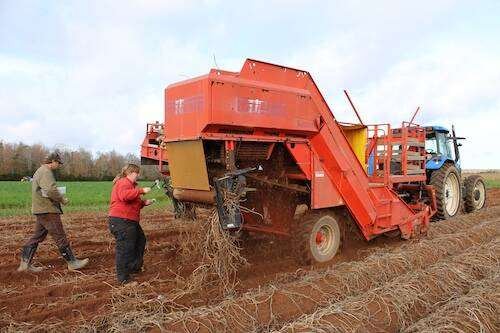
Through careful adjustments to spring tension and roller spacing, the team was able to find the most effective way to get maximum weed seed reduction on seeds as small as two or three millimetress in diameter, testing on everything from redroot pigweed, barnyard grass, yellow foxtail and volunteer canola.
“We’re getting this extra advantage of controlling those weed seeds at the same time,” he said.”With some of those other units, like the Harrington Seed Destructor, they do have quite a large horsepower draw, whereas we see really no impact on fuel efficiency or anything like that with this unit; it’s really minimal.”
His team’s research also determined a 20 to 30 per cent greater loss of overwinter weed viability following crushing.
Public domain
Unlike other equipment options, McKenzie-Gopsill kept the new crusher’s design open-source to facilitate widespread adoption among producers.
“We want to really minimize that barrier of entry,” he said. “I guarantee any producer in Canada would be able to retrofit their own. It’s really just two rollers and a motor that would attach to the back of the harvester.”
Rather than engaging with an equipment manufacturer, they’ve instead concentrated on designing a system that any farmer could either build in a farm shop, or have it fabricated at a local machine shop.
McKenzie-Gopsill said he encourages farmers to explore this technology as a weed management tool, as it will reduce the number of seeds being dumped into the seed bank and reduce herbicide-resistant weeds occurring in fields.
“You want to try and remove those seeds. They’re not going to be controlled by your in-season herbicide application or early-season herbicide application. We really have very minimal options in potatoes for broadleaf weed control,” he said.
The modified vine crusher gives growers another complementary option to help reduce overall seed bank load, while also controlling some insect overwintering.
“So it can be part of a full, kind of integrated pest management, not only weed management but a full pest management strategy,” he said.
McKenzie-Gopsill invites anyone interested in learning more about the technology to reach out to him via email andrew.mckenzie-gopsill@AGR.GC.CA or visit www.arg.gc.ca.
The post AAFC researchers take a bite out of weed seed spread appeared first on Farmtario.


