
 This article contains sponsored content.
When handling bulk solids in water treatment facilities, important steps include storage, transportation, and finally dosing of the material. Often, transportation and dosing are handled by a single auger-based machine. Alternative technologies are available, such as vibratory feeders, pneumatic conveying, or aero mechanical conveyors. However, auger-based equipment can provide controlled, accurate, and repeatable dosing of powders and is simple to implement.
This article compares three commonly used types of auger-based equipment for bulk solids handling in water and wastewater treatment plants. These are screw feeders, flexible screw conveyors, and rigid screw conveyors. With 30 years’ experience in powder metering and dosing, Trantec Solids Handling provides insight into how these technologies are applied effectively within treatment processes, how they operate and how their roles differ depending on the application requirements.
The importance of controlled dosing
From dosing lime, powdered activated carbon (PAC), and polymers, to handling dry sludge and conditioning agents, systems must manage a range of material characteristics while maintaining consistent flow. How material is extracted, conveyed, and delivered directly affects dosing accuracy, process stability, and plant efficiency. Poor feed control can result in over- or under-dosing, reducing treatment performance. To avoid such problems, correct equipment selection is essential.
Screw feeders: precision dosing
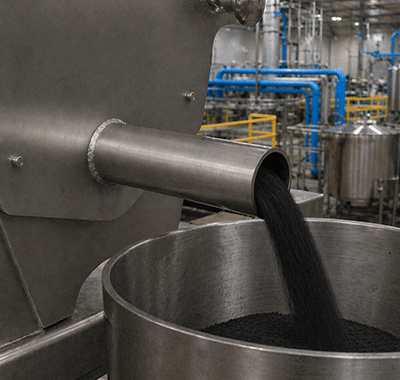
Screw feeders are designed for controlled, accurate material discharge, regulating flow from a hopper or silo and delivering a consistent feed rate into the process. They are widely used in metering applications and can be engineered to handle difficult or cohesive materials while maintaining high accuracy and repeatability. In water treatment, they are commonly used for lime, PAC, and polymer dosing, where reliable feed control is essential.
Two critical features of a screw feeder are the auger and the agitator. The agitator promotes reliable flow by preventing bridging and rat-holing, maintaining consistent feed into the auger and stabilising bulk density at discharge. The auger must be matched to the material’s characteristics to ensure consistent dosing, with different configurations influencing how the material is extracted and delivered.
Selecting the correct auger configuration
• Single-flight screws: Suited to free-flowing materials
• Variable pitch screws: Improve feed regulation and reduce surging
• Multi-flight augers: Improve feed consistency and reduce pulsation
• Twin screw feeders: Suited to cohesive or poorly flowing materials, promoting uniform discharge
• Mass flow configurations: Promote uniform movement across the hopper outlet, reducing segregation and ratholing
• Tapered core augers: Improve fill consistency for compressible or variable-density materials
Screw feeder performance and design considerations
Screw feeders provide accurate, stable dosing and integrate effectively with weighing systems, particularly at low feed rates and when handling cohesive or aerated materials. Their ability to maintain a consistent discharge makes them well-suited to critical dosing points within treatment processes.
However, they are typically limited to short conveying distances and depend on proper hopper and inlet design to achieve consistent performance.
Flexible screw conveyors: transfer versatility
Flexible screw conveyors transfer bulk solids over moderate distances using a rotating spiral within a flexible tube. Their ability to route around obstacles makes them well-suited to compact or complex layouts.
Their simple design and lower capital cost make them ideal for transferring materials from bulk bag dischargers or sack tip stations to intermediate hoppers. They are best suited to conveying dry powders, grains, and granules, with performance dependent on spiral design and material characteristics.
Flexible conveyor spiral configurations
Spiral geometry affects conveying performance:
• Round spirals – General-purpose use, suitable for most free-flowing materials
• Flat spirals – Used for aerated, fine or low-density powders
• Bevelled spirals – Reduce material degradation, suited to cohesive or sticky products
• Square spirals – Provide more positive conveying for dense or abrasive materials
Flexible conveyor performance and limitations
Flexible conveyors offer high installation flexibility and a cost-effective solution, particularly in retrofit or space-constrained applications. However, they are not designed for precise dosing, as variations in fill can lead to inconsistent discharge, especially with fine or low-density powders. Inclined operation can reduce efficiency due to material fallback, while segregation may occur in mixed materials, and continuous flexing can degrade friable products.
Rigid screw conveyors: controlled transfer over distance
Rigid screw conveyors operate on a similar principle to screw feeders but are designed primarily for efficient and reliable material conveying rather than dosing. The screw rotates within a fixed trough or tube, providing a consistent and enclosed method of transporting material over defined distances.
Unlike flexible conveyors, rigid systems offer more controlled, uniform material movement, particularly when higher throughputs or longer conveying distances are required.
Rigid conveyor auger configurations
• Standard full-flight screws – Suitable for free-flowing materials and general conveying
• Ribbon screws – Reduce build-up and improve flow of cohesive materials
• Shaftless screws – Suited to wet, fibrous, or sludge-like materials, reducing risk of blockage and clogging
• Heavy-duty / wear-resistant screws – Designed for abrasive materials such as lime, sand, or ash, improving durability
Rigid conveyors performance and limitations
Rigid screw conveyors provide consistent transfer with reduced risk of segregation and are suitable for a wide range of materials, including abrasive products. They can be configured for horizontal, inclined, or vertical conveying, and their enclosed design supports dust control and containment, although open-top options are available where access is required.
They do, however, require defined routing and are less adaptable than flexible systems. Installation is typically fixed, with layout changes more complex, and proper support and alignment are essential for long-term performance.
System integration and material considerations
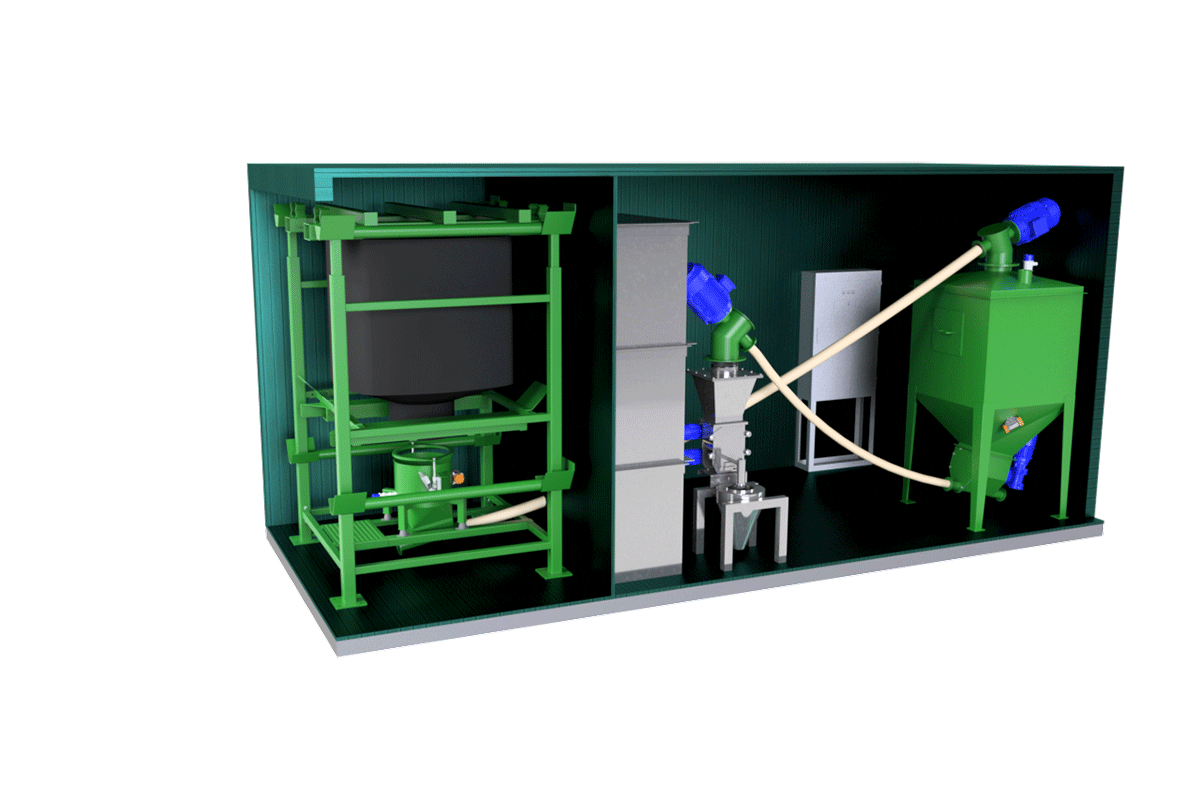
Effective bulk solids handling relies on combining appropriate technologies with an understanding of material behaviour. For optimal performance, material is transferred via a flexible or rigid conveyor into a hopper, where a screw feeder meters it into the process, enabling efficient transfer while maintaining dosing accuracy.
Material characteristics are central to equipment selection. Hydrated lime is cohesive and prone to bridging, powdered activated carbon (PAC) is lightweight and dusty, polymers can be compressible and moisture-sensitive, and granular salts are free-flowing but still require controlled dosing. Properties such as bulk density, particle size, and flowability must be considered to ensure consistent performance and avoid issues such as segregation, ratholing, or inconsistent discharge. Material testing is therefore often essential to validate system design and ensure appropriate auger and agitator selection.
Performance depends on accurate dosing, minimal downtime, and consistent operation. Screw feeders provide precise dosing, while flexible conveyors offer routing flexibility, and rigid screw conveyors provide a more robust transfer solution where layout allows. When correctly applied, these technologies deliver an efficient and reliable solution for modern treatment processes. For further technical guidance on bulk solids handling, material testing, or dosing system design, contact Trantec Solids Handling on 01282 777 566 or visit www.trantec.net


