
The global controlled environment agriculture (CEA) market is rapidly expanding, with aeroponics emerging as a leader due to its unparalleled resource efficiency. By removing inert growing media, aeroponics allows roots 100% access to oxygen, a critical factor that dramatically accelerates plant growth and enhances nutrient uptake.
This system directly addresses major modern farming challenges, including excessive water consumption and inefficient nutrient delivery, by meticulously timing and regulating every aspect of the plant’s environment. For a heavy-feeding crop like the tomato, this constant, high level of oxygenation is the key to unlocking peak production potential.
What Are Aeroponic Tomatoes?
Aeroponic tomatoes are plants grown in air, not soil. In an aeroponic system, tomato roots hang in a closed dark chamber and are regularly misted with a nutrient-rich water solution. This differs from hydroponics (where roots sit in water) and from soil gardening. The misting gives roots plenty of oxygen, which makes plants grow very fast.
Studies show aeroponic plants can grow up to 3× faster than soil-grown ones.
Because aeroponics is a vertical farming method, tomato towers can be stacked to use very little floor space. In fact, one analysis found that vertical farms (often using aeroponics or hydroponics) can produce about 10 times more yield per square foot than traditional fields.
With indoor and urban farming on the rise, aeroponic tomatoes are gaining popularity: in 2024 the global aeroponics market was about $2.4 billion and is projected to more than double by 2032. Aeroponic tomato towers can yield abundant harvests in a small footprint. Growers often report ~50% higher yields and 20–30% larger fruit compared to soil-grown tomatoes.
Why Grow Tomatoes Aeroponically?
Aeroponics offers several key advantages over soil or traditional hydroponics. For example:
i. Faster Growth & Higher Yields: With roots bathed in oxygen-rich mist, aeroponic tomatoes often grow much faster and produce more fruit. Trials have shown ~50% higher yields and 20–30% larger tomatoes on towers versus the same plants in soil. Aeroponic plants start fruiting sooner and continue fruiting longer into the season.
ii. Water and Nutrient Efficiency: Aeroponics uses water extremely efficiently. By misting directly onto roots, it wastes almost no water. Compared to soil farming, aeroponics can save about 95% of the water. Even compared to ordinary hydroponics, aeroponics still uses roughly 30% less water and about 80% less energy (since there is no heavy flood-and-drain equipment). Nutrients also go straight to the roots, so fertiliser use is very efficient.
iii. Healthier Roots & Plants: In aeroponics, roots never sit in water or soil, so they stay white and fuzzy (not slimy). This high oxygen exposure promotes strong root systems, leading to vigorous plants. Because there is no soil, many common pests and diseases (like nematodes, soil fungi or root rot) cannot infect aeroponic tomatoes. Growers report that aeroponic tomatoes are “usually pest-free” when kept off the ground, drastically reducing or eliminating the need for pesticides.
iv. Space-Saving Vertical Growth: Tomato vines normally sprawl, but aeroponic systems can use vertical towers or walls. This stacking means you can grow many more tomatoes in the same ground area. For urban farms or greenhouses, this is a huge advantage. For perspective, research shows a single vertical farm can produce about 10× the crops per square foot of land than a field farm.

v. Clean, Controlled Environment: Harvesting aeroponic tomatoes is cleaner (no mud on fruits). You have precise control over all conditions – water, nutrients, light and temperature – which means consistent quality year-round. In a well-controlled system, fruit taste and nutrition can be optimized. (Note: very high root temperatures can affect tomato flavor – see below.)
| Benefit | Key Points |
|---|---|
| Faster Growth & Yields | ~50% higher yields, 20–30% larger fruits, earlier and longer fruiting |
| Water & Nutrient Efficiency | 95% less water than soil, 30% less than hydroponics, 80% less energy use |
| Healthier Roots & Plants | White, oxygen-rich roots; fewer pests; minimal pesticide use |
| Space-Saving Growth | Vertical towers; up to 10× more crops per square foot |
| Controlled Environment | Clean harvests; precise control of nutrients, water, and climate |
Overall, aeroponic tomato gardening is a sustainable and productive method. It uses far less water than soil, avoids soil-borne problems, and can greatly increase yield in a small space. These benefits make aeroponic tomatoes ideal for modern urban farms and greenhouse producers seeking fresh local tomatoes.
Core Components of an Aeroponic System
In recent years, the cost of aeroponic systems has dropped significantly, making them more accessible to home growers. The global aeroponic farming market is expected to surpass $3.2 billion by 2026, with tomatoes being one of the top crops grown. These systems rely on specific components that ensure tomatoes receive the right balance of nutrients, oxygen, and environmental stability. Understanding these components is essential before setting up a productive system.
i. Reservoir: A tank holds the nutrient solution (water mixed with all needed fertilizer).
ii. Pump: A high-pressure water pump pushes the solution through the system at regular intervals.
iii. Misting Nozzles: These spray a fine fog of nutrient solution onto the hanging roots. In High-Pressure Aeroponics (HPA) systems, the mist is very fine (droplets < 50 microns), which is ideal but requires robust equipment. In Low-Pressure Aeroponics (LPA), misters are simpler (drip or spray) but work acceptably for home use.
iv. Root Chamber: An opaque container or chamber holds each plant’s roots in the dark. The roots dangle down into the mist from above. The chamber keeps light out to prevent algae and ensures roots only get nutrients from the mist.
v. Plant Support Structure: Since tomato vines can grow tall and heavy, aeroponic systems need supports. Common supports include net pots or collars that hold the plant, plus a trellis, cage or stakes to guide and support the vines as they climb.
vi. Timer/Controller: A timer (or digital controller) turns the pump on and off. Typical aeroponic schedules spray for a few seconds every few minutes. Precise timing is crucial – too little mist dries roots, too much keeps them waterlogged.

Most home growers use a tower garden or vertical column with these components built in. Commercial farms may use larger modular chambers or fogging rooms with many plants. Regardless, these core pieces work together to keep tomato roots suspended in air and fed continuously by mist.
Setting Up Your Aeroponic Tomato Garden
As of 2024, more than 60% of indoor growers in North America report experimenting with aeroponic or hybrid systems for crops like tomatoes, due to the promise of higher yields per square foot compared to soil or hydroponics. Setting up your system correctly determines long-term success, from choosing the right system type to selecting varieties that adapt well to aeroponics.
A. Choose Your System: Decide between a ready-made aeroponic tower (like the popular Tower Garden kits) or building your own. Pre-made systems save time and include pumps/nozzles optimized for plants. DIY builds (for example using PVC pipe) can save money but require careful design of reservoir, pump and sprayers. Also pick between High-Pressure Aeroponics (HPA) or Low-Pressure (LPA): HPA gives finer mist and usually better yields, but is more complex; LPA uses simpler drippers or PVC misters (often called “pumped water culture”) which are easier DIY options.
B. Pick the Right Tomatoes: Not all tomato varieties behave the same in aeroponics. You have two main categories:
i. Indeterminate (vining): These keep growing and producing fruit all season. Examples include heirloom beefsteaks, cherry vines like ‘Sweet 100’, etc. They can yield a lot, but require a sturdy trellis or cage and regular pruning to manage long vines.
ii. Determinate (bush): These grow to a fixed size and set most fruit in a shorter time. Varieties like ‘Roma’, ‘Celebrity’, or small patio hybrids are determinate. They are bushier and compact, so they fit better if you don’t want to build a tall trellis. Dwarf or patio tomatoes (e.g. ‘Tiny Tim’, ‘Patio Princess’) are especially easy – they stay small and often require little or no pruning.
In general, cherry or grape tomatoes (indeterminate vines) do very well once you support them. If space or support is limited, consider determinate or dwarf types that naturally stay shorter. Many aeroponic growers recommend starting with vigorous cherry varieties and pruning them to 2–3 main branches (yielding large sweet tomatoes).
C. From Seed to Harvest: Once you have a system and variety
i. Germinate Seeds: Start tomato seeds in starter plugs or rockwool cubes. Keep them warm (~21–27°C) and moist under a light. Tomato seeds usually sprout in 1–2 weeks, and seedlings need about 5–6 weeks to grow big enough for transplant. (Tomatoes do not like temperatures below ~20°C/68°F.)
ii. Transplant to Aeroponic System: When seedlings are strong (several true leaves), transfer each into a net pot or collar. Gently lower the roots into the aeroponic chamber. Adjust the height so the top of the soil plug is just at the mist zone. Secure the plant in the support system (e.g. clip plant collar, attach to trellis).
iii. Vegetative Growth: Provide plenty of light (if indoors, use grow lights 14–18 hours a day) and a nutrient solution. In this stage, tomatoes like a moderately high nitrogen feed. Ensure temperatures around 70–80°F (21–27°C) day, a bit cooler at night. Maintain humidity around 50–70%. Watch roots – they should stay white and crisp. If roots start browning, it may mean too much moisture or dirty water (see Troubleshooting).
iv. Flowering and Pollination: Tomatoes will soon form blossoms. In a closed aeroponic system (especially indoors), manual pollination is needed since there’s no wind or bees. You can gently shake the plant or use an electric toothbrush or small paintbrush to vibrate pollen into each flower. This ensures good fruit set. (In greenhouses, farming advice strongly recommends assisted pollination.)
v. Fruit Development: Once blossoms turn into small green tomatoes, maintain a stable feeding schedule. Increase potassium and calcium as fruits form to avoid issues like blossom-end rot. Keep the nutrient solution at a healthy temperature – if the reservoir water gets hotter than ~32°C (90°F), tomato flavor and growth can suffer.
(Some growers refrigerate the reservoir or place it in shade to prevent heat buildup.) Harvest ripe tomatoes by cutting them off the vine when they reach full color. Aeroponic tomatoes often ripen quickly and continuously, so you can pick batches over many weeks.
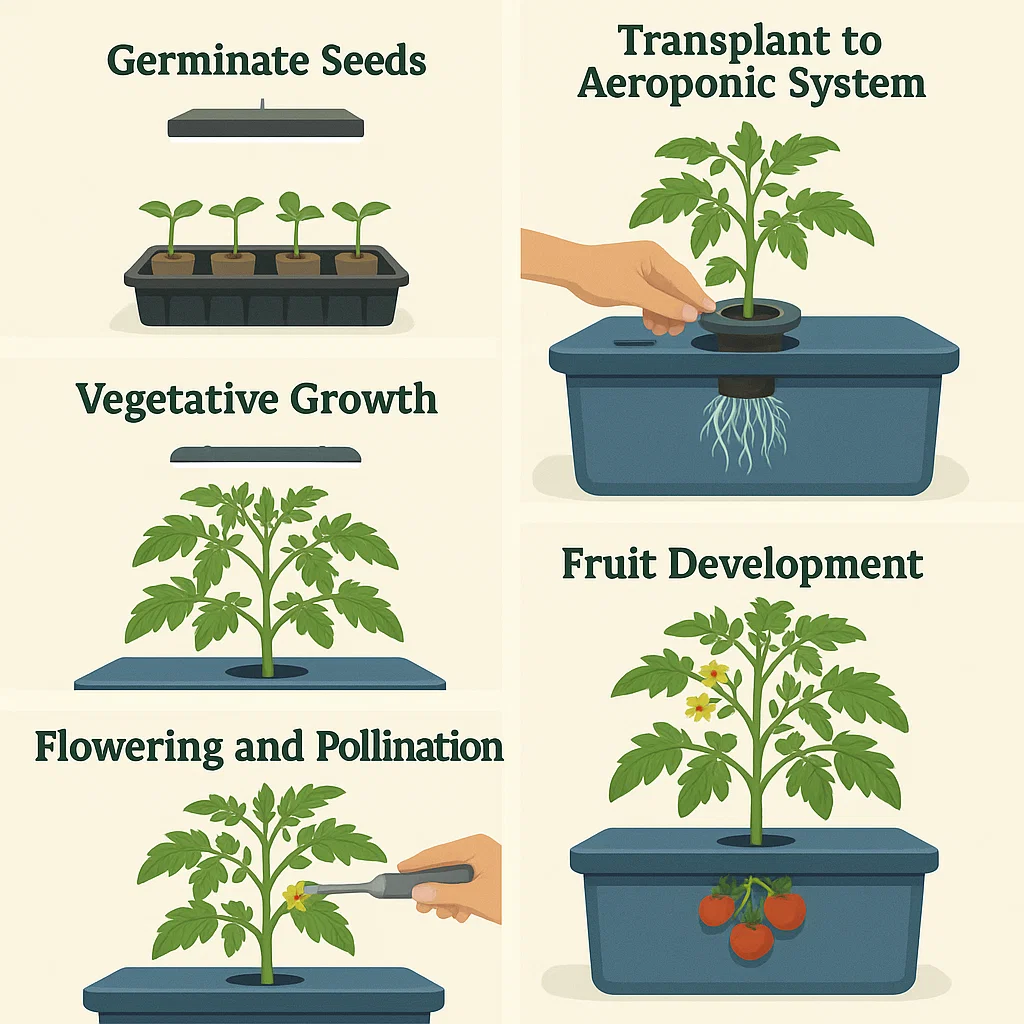
By following these steps and providing steady care, you can take aeroponic tomatoes from seed to harvest in just a few months, with abundant, tasty yields.
Maintaining a Healthy Aeroponic Tomato System
Indoor farming studies in 2024 show that aeroponic tomatoes can yield up to 40% more per square meter compared to traditional soil farming, but only when nutrients, environment, and system hygiene are carefully maintained. A well-managed system ensures faster growth, disease resistance, and consistent flavor quality.
a. Nutrient Management: Tomatoes are heavy feeders, especially as they grow and fruit. You’ll need a balanced nutrient solution with all macro- and micro-nutrients. A typical practice is to use a grow formula higher in nitrogen during vegetative growth, then switch to a bloom/fruit formula higher in phosphorus and potassium once flowers appear.
Most importantly, monitor pH and EC (nutrient strength) frequently. Tomatoes prefer slightly acidic solution around pH 6.0–6.5. The electrical conductivity (EC) – which measures total dissolved nutrients – should generally be around 2.0–4.0 mS/cm during fruiting. (You can buy an EC meter to check this.)
Keeping pH and EC in range ensures the plants absorb nutrients efficiently. Also maintain good oxygenation and cool temperature in the reservoir (ideally 18–21°C for water) to keep roots healthy. Replace or top up the reservoir every 1–2 weeks to refresh nutrients and prevent imbalance.
b. Environmental Control: Outside of the root zone, keep the growing environment ideal for tomatoes. Daytime air temperatures of about 21–27°C (70–80°F) and nights around 18°C (65°F) are good. High humidity (>80%) can promote mold, so aim for ~50–70% humidity if possible.
Provide strong grow lights if indoors – tomatoes need lots of light to set fruit (often 400–600 μmol·m^-2·s^-1). Good air circulation is also important: fans can strengthen stems and prevent fungal spots.
c. System Maintenance: Aeroponics systems must be kept clean. Check your misting nozzles every week – they can clog with salt or algae. If flow is uneven, clean nozzles with a weak acid (like vinegar) or replace them.
Every 1–2 months, drain and scrub the reservoir and wet parts of the system with diluted hydrogen peroxide or mild bleach, then rinse thoroughly. This prevents algae and Pythium (root rot fungus). Also test for root health: healthy aeroponic roots remain white.
If you spot brown, slimy patches, act quickly (flush system, raise mist interval, add a little hydrogen peroxide to kill pathogens). Finally, have a backup plan for power or pump failures – aeroponic tomatoes can suffer quickly if misting stops. Battery backup or alert systems can save a crop if the power goes out.
Troubleshooting Common Problems
Research from 2023 found that around 35% of aeroponic growers face root-related challenges within their first year, often due to clogged nozzles or poor sterilization. Nutrient deficiencies and environmental stress can also cause issues, but with proper monitoring, most problems are easy to fix compared to soil farming.
a. Root Rot (Pythium): Symptoms: Roots turn dark, slimy or have a foul smell. Plants will wilt and yellow. Causes: Overly wet conditions, poor cleaning, or a contaminated system. Fix: Immediately clean and disinfect the system. Increase misting intervals (so roots dry slightly between sprays). You can also add beneficial bacteria or peroxide to kill pathogens. Prevent by regular cleaning and proper oxygenation.
b. Nutrient Deficiencies: Nitrogen (N) Deficiency: Older leaves turn pale or yellow (starting at the base). Potassium (K) Deficiency: Leaf edges curl or scorch; fruits may have poor color. Calcium (Ca) Deficiency: Blossom-end rot (dark spot) on fruit bottoms is a classic sign.
Other: Purple stems or leaves can indicate phosphorus lack. If you see these signs, first check your pH/EC; a pH out of range can lock out nutrients even if they’re present. Adjust the nutrient mix accordingly. For calcium issues, you can add calcium nitrate or dolomite to your solution.
c. Nutrient Toxicity: Sometimes the opposite happens: leaf tips burn, or white spots appear due to excess salts. If EC is too high, flush the system with fresh water and rebalance nutrients.
d. Pests: Aeroponic systems usually avoid soil pests, but flying pests (aphids, whiteflies, spider mites) can still infest leaves. Inspect plants regularly. If needed, wash plants or use organic sprays (insecticidal soap) as a last resort. Keep surroundings clean to prevent pest buildup.
e. System Failures: Pump or Timer: If the pump stops and roots dry out, plants can die within hours. Check pumps and timers daily when starting out. Use high-quality timers and keep spares. Leaks: Any leak in a tower or reservoir can cause problems with oxygenation. Fix or seal immediately.
f. Poor Pollination: If few fruits form and most flowers drop, the flowers may not be pollinating. Increase vibration/shaking of the vines when flowers bloom.

Usually, careful observation is the best tool. Healthy aeroponic tomatoes should have bright green foliage and white roots. The troubleshooting above covers most issues you’ll encounter.
Advanced Aeroponic Tomato Topics
By 2025, commercial aeroponic tomato farms have expanded in Europe and Asia, with some reporting yield increases of 300% per acre compared to soil-based farming. These advanced methods are supported by automation, AI-driven monitoring, and integration with other modern farming systems, making aeroponic tomatoes a serious contender for large-scale production.
Commercial Production: Big farms now use aeroponic or vertical towers for year-round tomato production in greenhouses. Systems like AeroFarms (USA) or LettUs Grow (UK) use similar techniques, often integrating automation.
Commercial growers note that, while initial setup costs are high, the fast harvest cycles and larger yields can pay off. Some indoor farms even link towers into hydroponic or aquaponic loops (recycling nutrient water from fish tanks, for example). Overall, aeroponic tomato farming can be profitable where land is scarce or soil is poor.
Integration with Other Systems: Aeroponic modules can be part of a mixed farm. For instance, a vertical farm might grow lettuce on one tier and tomatoes on another, sharing the same nutrient reservoir or lighting.
In an aquaponic system, fish waste could feed the tomato towers (though aeroponics requires very clean water, so bio-filtration is critical). The technical integration is complex, but it’s an area of active research and experimentation.
Automation and Data: High-tech aeroponic farms increasingly use sensors and controllers. pH and EC probes can feed real-time data to controllers that automatically dose nutrients or acids. Timers or smart valves can adjust misting frequency based on root moisture sensors.
According to industry analyses, the future of aeroponics will involve more AI-driven automation for nutrient management and environment control. Some growers even use machine vision or smartphone apps to monitor plant size and health.
These advanced tools can maximize consistency and reduce labor. For example, if a sensor detects that nutrient levels are low, it can trigger a nutrient top-off. If temperature in the reservoir rises, a chiller could turn on automatically. By embracing technology, an aeroponic tomato garden can approach fully-automated “smart farm” operation.
| spect | Aeroponic Tomatoes |
|---|---|
| Growth Speed | ~50% faster, earlier fruiting |
| Yield | 20–30% larger fruits, longer season |
| Water Use | Up to 95% less than soil |
| Energy Use | ~80% less than hydroponics |
| Root Health | White, oxygen-rich, disease-resistant |
| Pest Issues | Minimal, usually pesticide-free |
| Space Efficiency | Vertical towers, up to 10× more crops |
| Environment | Clean harvest, full control of conditions |
Harvesting and Enjoying Your Tomatoes
Tomatoes are usually ready to pick when they have full color (red, orange, yellow, depending on variety) and slight give when gently squeezed. In aeroponics, you may start harvesting just 60–90 days after sowing (cheery varieties can fruit very quickly). Cut or twist each tomato from the vine, leaving a small stem attached for best storage.
The taste of aeroponic tomatoes is generally excellent because they receive an ideal diet of nutrients and consistent watering. Many growers say aeroponic tomatoes are juicy and sweet, sometimes even more so than field-grown ones.
However, temperature control matters: very high reservoir temperatures can reduce flavor compounds. In practice, tomatoes picked in cooler part of the season often taste the best. (Some growers note that fruits picked in early fall are sweeter than those from midsummer, due to cooler nights.)
How do they compare to soil tomatoes? Aeroponic tomatoes often have a cleaner, more uniform texture. In blind tastings, people often can’t tell if a tomato was aeroponic or soil-grown if the conditions were ideal.
The biggest factor is variety and how ripe the fruit is. Enjoy your aeroponic tomatoes fresh in salads or sauces! They should keep for about the same time as vine-ripened tomatoes (usually up to a week if refrigerated).
Conclusion
Aeroponic tomato farming is a cutting-edge way to grow this beloved vegetable. By suspending roots in air and misting them, aeroponics achieves remarkable efficiency: up to 95% less water than soil, faster growth, and higher yields. This method eliminates many soil pests and is very space-efficient, making it ideal for urban and indoor farms.
To succeed, you need the right setup (good pump, nozzles, lighting), the right varieties (often compact or cherry types), and careful attention to nutrients and cleanliness. With that done, you can enjoy a continuous harvest of fresh, clean tomatoes year-round. As urban gardening grows, aeroponic tomatoes stand out as a sustainable, high-tech crop – ready to help feed our cities of the future.


