
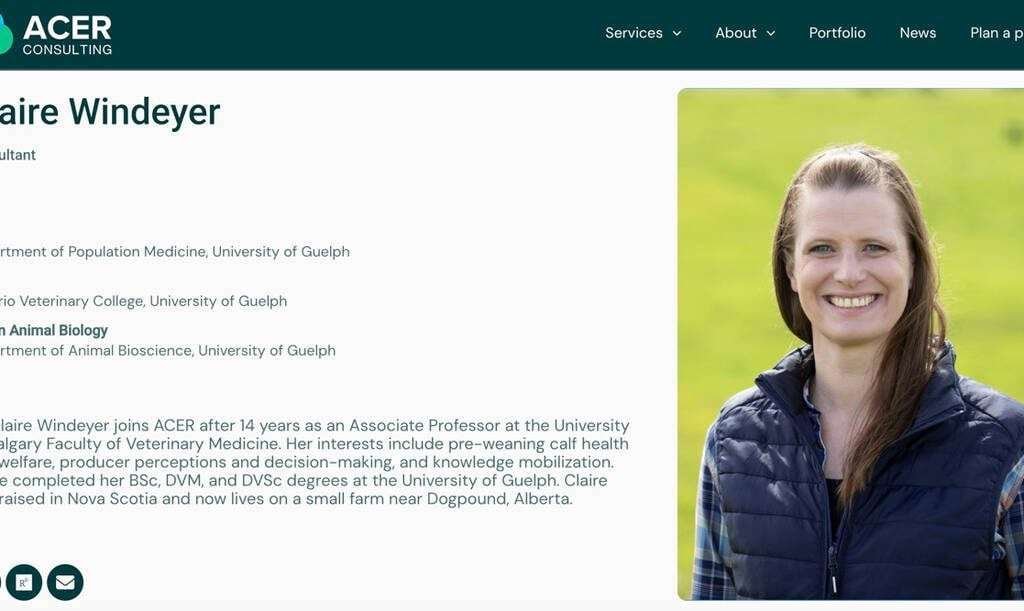
Claire Windeyer is a “recovering academic.”
For 14 years, she was an associate professor in veterinary medicine at the University of Calgary.
WHY IT MATTERS: Many academics and organizations wonder how to extend research and best practices to farmers.
She now works for ACER Consulting, an Ontario firm that specializes in research, communication and professional training to improve the health and welfare of animals.
So, why make a shift from veterinary research on cow-calf management to a role that’s more about knowledge transfer?
Windeyer, who lives on an acreage near Dogpound, Alta., north of Calgary, was seeking a different position in the world of animal agriculture.
“That’s part of why I left academia, is I wanted to be that bridge … someone who understands research but also cares about boots on the ground farming.”
Windeyer, who grew up in Nova Scotia and earned her doctorate in veterinary medicine at the University of Guelph, was enjoying a successful career at the University of Calgary.
In 2021, the Canadian Veterinary Medical Association honoured her with the Merck Veterinary Award for her work on beef cattle health and welfare.
That sort of recognition is always nice, but at some point in her academic career, she realized that research doesn’t matter if it doesn’t drive change.
“If academic research is to truly benefit society, the gap between it and potential end-users and decision-makers needs to be bridged,” Windeyer wrote in October on Linkedin.
In the posting, Windeyer notes that university culture rewards professors who publish in prestigious journals and attract research dollars to the university.
Academics who speak at farm meetings and communicate research findings are not recognized.
“Even for those who love community engagement and research extension, it comes at a cost,” she wrote.
“Best case scenario, that cost is just time; worst case, it’s a loss of career advancement.”
In practical terms, it comes down to priorities and time.
If an animal science professor spends their day writing an article for Canadian Cattlemen or driving to a producer meeting, that takes time away from writing a grant or publishing the next paper, Windeyer added.
Windeyer is one of many people in Canadian agriculture who are worried about how ag research and best practices are extended to farmers.
Some provinces still employ extension specialists for crops and livestock, but in the case of livestock, those specialists have become a rarity, said Tracy Herbert, knowledge mobilization and communication director with the Beef Cattle Research Council
“There’s not enough of it,” Herbert said.
“Saskatchewan is fortunate that they still have regional extension specialists (for livestock). Manitoba has a couple left, but far fewer than they did 10 to 20 years ago. … Most other provinces virtually don’t have any.”
In the United States, land grant universities such as North Dakota State still employ scientists who specialize in extension and deliver the latest research information to growers and ranchers.
That doesn’t exist in Canada.
If Canadian universities don’t make extension a priority and if provincial governments aren’t committed to it, then someone or something else needs to fill the void, Windeyer said.
“While the old system of government-funded extension agents is unlikely to return, that doesn’t mean we can’t reimagine how research moves into practice. We need to build new bridges.”
One possibility is what Windeyer calls a knowledge broker.
Similar to an extension agent, such a position fills the gap between the knowledge creators (researchers) and the knowledge user, or farmer.
“Perhaps it’s time we revisit the idea that being a knowledge broker should be a legitimate career path,” Windeyer wrote on Linkedin.
In Windeyer’s case, she’s found a way to be a knowledge creator and broker in her job at ACER Consulting.
For others who want careers as knowledge brokers in Canadian agriculture, someone needs to pay their salary.
Who will pay, remains unclear, Windeyer said.
“I don’t know the answer to that question.”
The post Ag researcher floats idea of knowledge broker appeared first on Farmtario.


