
American Battery Technology Company (NASDAQ: ABAT) has achieved a significant milestone. The U.S. Department of Energy (DOE) reinstated a $115 million grant for its Tonopah Flats Lithium Project (TFLP) in Nevada. This decision eliminates uncertainty for the company and bolsters its aim to establish a domestic lithium supply chain. This is crucial as the U.S. seeks to gain more control over critical mineral production.
The grant will fund the first phase of a lithium refinery. This facility is set to produce battery-grade lithium hydroxide for electric vehicles, energy storage, and other clean energy uses.
For investors, this reinstatement is vital. It confirms the project’s progress and validates the company’s technology after months of federal review.
DOE Reverses Earlier Decision
ABAT first received the DOE award in October 2022. This five-year grant was meant to help build the first phase of its lithium refinery at Tonopah Flats.
However, in October 2025, the company learned that the grant would be terminated, along with many others. ABAT quickly contested this and entered the DOE’s Informal Dispute Resolution process. After several months, DOE officials assessed the project’s achievements and progress. Based on this review, the agency decided to fully restore the grant.
Importantly, the reinstatement keeps the funding unchanged. The original $115 million award remains, and the project’s milestones are still intact. The only change is an updated timeline reflecting the review period.
ABAT’s CEO, Ryan Melsert, stated that the decision shows the company met all requirements and proved the value of its technology.
This reinstatement is noteworthy, as few terminated DOE grants have been restored after appeals.
Tonopah Flats Could Be a Major Lithium Source
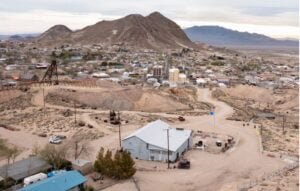
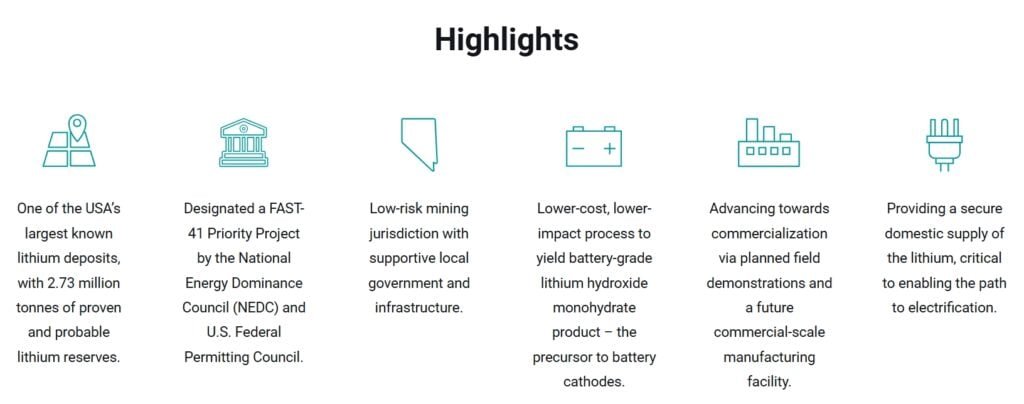
The Tonopah Flats Lithium Project is among the largest lithium claystone resources in the U.S. Located near Tonopah, Nevada, the project spans over 10,000 acres across many mining claims managed by the Bureau of Land Management.
The Tonopah Flats Lithium Project Site
ABAT began exploration in 2021 and has advanced through multiple development stages. The company has completed resource studies, economic assessments, and a pre-feasibility study.
- The project aims to extract lithium from sedimentary claystone deposits, which differ from the hard-rock and brine deposits used globally.
- ABAT claims these claystone deposits are ideal for its proprietary extraction technology, unlocking a large domestic lithium resource.
Domestic lithium production is increasingly vital as electric vehicle adoption rises and battery manufacturing expands in North America.
Proprietary Technology Aims to Lower Costs and Environmental Impact
A key part of ABAT’s investment appeal is its lithium extraction technology.
Traditional methods often need vast amounts of chemicals, water, and energy. ABAT’s selective leach extraction (SLE) process aims to cut these needs while keeping commercial recovery rates high.
The company has already produced battery-grade lithium hydroxide from Nevada claystone deposits.
ABAT highlights several advantages of its technology:
- Lower chemical reagent use
- Reduced water consumption
- Less contamination during processing
- Lower production costs
- Smaller environmental footprint
These benefits are crucial as regulators and manufacturers push for sustainable mineral production.
The company is refining its technology through ongoing research at the Nevada Center for Applied Research at the University of Nevada, Reno.
- ALSO SEE:
- Surge Battery Metals (NILI) Upgrades Nevada North to 10.5 Mt LCE M&I Resource as U.S. Lithium Development Gains Momentum
- Texas-Based EnergyX’s Project Lonestar
 Signals a Turning Point for U.S. Lithium Supply
The Case for Expanding U.S. Lithium Production
The U.S. faces challenges in securing critical battery materials. Demand for lithium-ion batteries is rising due to electric vehicles, energy storage, consumer electronics, and data centers.
According to the U.S. Geological Survey (USGS):
- The United States holds about 30 million metric tons of lithium resources, while global lithium resources total roughly 150 million metric tons.
- These resources are found in claystone, brines, geothermal sources, oilfields, and pegmatites.
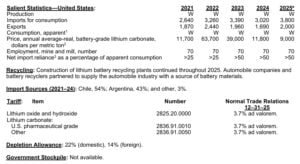
However, the U.S. still depends heavily on imports for critical battery materials. It accounts for less than 1% of global processing capacity for lithium, nickel, cobalt, and manganese.
While domestic EV and battery manufacturing have expanded rapidly, production of key battery metals has lagged. Thus, expanding domestic lithium production has become increasingly important for supply security and energy independence.
This creates three major issues:
- Supply Security: The U.S. heavily relies on foreign sources for critical battery materials. Lithium, nickel, cobalt, and manganese are classified as strategically important minerals. Boosting domestic production could reduce supply chain risks and enhance national energy security.
- Rising Costs: Increased global demand has raised battery metal prices in recent years. More domestic production could help improve supply and lower long-term costs.
- Environmental Concerns: Conventional mining and processing can create significant greenhouse gas emissions. New extraction methods aim to reduce these effects while remaining economically viable.
ABAT believes both recycling and primary mineral production will be essential to meet future demand.
While battery recycling will be important in the circular economy, it won’t produce enough lithium to meet rapidly growing global demand. New domestic mining and refining projects are still necessary.
Federal Support Across Administrations
A notable aspect of the Tonopah project is its bipartisan support.
Initially, it received federal funding during the Trump administration through the DOE’s Advanced Materials and Manufacturing Technologies Office.
Later, support continued during the Biden administration via the Manufacturing Energy Supply Chain program.
Under the second Trump administration, the project received further federal backing through the grant reinstatement process.
In June 2025, the White House National Energy Dominance Council designated Tonopah Flats as a Priority Project, allowing for streamlined federal permits. This consistency shows that domestic critical mineral development remains a priority, regardless of political leadership.
What It Means for ABAT Stock
The grant reinstatement alleviates a major concern for investors.
Federal funding eases project financing pressures and paves the way for commercial lithium production. It also validates the project’s technical progress and economic potential.
Despite this positive news, ABAT shares are still below their 52-week high of $11.49. The stock trades near its 50-day moving average and below its 200-day average, showing cautious long-term market sentiment.
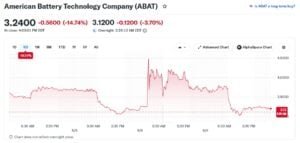
However, Wall Street remains optimistic about the company’s future. One analyst has a 12-month price target of $6.00 per share, suggesting a significant upside from current levels.
As the Tonopah Flats project moves through permitting, engineering, and construction, investors will likely focus on execution, lithium market conditions, and the company’s ability to scale its extraction technology.
For now, the DOE’s decision marks an important step for ABAT and the broader goal of building a secure domestic lithium supply chain in the U.S.
The post American Battery Technology (ABAT Stock) Wins Back $115M DOE Grant as Tonopah Lithium Project Moves Forward appeared first on Carbon Credits.


