America’s Missile Interceptor Stockpiles Have Plunged
Key Takeaways
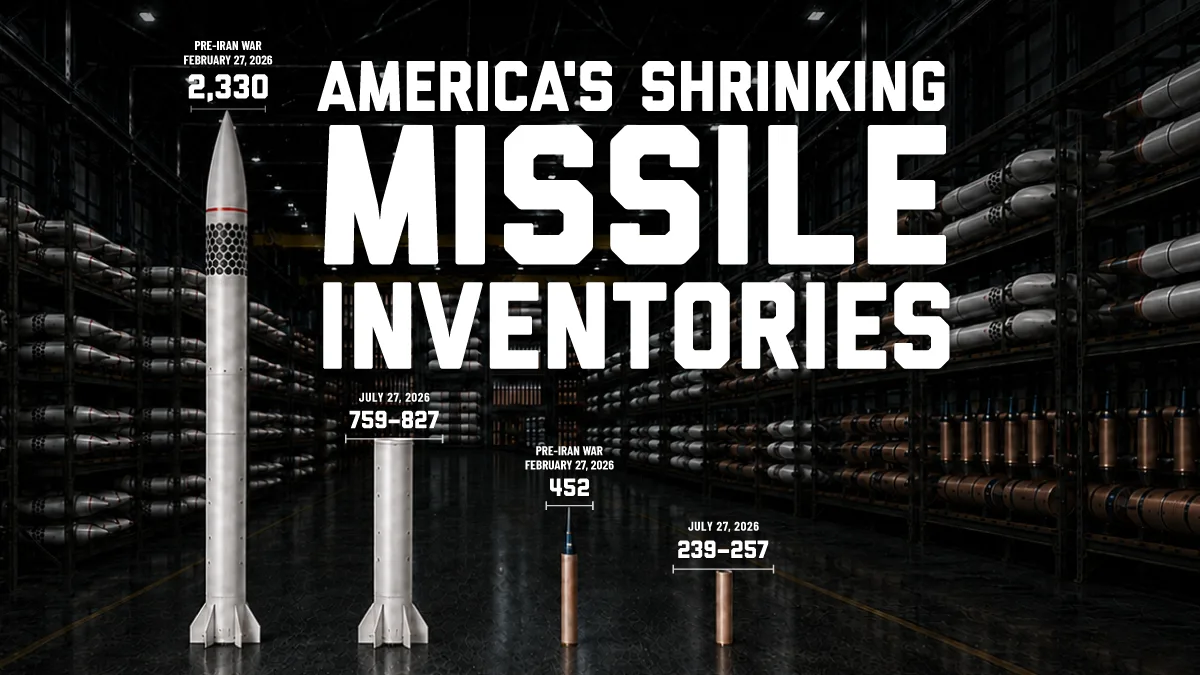
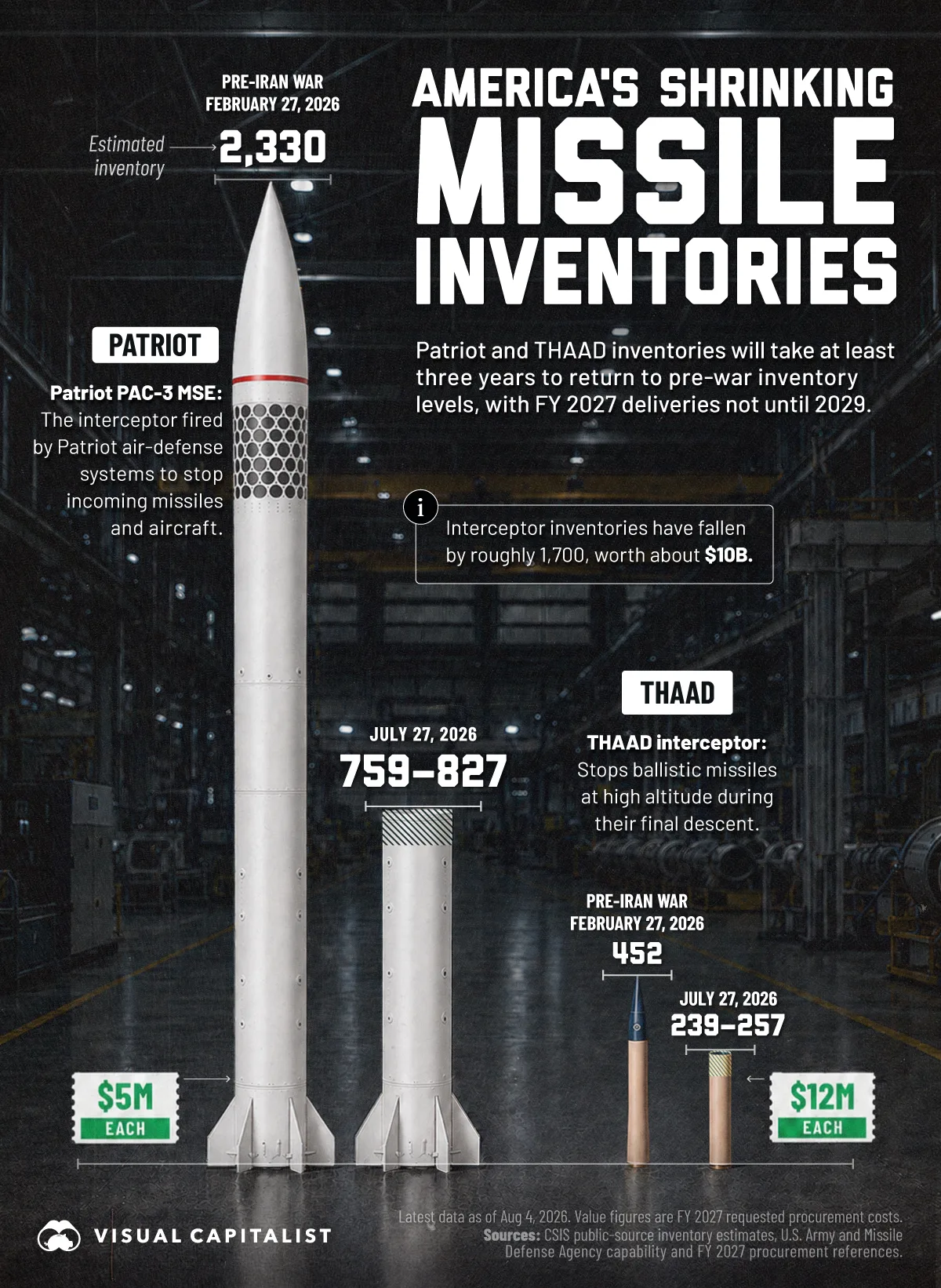
- U.S. Patriot interceptor inventories have fallen from an estimated 2,330 before the Iran war to 759–827 as of July 27, 2026, a decline of roughly two-thirds.
- THAAD interceptor stocks are down by nearly half over the same period, from 452 to an estimated 239–257.
- CSIS estimates both systems will take at least three years to return to pre-war inventory levels, with new FY 2027 orders not arriving until 2029.
Months of intercepting Iranian missile barrages have drawn down America’s stockpiles of its two most important air-defense interceptors far faster than they can currently be replaced.
Since the start of the Iran war in late February, combined Patriot and THAAD interceptor inventories have fallen by roughly 1,700 missiles.
This graphic visualizes estimated U.S. Patriot and THAAD interceptor inventories, based on public-source estimates from the Center for Strategic and International Studies (CSIS), with per-interceptor values from U.S. Army and Missile Defense Agency FY 2027 procurement references.
How Much of America’s Missile Inventory Is Left?
Patriot accounts for the vast majority of the absolute decline in U.S. interceptor stocks, reflecting its much larger pre-war inventory and heavy use during the conflict.
THAAD stocks have also fallen substantially. While fewer THAAD interceptors have been expended, each costs more than twice as much as a Patriot interceptor.
The table below compares estimated U.S. inventories of both interceptor types before the war and as of July 27, 2026:
| Missile System | Estimated U.S. Interceptor Inventory | Estimated Decline (%) | |
|---|---|---|---|
| Pre-war (Feb. 27, 2026) | July 27, 2026 | ||
| Patriot | 2,330 | 759–827 | 64.5–67.4% |
| THAAD | 452 | 239–257 | 43.1–47.1% |
A PAC-3 MSE interceptor used by Patriot systems costs roughly $5 million in the FY 2027 budget request. A THAAD interceptor, designed to destroy ballistic missiles at longer ranges and higher altitudes than Patriot, costs nearly $12 million.
Both systems are being used primarily against Iranian ballistic missiles. Using FY 2027 unit costs as a rough benchmark, replacing the estimated drawdown would cost about $10 billion.
A Three-Year Road Back to Pre-War Levels
According to CSIS analysis of Pentagon delivery projections, Patriot and THAAD stockpiles will each take at least three years to return to pre-war levels. THAAD’s FY 2027 order of 857 interceptors is projected to complete the replacement of Iran-war usage by the end of 2029.
Washington is spending heavily to close the gap as global military spending climbs. The FY 2027 defense budget includes a $95 billion munitions request, with another $21 billion in a war supplemental. Lockheed Martin also plans to more than triple PAC-3 MSE production capacity and expand THAAD output from 96 to 400 interceptors per year.
Until those deliveries arrive, CSIS warns that depleted stockpiles create a window of vulnerability. With no good alternatives to Patriot and THAAD for ballistic missile defense, every interceptor fired over the Middle East will take at least one to two years to replace.
Learn More on the Voronoi App
If you enjoyed today’s post, check out The Global Defense Industry in One Chart on Voronoi.