

One heatwave follows another, with new temperature records being set across Europe. Forests are burning and rivers are drying up, even in temperate climate zones. What until recently sounded like dystopia from a mediocre science fiction novel has, this summer, become a bitter reality. Europe is feeling the consequences of climate change.
As a result, demand for air conditioning systems and heat pumps capable of providing cooling is rising sharply. This is driving up electricity demand among households, public buildings, and commercial and industrial consumers. High energy costs are a growing concern, particularly as conventional energy supplies based on coal, gas and nuclear power come under pressure globally because of high temperatures and ongoing crises.
The obvious response would be to accelerate the energy transition and make renewable power generation a top priority. Yet governments remain largely silent, offering short-term measures to mitigate the effects of climate change without addressing the bigger picture. Against this backdrop, it is hardly surprising that demand for photovoltaic systems, while not declining, is not growing exponentially either. There are even indications that stagnant solar module sales are largely attributable to “pull-forward effects”: buyers in various regions anticipate a significant deterioration in investment and installation conditions next year, or possibly as early as the fourth quarter of this year.
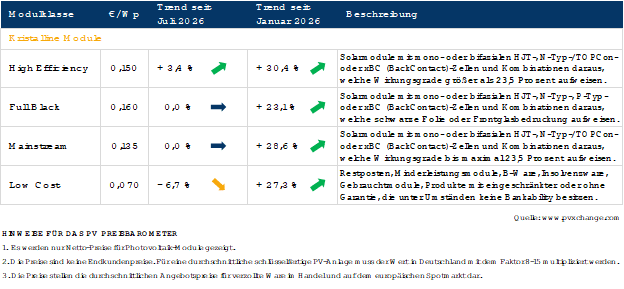
Nevertheless, module prices have changed little, with some segments even seeing renewed declines. Production surpluses need to be cleared, putting pressure on market prices, particularly for modules intended for large rooftop systems and ground-mounted projects. In the index, these products are primarily represented by the “Mainstream” price category.
However, the basis for data collection had to be adjusted this month. Continued improvements in module efficiency meant that the previous 23% efficiency threshold separating the “Mainstream” and “High Efficiency” categories left almost no price points in the former. The dividing line has therefore been raised to 23.5% efficiency. For small-scale system modules, this corresponds to a nominal output of approximately 470 W. For utility-scale modules, the new threshold places modules above 635 W or 730 W, depending on the form factor, in the “High Efficiency” category.
As a result of the redefinition, modules with efficiencies below 23.5% have shifted from one category to the other, slightly skewing the reported price trends. Lower-efficiency products are typically offered at lower prices than higher-efficiency modules. Without this adjustment, the August price for high-efficiency modules would have remained at the previous month’s level, while less-efficient products would have shown a slight decline.
According to manufacturers, however, module prices are unlikely to fall much further this year for the reasons outlined above. Whether this forecast proves accurate depends, at least in Germany, on developments surrounding the new renewable energy law – EEG 2027 – and the “Grid Package” (Netzpaket) following the summer recess.
Numerous associations have already lodged complaints and called for extensive revisions to the draft legislation. Resistance has also emerged within the governing coalition, particularly among state premiers from federal states with large numbers of renewable energy installations and industrial companies active in the photovoltaic and wind sectors. If the federal government implements the measures outlined in the draft legislation without significant changes, it could lead to substantial job losses, reminiscent of the situation under then-Federal Economics Minister Peter Altmaier (CDU) in the early 2010s.
Uncertainty over the future of EEG is prompting some market participants to adopt a “wait-and-see” approach, while others are rushing to act. As a result, many installers’ order books remain well filled for the time being. How long this surge in demand for photovoltaic systems and energy storage will last, even through the holiday season, depends on how quickly subsidy-free business models gain traction.
Many installations are already financially viable without statutory feed-in tariffs. Mid-sized photovoltaic systems, however, often still rely on the EEG in its current form, at least as a fallback option. A sensibly designed transitional solution could significantly ease the situation — or so the industry hopes.
The USA and India are further regions where “pull-forward” effects—purchases made in anticipation of future changes—are influencing demand, and consequently module availability and pricing. In early August, the US government imposed minimum import prices and additional tariffs on polysilicon and other photovoltaic products from China, set to take effect on December 4, 2026. In the short term, this is triggering increased stockpiling and a resulting outflow of material specifically to that region. Similar moves to tighten existing domestic industry protection measures are also being reported from India; this, too, could lead to a rapid surge in imports from China and, consequently, localized supply shortages. The remainder of the year promises to be eventful, likely holding a few surprises in store for us—and not just regarding further weather-related volatility.
Overview of module price levels by technology for August 2026, including monthly changes (as of August 14, 2026):
About the author: Martin Schachinger has studied electrical engineering and has been active in the field of photovoltaics and renewable energy for almost 30 years. In 2004, he set up the pvXchange.com online trading platform. The company stocks standard components for new installations and solar modules and inverters that are no longer being produced.
The post As Europe overheats, solar module prices cool down appeared first on pv magazine Global.


