

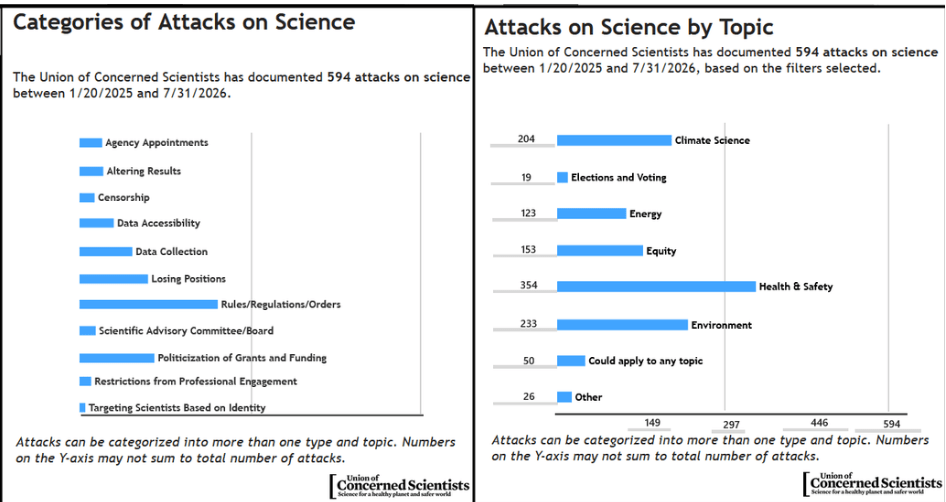
As of August 1, 2026, the second Trump administration has carried out 594 attacks on science since taking office. These attacks limit the ability of scientists—both within and outside the federal government—to carry out their research, communicate about it freely, and use the best available data and evidence to inform decisions that affect us all.
While the Union of Concerned Scientists (UCS) has been documenting and publicizing such attacks for more than 20 years, the pace, scale, and scope of attacks since January 2025 has been dizzying, and incredibly damaging to our safety, health, and environment. (For context, UCS recorded 207 attacks during the entire first Trump administration, 96 during the two terms of George W. Bush, and 21 during the Obama and Biden administrations combined.)
With the Trump administration unleashing an average of more than 30 attacks each month, UCS needed a more robust and effective system for keeping track of them. Dr. Jules Barbati-Dajches, an analyst with the Center for Science and Democracy at UCS, took the lead on a new multipurpose tool that not only tracks attacks on science, but offers anyone who wants to use it the data they need to fight back.
What is the new Attacks on Science Tracker? How can people use it?
Jules Barbati-Dajches: The Attacks on Science Tracker is an interactive analytical platform that presents data on such attacks, along with potential scientific integrity violations, all in one place. It has a lot of different uses and interactive features that allows users from any area, any expertise, any interest level—basically, any person who cares about science—to narrow in on the data that they are interested in, with visualizations.
What’s really cool about it is that users can look at attacks in isolation, or explore patterns, or how different variables intersect with one another, just in the tool alone. People can use this data and connect it to other sources for any type of purpose that they would want—I think of it as a “choose your own adventure” kind of resource. For scientists and researchers, there are endless possibilities for creating custom research products. And it can also be used just for curiosity’s sake, or if someone’s interested in becoming more involved in science advocacy.
For example, if someone wants to write a letter to the editor, or author an op-ed on a topic that they’re particularly passionate about, then the Tracker can be used to help inform the content. In a UCS webinar last month, I walked audience members through an example of how they can use the Tracker to help develop talking points for in-district meetings with their members of Congress. Our team wanted to create something that can be used for many different purposes, by people with different levels of expertise and familiarity with scientific policies.
What rises to the level of an attack on science to be included in the tool?
Jules Barbati-Dajches: Attacks on science, in general terms, are instances of political interference in the federal government. Our Attacks on Science Tracker categorizes 11 different types of attacks and seven attack topics—e.g., climate science—to contextualize how this is happening and why it matters. Anyone who’s curious about how we arrived at these classifications can review our methodology.
How does the Attacks on Science Tracker differ from previous UCS efforts to record and monitor attacks on science under different presidential administrations?
Jules Barbati-Dajches: The Tracker is the front-facing product component of it that everyone sees. But the methodology behind that—how the data is collected, screened, analyzed, organized to feed into it—has been updated. The new methodology is based on over two decades of UCS research and advocacy documenting attacks on science. Now, scripts automate the collection and organization of news coverage of attacks on science, and our team analyzes the data to identify and categorize attacks. This will allow us to document and record these attacks much more efficiently and consistently, and in perpetuity.
Why is it so important to document these attacks on science?
Jules Barbati-Dajches: Documenting is just one part of this work, and it’s important for folks who are interested in pursuing litigation, or in helping to connect the dots between different attacks on science and impacts that we see down the line. There’s a whole host of uses for people who want that record.
But the Tracker also presents an opportunity to think forward: to have a clear sense of what has been attacked and dismantled, and what can be reimagined or rebuilt, to be able to better serve the public and keep people safe.
In my view, it also highlights the need to protect the role of scientific integrity in government decisionmaking. The Tracker suggests how potential scientific integrity violations could be prevented by implementing protections like those in the Scientific Integrity Act. This bill, which has some bipartisan support, is currently being debated in the House and Senate. It would reinforce federal science against political interference in all scientific agencies. It would be more consistent than agency-specific policies, and would also be more resistant to changes coming from executive orders.
Our team has presented the Tracker to members of Congress who have signed on to the Scientific Integrity Act, and members who are interested in signing on. It’s pretty stark evidence to support these protections.
The Tracker has been live for about two months! How has it been received by the people now using it?
Jules Barbati-Dajches: Overall, there’s been a very positive reception. Our team has been getting good feedback on how useful it’s been for different purposes—from supporters, from our colleagues at UCS, and from partner organizations. I’ve been presenting the Tracker to different partners to learn how they’re interested in using the tool and how they can plug it into their own work, and they’ve been sharing different use cases of the tracker in response.
Did anything surprise you or stand out to you as you worked on the Tracker? What are you hoping people will take away from it?
Jules Barbati-Dajches: For me, what stood out the most about what we’ve recorded in the Tracker is the frequency of attacks on health and safety. That means the physical, mental, emotional, or social health and safety of people, groups, and communities. So many of these attacks are negatively impacting our safety and well-being.
And as a takeaway: People should know that we created this tool for anyone who cares about science. I hope that people feel like they can use it for whatever purpose will serve them best, and whatever will help them advocate for scientific protections and evidence-informed policy.


