
High-tech shrimp farmer Atarraya is working with a partner in the United Arab Emirates (UAE) to pilot its production system there, which, if successful, could lead to a large-scale deployment as food security moves up the agenda in the MENA (Middle East and North Africa) region.
The move reflects the evolution of the company’s business model toward an asset-light approach, scaling through partnerships with “master franchisors” in key regions or countries.
While it is still producing shrimp in Mexico, its company-owned facility in Indianapolis has closed, and the New Jersey operation will become a processing hub and R&D/demo facility to showcase Atarraya’s capabilities to potential partners.
As part of the new strategy, it is also exploring co-location opportunities with tomato growers in greenhouses that require similar conditions to shrimp and can use microbial biomass produced by its systems as organic fertilizer, founder Daniel Russek tells AgFunderNews.
The UAE pilot
The UAE talks started more than two years ago, says Russek, who is working with Silal, a company established by ADQ (Abu Dhabi Developmental Holding Company) to strengthen food security by diversifying food sources.
“They originally reached out to us when we had the first shrimp box model [since replaced by a lower-cost, IKEA-style flat-packed ‘air shrimp box’ that’s easier to ship], and at that time the economics didn’t work for them.”
“But they reached back out once we announced the new version and we started with very deep due diligence last February. They visited our farm, hired a company specializing in due diligence for aquaculture projects and went through three years’ worth of data from farms to form technical assumptions to build a financial model for an expansion into the UAE.”
The next step is a pilot to test whether the technology can be adapted to desert conditions and, if so, how quickly it could scale to reach at least 5% of UAE demand, he says, noting that the country imports most of its shrimp but has recently begun experimenting with land-based domestic production.
“The UAE has one of the highest per capita demands for shrimp, and they are not going to bet 100% on one company. They want to jumpstart the whole industry. And while most protein staples have low margins, shrimp farming is high margin. They also have very low energy costs.”
The evolving strategy
What has become clear over time, says Russek, is that the venture capital model is not well suited to a business model whereby Atarraya would own and operate its own facilities.
“We’ve got to the stage where we’ve de-risked the technology and checked the boxes on stabilizing the biology, predictability, feed conversion ratios, and productivity per hectare. We also decreased the capex significantly and got offtake agreements.
“But we need funding to scale up to reach profitability, and I think we can confidently say the tech VC match doesn’t work well for food; it’s like fitting a square peg into a round hole. We have software but we are not just a SaaS company. You can’t build a shrimp farm on ChatGPT. Aquaculture operates in biological times, not software timelines.”
Over time it became clear that he “needed to realign the ownership and capital structure to support long term realities,” explains Russek.
“We reduced burn, reduced our capital requirements by 70% [with the new ‘air shrimp’ boxes – see below], increased the cash discipline, and I got majority control of the company, which makes it much easier for me to do this strategic realignment.”
Asset-light partnership model
Moving forward, he says, “It’s all about scaling with discipline and structured partnerships. We’re keeping the talent that we know will move the needle, people we know can go and execute our farms anywhere in the world. And we’re building partnerships for people that are not looking for software returns, they’re looking for food returns, and we have a lot to offer to them.”
He adds: “We’re in conversations with a couple of groups in the Midwest that have different kinds of interests, some of them in ag. And for them, the ROI for a shrimp farm is very good. It matches very well their investment thesis. And the great thing is that we already have customers; we’re offering them a market that we have already developed.”
The first farm for 100 or 200 shrimp boxes would have enough customers to reach profitability, he claims. “We have already de-risked the technology and we will support our partners. If you buy a farm from us, for two seasons, for two cycles, we will be responsible for achieving the KPIs. And then we will do the handoff.”
Shrimp + tomatoes…
As Atarraya explores scaling models and partnerships it is looking closely at co-location opportunities with tomato growers in greenhouses, says Russek.
“We are focusing on the most affluent metro areas in the world, and we have an interesting value proposition for tomato producers close to these cities.
“A key question is where do you host your tanks? We looked at poultry barns, warehouses, different structures, and then at tomato greenhouses, which most countries now have. Shrimp and tomatoes basically need the same conditions, about 26-28 ⁰C. If you put some shrimp tanks in your tomato greenhouse, you could get significantly higher profitability per hectare, and the building, permits, water, energy, and so on is already there.”
And there is also the added bonus of being able to use biofloc [microbial biomass] from the shrimp farms as fertilizer, he adds. “We got a grant from the Rockefeller Foundation in 2024 to see if our biofloc could be a more effective fertilizer than the commercial fertilizer and the answer was a resounding yes for tomatoes and corn, and that’s a valuable position to tomato producers.
“If they switch a portion of their greenhouse production to shrimp, they can also save money on fertilizer.”
The tech: high-tech shrimp farming in low-cost vessels
Russek has spent his career developing an alternative to coastal shrimp farming, which comes with a laundry list of problems from slave labor and the destruction of mangrove forests and wetlands to the pollution of waterways with organic waste, chemicals and antibiotics. It is also vulnerable to disease and extreme weather.
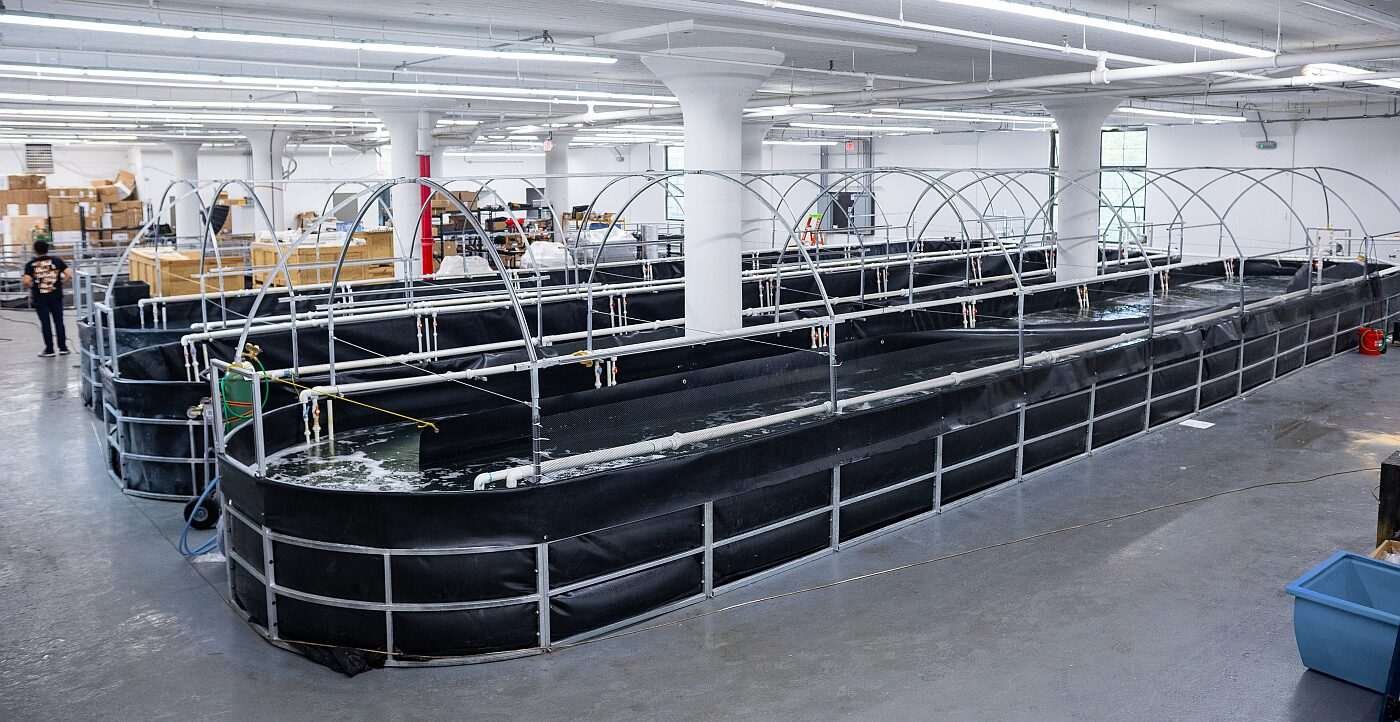
Atarraya, which originally raised its shrimp in rigid blue vessels that look like shipping containers, recently introduced a lighter, cheaper, IKEA-style flat-packed “air shrimp” container that slashes capex costs by 70% per ton and is far easier to ship.
The new tanks, which are 19 meters long, combine steel frames and fiberglass and plastic, and can be shipped far more easily than the original tanks.
The vessels deploy a biofloc, cultivating a microbial community that helps manage water quality and the nitrogen cycle. Microbes assimilate nitrogen into biomass, while nitrifying bacteria convert ammonia/nitrite into less toxic forms.
This is then assimilated into microbial biomass that is removed and used as organic fertilizer. Air pumps are used to ensure the tank maintains adequate levels of dissolved oxygen.
“In the tanks we populate this microbial community that includes bacteria, algae, and protozoa,” explains Russek.
While the contents of Atarraya’s tanks can look rather murky and lagoon-like, you don’t need to see all the shrimp to determine how they are doing, he points out. “We can determine that by monitoring what’s happening in the tanks [pH, salinity, oxygen levels, alkalinity, temperature, ammonia, nitrites, nitrates]. We also have a way to estimate biomass in the tank, and after many years, we have developed a pretty predictable system.”
One key advantage of Atarraya’s system is that it doesn’t need highly skilled labor, can be set up much more quickly than recirculating aquaculture (RAS) systems, and comes with proprietary software that automatically defines tasks for employees, guides decision-making, and forecasts production, he says.
Further reading:
MENA signals point to a global innovation powerhouse agrifoodtech is waiting for
Breaking: Vivici and The Every Co explore 4m-liter alt protein facility in UAE
The post Atarraya looks to bring high-tech shrimp farming to UAE, evolves business model appeared first on AgFunderNews.


