

A 2025 Geotab analysis of more than 22,700 electric vehicles put average battery capacity loss at 2.3% a year. That leaves a typical pack holding 81.6% of its original capacity after eight years on the road.
Battery replacement is still the expense people brace for when they price out an EV. A new pack can run $5,000 to $16,000 out of warranty. Cooling systems, battery management software, and pack sizes have all changed since the first mass-market electric cars went on sale, and the average EV battery lifespan has moved with them.
So how long do EV batteries last? Longer than the warranty covers, according to field data. Here’s a look at the numbers, what wears them down, and what you can do to slow it.
Key takeaway: The Department of Energy puts electric vehicle battery lifespan at 12 to 15 years in moderate climates. Manufacturers cover the pack for at least eight years or 100,000 miles, and fewer than 4% of the 30,000 electric cars in Recurrent’s database have ever had one replaced.
What Is the Average EV Battery Lifespan?
Average Lifespan in Years
The Department of Energy estimates the average EV battery lifespan at 12 to 15 years in moderate climates and 8 to 12 years in severe ones. Climate is the difference between those two ranges.
Geotab’s 2025 study showed that vehicles that rarely fast-charged — DC fast charging under 12% of their sessions — finished at 88% after eight years. Vehicles that leaned on high-power DC fast charging finished at 76%. Geotab concludes that modern packs are built to outlast the vehicle’s service life, which puts the better performers beyond the Department of Energy’s range.
Average Lifespan in Miles
Almost every EV carries a battery warranty of at least 100,000 miles, so that number works as a floor rather than a ceiling. How far past it a pack goes is harder to answer, because most EVs on the road are too new to have driven that far.
Recurrent reported in November 2025 that fewer than 4% of the electric cars in its 30,000-vehicle database have had a battery replaced, including vehicles more than 10 years old.
EV Batteries Don’t Usually “Fail”
Mechanical failure and capacity fade are different problems. A gas engine can throw a rod and strand you on the shoulder in a single moment. A battery pack loses a percent or two of capacity a year, and the owner sees it as shorter range rather than a breakdown. The industry calls that slow decline degradation.
First-generation EVs have needed replacement batteries at about 8.5%. Cars built in 2022 and later sit at 0.3%.

Join us – we've been at this for more than 20 years, so you're in good hands.
How EV Batteries Work
Lithium-Ion Battery Technology
The cells in an EV pack use the same lithium-ion chemistry as the batteries in phones and laptops. What sits around them is different: a liquid cooling loop, a heater, and a battery management system that throttles charging when cell voltage or temperature drifts out of range.
Battery Capacity Explained
Battery capacity is measured in kilowatt-hours, just like on your electric bill. For example, a 65-kWh battery stores 65 kilowatt-hours of energy. Most EVs travel about 3 miles per kWh, so a 65-kWh pack gives around 200 miles of range. A 300-mile range usually means a battery closer to 100 kWh.
Recurrent found that average pack sizes grew 167% between 2015 and 2024. A bigger pack can lose the same percentage and still cover a commute.
How Charging Cycles Affect Longevity
A charging cycle is one full pack’s worth of energy charged and discharged. It doesn’t have to happen at once, so five nights of topping up from 60% to 80% add up to one cycle.
Manufacturers design packs for thousands of cycles. At the 11,026 miles a year the average U.S. passenger car travels, a 300-mile EV works through fewer than 40 of them.
Related: About EV Batteries
What Causes EV Battery Degradation?
Natural Aging
Lithium-ion cells lose capacity over time and mileage. Side reactions inside the cell consume lithium whether the car is driven daily or parked for a year, which is why a low-mileage 2018 EV and a high-mileage one can show similar range loss.
High Temperatures
Owners have little control over heat. In Geotab’s data, vehicles operating in hot conditions lost capacity 0.4 percentage points a year faster than vehicles in mild climates. Thermal management is what keeps that penalty small.
Charging Habits
Three EV battery charging habits show up repeatedly in degradation research:
- Frequent DC fast charging above 100 kW
- Routinely charging the pack to 100%
- Draining the pack to near 0% before plugging in
Geotab measured the first habit directly. Cars that fast-charged often, with more than 40% of those sessions above 100 kW, lost 3.0% of capacity a year. Cars where fast charging was under 12% of sessions lost 1.5%. A middle group lost 2.2%.
Driving Conditions
Higher mileage and towing increase the number of battery cycles, while towing also raises battery temperature because the motor requires sustained power.
Interestingly, rapid acceleration may have a different effect. Research from the SLAC-Stanford Battery Center found that lithium-ion cells tested with real-world driving patterns—including bursts of acceleration—aged more slowly than those cycled with steady, uniform discharges. In their multi-year study, cells exposed to realistic driving profiles aged about one-third more slowly than those tested under constant laboratory conditions.
How Much Range Loss Should Owners Expect?
Battery Degradation Is Usually Gradual
Range loss arrives a percent or two at a time. That is slow enough that most owners notice it as a season-to-season change rather than an event. Geotab’s 2.3% annual average works out to roughly seven miles of range a year on a 300-mile car.
What 80% Battery Capacity Means
State of health is how EV battery health gets reported in warranty terms and battery-health apps, and it is a percentage of the pack’s original capacity. Take a car rated at 300 miles new. At 80% state of health, it shows about 240 miles on a full charge. The average American passenger car covers 11,026 miles a year, or roughly 212 miles a week.
Why Most Drivers Never Notice Major Changes
Most people drive short distances each day. The average is about 11,026 miles a year, or 30 miles a day. A 240-mile EV can go about eight days on one charge. Bigger batteries and better management mean that losing a few percent of capacity just means charging a bit more often, not shorter trips.
EV Battery Warranties Explained
Federal Warranty Requirements
EPA finalized a battery durability and warranty program for model year 2027 vehicles in March 2024. A final rule published Feb. 18, 2026, rescinded the greenhouse gas standards that program rested on.
The Common 8-Year / 100,000-Mile Standard
The Department of Energy’s Alternative Fuels Data Center notes that several EV manufacturers offer eight-year, 100,000-mile battery warranties. That has become the industry floor, and some automakers go further for the original owner. Terms vary by manufacturer and by state, so read the EV battery warranty section of the booklet before you sign.
What Battery Warranties Usually Cover
A battery warranty is written around three terms: manufacturing defects, premature capacity loss, and a capacity retention floor. The floor is the operative one. It is commonly set at 70% of original capacity, and a pack that measures below it inside the warranty period is repaired or replaced at the manufacturer’s cost.
Normal gradual degradation above the threshold isn’t a warranty claim. Neither is damage from a collision or from flooding.
Why Warranties Give Buyers Confidence
Eight years of coverage on the most expensive component in the car runs longer than the bumper-to-bumper warranty on most gas vehicles, which typically ends at three years or 36,000 miles. Manufacturers write those terms knowing what their own field data says about failure rates.
Your Satisfaction is Our Priority
We're confident you'll love your plan, but if not, call us, and we’ll help you find the perfect plan without any extra cost.*
How to Make Your EV Battery Last Longer
Avoid Frequent Fast Charging
DC fast charging makes road trips possible, and it’s also the single largest stressor Geotab identified. Using a fast charger on a road trip every few weeks is a different pattern from using one as your main source of electricity.
Learn more about EV charging stations.
Maintain Moderate Charge Levels
Tesla tells owners to keep the charge limit at 80% for daily use and to raise it to 100% only when necessary, such as before a long road trip. The setting lives in the charging screen and takes about 10 seconds to change.
Limit Deep Discharges
Tesla also advises against leaving a vehicle near 0% or 100% for days or weeks at a time, and recommends parking at roughly 50% if the car will sit for more than two weeks. Arriving home at 15% now and then does no real harm. The wear comes from making it the routine.
Protect Your Vehicle From Extreme Heat
Geotab’s 0.4% extra battery wear from heat is often due to parking, not just driving. Parking in direct sun on a hot day heats up the battery, but using a garage, carport, or shade helps. Preconditioning your plugged-in car uses wall power for cooling instead of draining the battery.
Follow Manufacturer Recommendations
The right limit depends on the battery chemistry. Tesla’s own guidance is that the touchscreen displays the recommended limit for the specific battery in the car. Over-the-air updates change battery management behavior on cars already sold, so the number on the screen can change without the owner touching it. Most manufacturers also ship a scheduled-charging setting, so the car reaches that limit at departure time rather than hours earlier.
Can EV Batteries Be Replaced?
Yes, Battery Replacement Is Possible
Recurrent’s survey of out-of-warranty EV battery replacement jobs runs $5,000 to $16,000. A 24-kWh Nissan Leaf pack came to $5,500 with labor. A 75-kWh Tesla Model 3 Long Range pack came to about $13,000 in 2023. That works out to $229 and $173 per kilowatt-hour installed.
Why Most Owners Never Need a Replacement
Recurrent put the replacement rate at 0.3% for model year 2022 and newer, compared with under 4% across every model year on the road. Recurrent’s assessment is that the batteries “are holding up better than expected and should outlast the cars themselves.”
Battery Costs Continue to Fall
Pack prices fell from more than $400 per kilowatt-hour to $111 by the end of 2024. Manufacturing scale, a larger EV market, cheaper chemistries, and competition among cell suppliers have all pushed the number down.
What Happens to EV Batteries After Their Automotive Life?
Second-Life Battery Storage
Most EV batteries are retired with as much as 70% to 80% of their original capacity remaining, according to the World Resources Institute. Utilities and building owners use retired packs for solar storage, backup power, and peak demand shaving.
Battery Recycling
According to the EPA, there are two main ways to recover materials from used batteries. Smelting burns the battery pack to recover cobalt and nickel, though extracting lithium from the remaining material requires additional processing.
Leaching uses a chemical solution to dissolve the cathode, making it possible to recover cobalt, nickel, lithium, and manganese. This method is cost-effective for commercial use. The United States is still developing collection facilities for these batteries. Retired packs may arrive at dealerships, repair shops, or auto dismantlers, depending on how the vehicle leaves service.
The Future of Battery Reuse
Second-life projects remain small compared with new battery installations. EPA describes reuse as something that could someday happen on a larger scale before packs get recycled. Reuse first and recycling second is what a circular battery economy looks like in practice.
EV Battery Lifespan vs. Gas Vehicle Longevity
Comparing Major Components
A gas powertrain includes an engine and a transmission, each with hundreds of moving parts and fluids that degrade on a service schedule. An EV powertrain carries a motor, a single-speed reduction gear, and the pack. A rebuilt transmission and a replacement battery land in the same price bracket.
Maintenance Differences
EVs skip oil changes, spark plugs, and timing belts. The Alternative Fuels Data Center gives three reasons: fewer fluids that need regular maintenance, far fewer moving parts than a combustion engine, and regenerative braking that significantly reduces brake wear.
The Department of Energy puts scheduled maintenance for a light-duty battery electric vehicle at 6.1 cents per mile, against 10.1 cents for a conventional gas vehicle.
Long-Term Ownership Considerations
At the 2025 U.S. average residential rate of 17.30 cents per kilowatt-hour, driving 11,026 miles in an EV that covers 3 miles per kilowatt-hour costs about $636 a year in electricity. The same 11,026 miles in a gas vehicle averaging 27.2 mpg, the model year 2024 figure, burns about 405 gallons, or roughly $1,650 at the $4.07 national average. The gap is about $1,000 a year. Warranty coverage also runs longer on the battery than on almost anything under a gas hood.
Does Home Charging Affect Battery Life?
Home Charging Is Typically Battery-Friendly
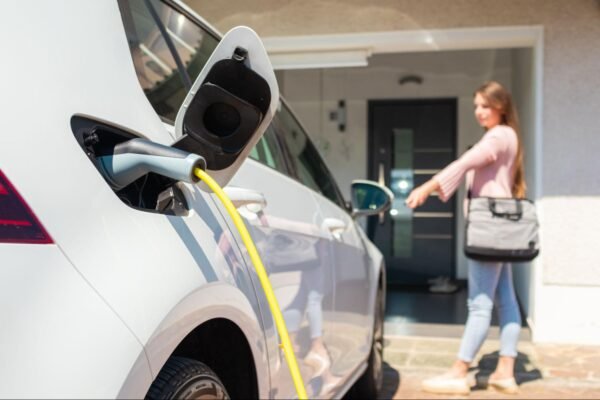
Home EV charging is slow, and the pack prefers slow charging. A 120-volt outlet adds about 5 miles of range per hour, and a 240-volt Level 2 charger adds about 25 miles per hour. A DC fast charger delivers 100 to 200 miles in 30 minutes. Geotab’s lowest-degradation group includes cars that rarely fast-charge, which is what home charging looks like in practice.
Smart Charging Features
A departure time set in the car or its app delays the charge until a few hours before the car leaves. The pack then spends most of the night at its starting level rather than at the limit, and on a time-of-use rate the electricity itself lands in the cheaper window.
Managing Charging Costs
A 65-kWh pack charged from 20% to 80% draws 39 kilowatt-hours. At 17.30 cents, the 2025 national residential average, that session bills at $6.75. It lands on the household meter rather than at a pump.
Do that twice a week and you’ve added about $700 a year to your electric bill. Knowing your rate, and whether it shifts by time of day, is what makes that number predictable.
Find an Energy Plan That Fits Your EV Charging Needs
Frequently Asked Questions
The Department of Energy estimates 12 to 15 years in moderate climates and 8 to 12 years in severe ones. Geotab measured an average annual capacity loss of 2.3% across 22,700 vehicles.
Electric car battery life usually outlasts ownership. Most owners sell the car before the battery becomes the limiting factor. Fewer than 4% of the 30,000-plus EVs Recurrent tracks have needed a replacement battery.
Warranties run to at least 100,000 miles. Beyond that, the record is thin, because about 75% of the electric cars on the road were sold in 2023 or later.
Most never do. Recurrent puts the rate at 0.3% for model year 2022 and newer, and under 4% across all model years.
Calendar aging, heat, frequent high-power DC fast charging, and sitting for long stretches at a very high or very low state of charge.
It accelerates wear rather than causing damage. Geotab measured 3.0% annual capacity loss in heavy fast-charging use, compared with 1.5% in cars that rarely fast-charge.
About 2.3% a year on average, which leaves a typical eight-year-old pack at 81.6% of its original capacity.
Yes. EPA describes smelting and leaching processes that recover cobalt, nickel, lithium, and manganese for new cells.
Yes. Most manufacturers cover the battery for at least eight years or 100,000 miles, including a capacity retention floor commonly set near 70%.
Manufacturers converge on four things: a daily charge limit near 80%, reserving DC fast charging for trips, shade or a garage in hot weather, and avoiding long stretches near 0%.
Energy That Moves With You
Moving homes? Take your services with you completely fee-free.*
Get More From Your EV Ownership Experience
Three measurements set the average EV battery lifespan: 2.3% average annual capacity loss across 22,700 vehicles, under 4% of 30,000 tracked cars ever needing a new pack, and warranties running at least eight years or 100,000 miles.
Charging at home is the cheapest and most convenient way to power an EV, and it’s also the gentlest on the battery. It does mean your car’s fuel now shows up on your electricity bill, so the rate you pay per kilowatt-hour becomes one of the larger EV ownership costs you can actually control.
Compare Electricity Plans from Just Energy.
Brought to you by justenergy.com
All images licensed from Adobe Stock.
The post Average EV Battery Lifespan: How Long Do Electric Vehicle Batteries Last? appeared first on Just Energy.


