

India, indeed, is having a solar moment. Electricity bills are booming, government subsidies are making rooftop systems more affordable than ever, and awareness about clean energy has reached neighborhoods smoothly. Installers are available in every city, and social media is full of posts like “I saved INR 3000 last month.”
On the surface, everything looks like progress. Whereas when you spend an hour on any Indian consumer forum, a different picture emerges.
“They promised installation in 30 days. It’s been 4 months. “I paid the advance. Now nobody picks the phone. The quote changed completely after I signed. “
The lack of transparency in the solar panel installation process, hidden clauses, communication gap after advance payment, and the unmet promises- all of these are not isolated incidents. They are patterns. The technology behind the solar panels is mature and largely reliable.
What isn’t reliable, it turns out, is the industry built around selling and installing them. The biggest problem in Indian rooftop solar right now is not technical. It is trust.
India’s Solar Industry is Growing Faster Than Ever
Rising Demand for Rooftop Solar
Electricity bills have crossed a threshold where rooftop solar now makes straightforward financial sense for millions of middle-class households. Add government subsidies, growing environmental consciousness, and a genuine desire for energy independence, and the demand picture becomes obvious. Homeowners who once rejected solar as “for factories” are now checking out quotations.
Why are more companies entering the solar market
Where demand goes, business follows. The rooftop solar installation market has taken everyone under its roof, be it well-capitalized startups or any small local operators running lean teams. Competition has pushed prices down, which benefits customers- in theory. In practice, the rush to win business at lower margins has created a different set of problems.
The problem with rapid industry growth
When an industry scales fast, quality control often becomes its first casualty. Sales teams grow before technical teams do. Companies take on more projects than they can execute well. Customer education gets skipped in the rush to close the deal. And because most homeowners are buying solar for the first time, there is no accumulated experience to protect them from aggressive or misleading sales practices.
The Hidden Problem Homeowners Discovered Too Late
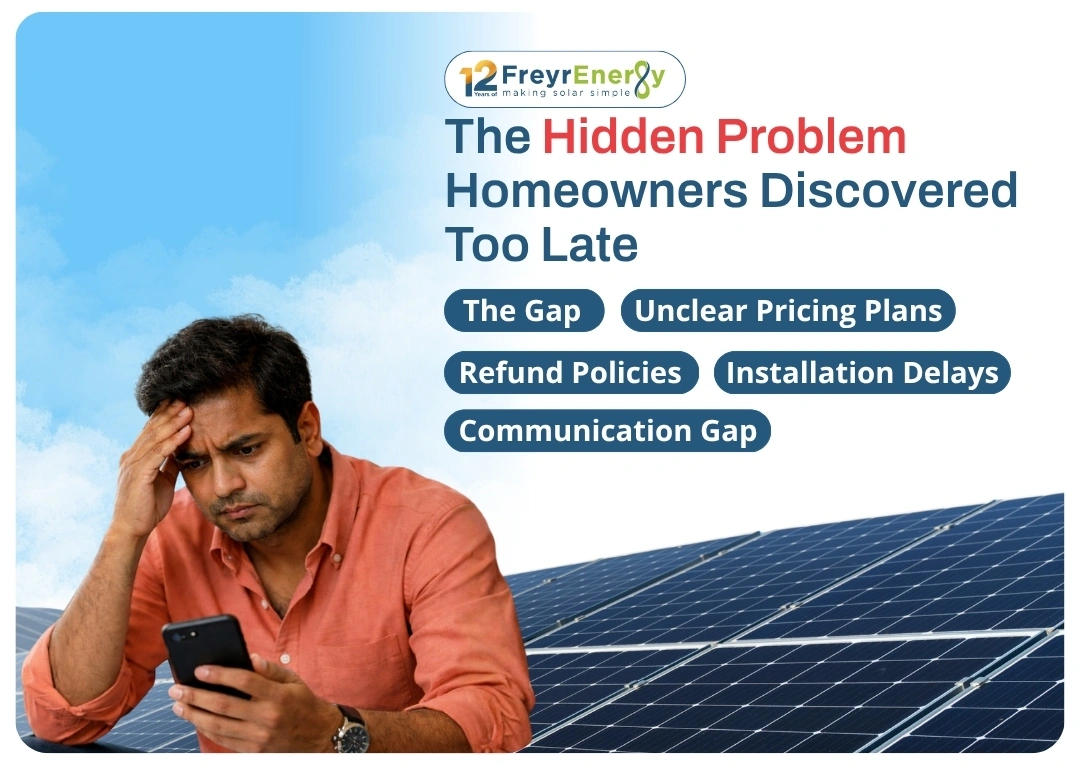
- The Gap: The sales consultation and the installation experience were significantly lacking. It felt like two entirely different companies dealing with each other. During the pitch, everything is possible- fast timelines, guaranteed savings, and simple approvals. Once the advance is paid, reality asserts itself.
- Unclear Pricing Plans: The initial quotation at the time of sales discovery looks clean. Then additions come- structural mounts, upgraded cable runs, documentation. All of which was never discussed during the sales conversation, because that was focused on converting, not informing.
- Refund Policies: Most customers do not ask about the solar panel refund policy or cancellation terms before paying. Most companies do not volunteer them. When a project goes sideways and the customer wants out, they discover the terms for the first time, and that too unfavorably.
- Communication Gap: Before payment, every salesperson interacts without any communication gap. After the payment, project updates become infrequent, answers to questions become vague, and the single point of contact becomes hard to reach.
- Installation Delays: Solar installation involves coordination across multiple stakeholders, including procurement, structural work, electrical connections, and DISCOM approvals for net metering. Each stage can slip, and companies ignore the need to explain this up front in the event of solar project delays.
Why does Solar call for more trust than any other resource?
Solar is an investment
The value you get from installing solar depends on how well it is designed for your specific roof, how it is installed, and how correctly it is commissioned.
Professional execution
Buying an appliance requires no technical assessment of your home, no engineering design, and no government approval process. Solar installation needs all these. Each stage introduces a dependency on the company you have picked. A company that executes well delivers a perfect outcome.
Clarity before commitment
The customer expects clarity before committing financially. Not just about price, but about the solar panel installation process, realistic timelines, and what happens when things do not go as planned. Expectations that are documented in writing before any money exchange should be executed.
Red Flags
Extremely low prices without proper explanation
A quote significantly lower than market rates suggests owners are being cut on equipment quality, or that additional charges will surface. Question the specifics, like which panel brand, which inverter, and what is excluded.
No proper site survey
A legitimate solar design requires a rooftop feasibility analysis, including shadow mapping, structural assessment, and load calculations. A company that skips this or rushes through a ten-minute check is just guessing about your system.
Verbal Commitments without written documentation
If a promise is not in writing, then it does not exist. A legitimate company will document equipment specifications, timeline, cost, and what happens if commitments are not met.
Pressure to make advance payments
High pressure around payment or statements like “this price is only valid today” are tactics, not business constraints. Standard practice is structured payment milestones tied to project progress.
No clear timeline
You can ask for a written project plan. If the company cannot produce one for you, that tells how serious they are about the installation. Also, the solar company reviews are not positive or are nil.
Questions to Ask Before Paying for Solar
About pricing
- What is included in the quote?
- Details about the hidden costs of solar panels
- Are there any additional charges related to structural, electrical, and approval-related?
- What are the payment milestones?
About System Quality
- Which panel and inverter brands are being used?
- What are the warranty terms, and who handles the warranty claims?
On Installation
- How long will the full solar installation process take?
- How long does a site survey for a grid connection take?
- Who handles DISCOM approvals and net metering paperwork?
On Support
- Who is the dedicated point of contact after payment?
- What is the process if I need service or have a complaint six months after installation?
On policies
- What is the solar panel refund policy if I need to cancel before installation begins?
- What happens if the timeline is missed?
What does a transparent solar process look like?
Step 1: Detailed consultation and energy assessment
Step 2: Proper site inspection
Step 3: Clear proposal and documentation
Step 4: Structured solar installation process
Step 5: Post-installation support
Freyr Energy Approach in Building Solar with Transparency and Accountability
At Freyr, transparency is not a marketing position; it is an operational foundation. Each project begins with a thorough site assessment, not a generic pitch. Proposals specify exactly what is included, which equipment brands are being used, and the payment milestone. During installation, the customer receives regular updates and has a dedicated point of contact.
Freyr does not compete on the lowest quote. The goal is a system that performs well for 25 years and a relationship in which customers know exactly who to call if it fails.
To Conclude
Solar technology is proven, and the government support is real. But which companies to trust will be determined not by the panels they sell, but by the trust they build. Homeowners who choose carefully will gain their savings, independence, and peace of mind. The ones who chase the lowest number on a quote may get something else entirely.


