
Climate change has received much global attention in recent years, but it is not an isolated problem. We cannot understand climate change without also understanding two co-occurring crises: Biodiversity loss and social inequity. These three crises are often discussed separately, but they represent a ‘polycrisis,’ meaning they share common causes (and solutions), and they interact in ways that worsen one another.
Einstein once said: “We cannot solve problems with the same kind of thinking that caused them”. This claim emphasizes the importance of investigating problems and their underlying driving factors, to inform new ways of thinking and effective solutions. Nowhere is this more true than in addressing our current polycrisis. This article puts forward a framework to describe the anatomy of the problem we face and enable reflections on how humanity can pursue genuine progress.
Anatomy of our polycrisis
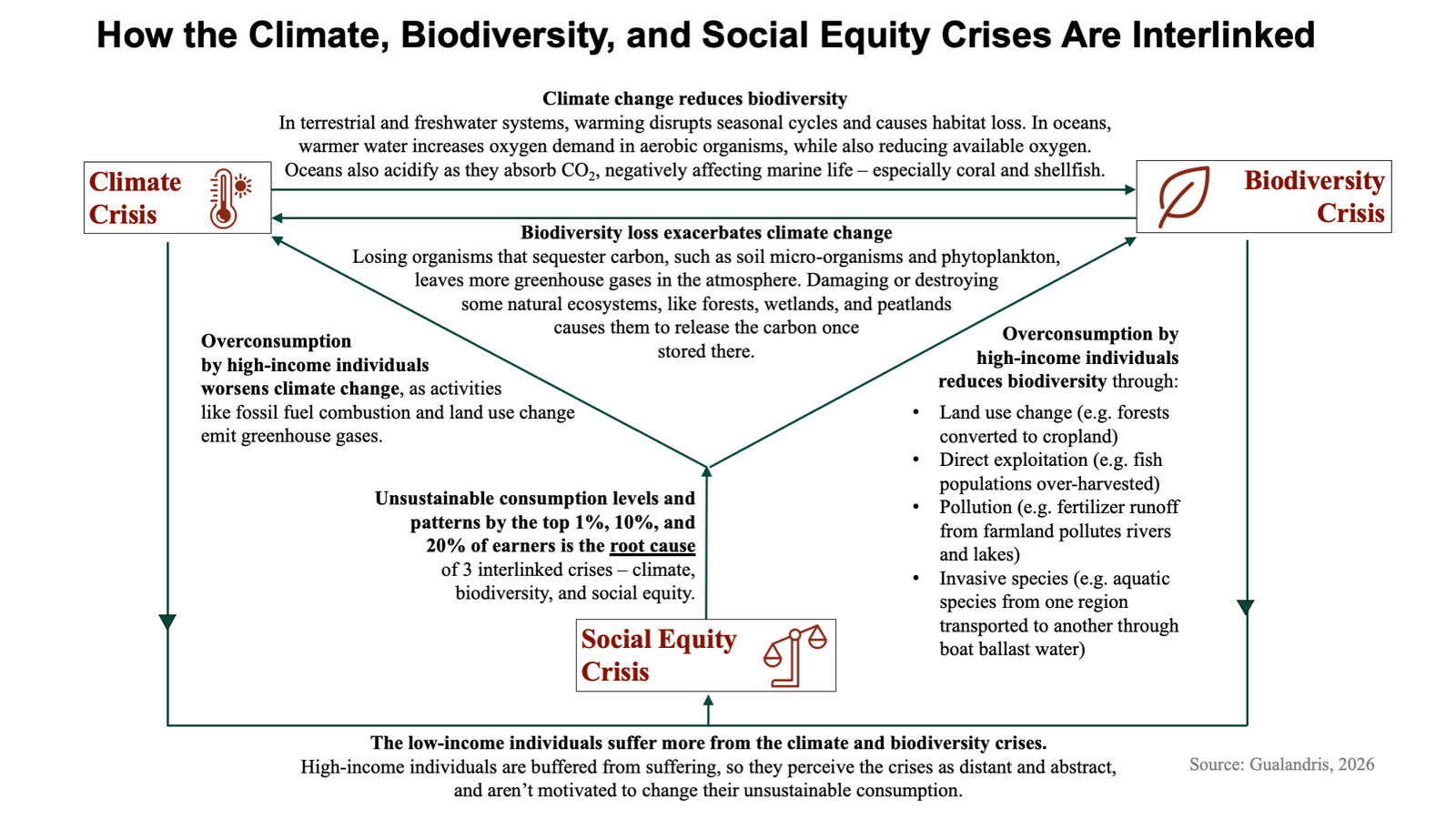
Social-ecological systems are affected by three mutually reinforcing crises concerning climate, biodiversity, and social equity. I unpack these crises and their reinforcing mechanisms in the following paragraphs.
Climate crisis
What is climate change?
When sunlight reaches the Earth, it is absorbed and then re-emitted as infrared radiation. Most of this radiation escapes back into space, but CO₂ and other greenhouse gases (GHGs) act like a blanket around the planet, trapping a portion of it. Since the Industrial Revolution, human consumption patterns – especially by high-income individuals – have been raising the level of CO2 in Earth’s atmosphere.
The key question is this: how significantly does atmospheric CO₂ concentration affect Earth’s temperature? Lorius et al. (1990) analyzed ice core data and estimated that doubling the atmospheric concentration of CO₂ would lead to an increase in global temperatures of approximately 2.2–2.4°C. This estimate was corroborated by Allen et al. (2009), who used ensemble simulations to predict temperature responses under a range of CO₂ emission pathways.
Mechanisms that cause global warming
Roughly half of this warming results directly from the insulating effect of CO₂, as calculated using the Stefan–Boltzmann equation. The remaining half arises from a multiplier effect, in which increasing CO₂ concentration induces secondary changes that further enhance warming. Those secondary changes are non-linear, and include (Scheffer et al., 2006; Nicholls et al., 2020; Hu et al., 2024; Gordon et al., 2017):
-
Warmer air, due to higher atmospheric CO₂ levels, can hold more water vapor—another greenhouse gas (GHG).
-
Rising temperatures accelerate the release of other GHGs from terrestrial systems: thawing permafrost allows decomposition of organic matter, releasing CO₂ and methane; warming wetlands emit more methane.
-
Increasing GHG concentrations cause changes in cloud cover and planetary albedo, which in turn reduce Earth’s ability to reflect solar radiation.
-
Warmer oceans support less phytoplankton, diminishing the ocean’s role as a natural carbon sink. (Notice here the reciprocal relationship between climate change and marine biodiversity; warming strains marine life, making oceans less able to mitigate warming.)
Dispelling climate myths
Yes, our greenhouse gas emissions are causing warming.
In paleoclimate records, we often observe a rise in temperature before a rise in atmospheric greenhouse gases, which some interpret to mean that warming increases GHGs, and that GHGs do not cause warming – but that is a misinterpretation. In historical warming events, it’s true that GHGs were not the initial trigger for warming; rather, global-scale disasters like volcanic eruptions, asteroid impacts, and increased solar irradiance caused an initial rise in Earth’s temperature. But soon, the initial warming activated the secondary mechanisms described above, triggering the release of GHGs, which in turn caused additional warming. Furthermore, in the most recent 150 years, is there is a unidirectional causality from GHG concentrations to anomalies in global mean surface temperature (Stips et al., 2016). Since approximately 1850, GHG emissions released by our industrial systems concentrate in the atmosphere, causing an increase in global temperatures.
Yes, climate models are reliable.
Climate models published over the past five decades have been consistently skillful in predicting observed changes in global mean surface temperatures based on changes in CO₂ concentration (Hausfather et al., 2020). Even the most conservative estimates suggest a moderate anthropogenic warming of approximately 2°C by 2050 (Scarletta, 2022). Both minimum and maximum global surface temperatures have been rising steadily for over 40 years (Vose et al., 2025), and recent analysis indicates that there has been faster warming over the last 10+ years than during any previous decade (Foster and Rahmstorf, 2026).
No, warming will not stop on its own
A common misconception is that CO₂ concentrations might reach a saturation point, beyond which additional emissions would have a negligible warming effect. However, this is not supported by theory or evidence; as CO₂ levels continue to rise, temperature will continue to rise (Pierrehumbert, 2011).
How will climate change affect human well-being?
What are the negative consequences of anthropogenic global warming? Based on empirical observations, Myhre et al. (2019) and Papalexiou and Montanari (2019) find that the frequency of heavy rainfall events doubles per degree of global warming: “it never rains but it pours” (Trenberth, 2011, p. 130), causing microbial contamination in runoff that impacts public health (Parker et al., 2010), severely damaging crops (Rosenzweig et al., 2002), triggering fatal landslides (e.g., Martelloni et al., 2012), and increasing infrastructure failure and damage risk (e.g., Nissen & Ulbrich, 2017).
Besides heavy rainfall, there is high confidence that more regions have been affected by increases in agricultural and ecological droughts under global warming, due to both shifts in rainfall patterns and increased evaporation and water consumption by plants (Dai, 2013; Chiang et al., 2021; Walker and van Loon, 2023). Moreover, recent studies show that while the frequency of tropical cyclones has decreased relative to pre-industrial times for natural reasons (Chand et al., 2022), anthropogenic GHG emissions are warming ocean surface waters, resulting in more intense cyclones across the globe (Klotzbach et al., 2022; Knutson et al., 2019; Zhang et al., 2023) and causing cyclones to intensify more quickly (Garner, 2023).
Over the past 485 million years, Earth’s average surface temperature has changed as rapidly as it has in the past decades only a handful of times (Judd et al., 2024). These past episodes triggered extinction events that eliminated most life on Earth. Today’s unprecedented, human-induced GHG emissions (including through land-use changes) are comparable in magnitude and effect.
Biodiversity crisis
The second crisis in this trifecta is that of rapid biodiversity loss. Here, I explore how much biodiversity loss we are seeing, what’s causing the decline, and how biodiversity loss connects to climate change.
What is the biodiversity crisis?
Biodiversity (or biological diversity) refers to the amount of variety that exists in Earth’s living things. Biodiversity can be measured on various scales, from genetic variability and species diversity, to ecosystem and phylogenetic diversity. The global Living Planet Index tracks the average change in the relative abundance of 32,821 populations, representing 5,230 species monitored since 1970 (WWF, 2022). The index shows an average global decline of 69% in the abundance of these populations over the past 50 years. Other studies detect anthropogenic biodiversity loss at local scales as well (Gonzalez et al., 2016).
Mechanisms that cause biodiversity loss
Based on a review of 45,162 studies, Jaureguiberry et al. (2022) find that biodiversity loss has different drivers across terrestrial, freshwater, and marine realms. In terrestrial ecosystems, the two dominant drivers of biodiversity loss over recent decades have been land-use change—primarily in the form of cropland expansion and intensified land management—and direct exploitation—mostly through logging, hunting, and wildlife trade. Pollution (Zhu et al., 2025) and invasive species (Cuthbert et al., 2021) are two other prominent drivers in terrestrial ecosystems. Biodiversity in freshwater systems is affected by the same stressors, but the relative impact of the stressors differs; land-use change remains the top threat, followed by pollution, and then direct exploitation. While these drivers remain significant in marine ecosystems, direct exploitation (i.e. overfishing) is the primary driver of biodiversity loss in oceans, with climate change ranked second.
How are biodiversity loss and climate change linked?
Biodiversity loss has many reciprocal connections with climate change. Oceans have been absorbing significant amounts of anthropogenic CO2 emissions, becoming more acidic in the process. Acidification negatively affects marine life – especially coral and shellfish. Warmer oceans also have major effects on the community composition of marine life by putting pressure on aerobic metabolisms; warmer water increases oxygen demand, while simultaneously reducing available oxygen. Warmer oceans also support less phytoplankton, diminishing the ocean’s role as a natural carbon sink. So, in a vicious cycle, climate change reduces the capacity of oceans to mitigate GhG emissions, a major driver of climate change.
In terrestrial systems, land use change accelerates both biodiversity loss and climate change. Carbon-sinking forests and wetlands become carbon-producing farmland and cities, all while less habitat is available for wildlife.
These linkages suggest that “nature-blind” strategies for mitigating climate change may result in habitat loss that directly harms biodiversity, net of any positive effect on climate change. For example, bioenergy with carbon capture and storage (BECCS) does reduce CO2 emissions. Crops are grown to produce biofuel, sequestering atmospheric CO2 as they grow. When the crops are converted to heat, electricity, or biofuel, some of the CO2 is sequestered and stored underground, resulting in a net decrease in atmospheric CO2. However, this process also requires more farmland, resulting in deforestation and, in turn, biodiversity loss. More biodiversity is damaged through land-use change and intensification than the biodiversity that is protected indirectly through improvements in climate change mitigation (e.g., Hof et al., 2018).
By contrast, Nature-based Solutions (NbS), such as large-scale restoration of natural forests and coastal wetlands or agroecology, not only help mitigate climate change but also offer additional benefits to biodiversity and human well-being (e.g., Seddon et al., 2018).
Social equity crisis
What is social equity?
Social equity has been defined as ensuring fairness and justice for all members of society, with a focus on providing targeted support to marginalized or systematically disadvantaged groups (Guy and McCandless, 2012). This is deeply relevant to the climate change and biodiversity crises, which are caused mostly by high-income individuals, who also suffer the least as a result of the crises.
How is social equity linked to climate change and biodiversity loss?
Social equity is undermined when those who contribute the least to climate change and biodiversity loss are the most affected by their consequences. As Morell and Dahlman (2022, p. 616) put it, “Rather than humanity in general, the Anthropocene is ‘elite-driven’ (Lewis and Maslin, 2015: 177), fuelled by consumerism and a socio-economic system dominated by markets, large multinational corporations, and state-owned enterprises (Wright et al., 2018). As such, the term ‘Anthropocene’ glosses over important inequalities, as well as spatial and temporal differences between human causes and socio-ecological effects (Banerjee and Arjaliès, 2021).”
On average, across the globe, high-income individuals contribute the most to climate change and biodiversity loss, even if they do not perceive themselves to be doing so (Köchling et al., 2025). Chancel (2022) provides evidence suggesting that the top 1% of earners worldwide are responsible for a share of GHGs emission about 1.5 times greater than that of the global bottom 50%. Since 2019, 63% of global inequality in individual emissions has been due to differences between low and high emitters within countries. Similar patterns are observed when considering pressure on biodiversity: depending on the metric, 31–67% and 51–91% of responsibility for environmental degradation can be attributed to the global top 10% and top 20% of earners, respectively (Tian et al., 2024). If the global top 20% adopted the most environmentally friendly consumption patterns within their income quintile, environmental degradation could be reduced by 25–53%.
Despite being the cause of the climate and biodiversity crises, high-income individuals are also least affected by the consequences. For example, Smiley et al. (2022) provide compelling evidence of social inequalities in the impacts of climate change-related extreme weather. During Hurricane Harvey in Texas (2017), 30–50% of flooded properties would not have flooded without climate change. These climate change-attributed impacts were disproportionately felt in neighborhoods inhabited by racial-ethnic minorities, particularly low-income groups located outside the 100-year floodplain. Similarly, Tessum et al. (2021) found that racial-ethnic minorities in the U.S. are exposed to disproportionately high levels of pollution.
Without solving for inequity, we won’t solve the climate or biodiversity crises
This distance between those who are causing the crises, and those who most strongly experience the harm, is a barrier to advancing solutions. Construal theory—a social psychology framework that describes how people think about psychologically distant events and groups— proposes that distance in terms of time, space, or social class between where an action is taken and where its consequences manifest shapes how we mentally represent problems and act on them. High income individuals perceive the negative events caused by climate change and biodiversity loss as distant and abstract, because the effects are felt by lower-income individuals, in other neighbourhoods and countries, and in the future. As a result, they do not feel motivated to change their individual behavior. A similar phenomenon has been observed among firms, which struggle to collaborate on large-scale issues such as the reduction of GHGs emission (Bowen et al., 2018).
High-income individuals also exhibit lower levels of prosocial behavior—behavior that benefits others in their community. While individuals with low socioeconomic status have fewer resources and face higher exposure to economic hardship, they often engage in greater prosocial behaviour. Piff et al. (2010) found that low-income individuals tend to orient toward the welfare of others as a coping mechanism for navigating their hostile societal environment. In contrast, high-income individuals—particularly in contexts of high economic inequality—tend to develop a sense of entitlement and view the distribution of resources as fair (Coté et al., 2015). Wealth brings about a self-sufficient orientation in which individuals prefer independence from both obligations and dependents (Vohs et al., 2006).
Closing Thoughts
We can’t solve today’s problems with the same thinking that created them.
In other words, we cannot effectively address the interlinked climate, biodiversity, and social equity crises without questioning their underlying consumption and production patterns.
We need stronger morals that, in turn, drive bottom up, effective local actions and overarching public policies.
Mounting evidence suggests that this transformational journey toward more responsible, balanced production and consumption can generate genuine progress, capable of reconciling economic, social, and ecological outcomes for all.
References
-
Allen, M. R., Frame, D. J., Huntingford, C., Jones, C. D., Lowe, J. A., Meinshausen, M., & Meinshausen, N. (2009). Warming caused by cumulative carbon emissions towards the trillionth tonne. Nature, 458(7242), 1163-1166.
-
Banerjee SB, Arjaliès DL (2021) Celebrating the end of enlightenment: Organization theory in the age of the Anthropocene and Gaia (and why neither is the solution to our ecological crisis). Organization Theory [Online] 2(4).
-
Bowen, F. E., Bansal, P., & Slawinski, N. (2018). Scale matters: The scale of environmental issues in corporate collective actions. Strategic Management Journal, 39(5), 1411-1436.
-
Chancel, L. (2022). Global carbon inequality over 1990–2019. Nature Sustainability, 5(11), 931-938.
-
Chancel, L., Mohren, C., Odersky, M., Piketty, T., Somanchi, A., (2026) Prosperity within limits? Planetary habitability, global convergence, and structural transformation 2026-2010. World Inequality Lab. Available at: https://wid.world/document/prosperity-within-limits-planetary-habitability-global-convergence-and-structural-transformation-2026-2100-world-inequality-lab-working-paper-2026-03/
-
Chand, S. S., Walsh, K. J., Camargo, S. J., Kossin, J. P., Tory, K. J., Wehner, M. F., Chan, J.C.L., Klotzbach, P.J., Dowdy, A.J., Bell, S.S., Ramsay, H.A., & Murakami, H. (2022). Declining tropical cyclone frequency under global warming. Nature Climate Change, 12(7), 655-661.
-
Chiang, Felicia, Omid Mazdiyasni, and Amir AghaKouchak. 2021. “Evidence of Anthropogenic Impacts on Global Drought Frequency, Duration, and Intensity.” Nature Communications 12(1). https://doi.org/10.1038/s41467-021-22314-w
-
Côté, S., House, J., & Willer, R. (2015). High economic inequality leads higher-income individuals to be less generous. Proceedings of the National Academy of Sciences, 112(52), 15838-15843.
-
Cuthbert, R. N., Bartlett, A. C., Turbelin, A. J., Haubrock, P. J., Diagne, C., Pattison, Z., … & Catford, J. A. (2021). Economic costs of biological invasions in the United Kingdom. NeoBiota, 67, 299-328.
-
Dai, A. (2013). Increasing drought under global warming in observations and models. Nature climate change, 3(1), 52-58.
-
Foster, G., & Rahmstorf, S. (2026). Global warming has accelerated significantly. Geophysical Research Letters, 53(5), e2025GL118804.
-
Garner, A. J. (2023). Observed increases in North Atlantic tropical cyclone peak intensification rates. Scientific Reports, 13(1). https://doi.org/10.1038/s41598-023-42669-y
-
Gonzalez, A., Cardinale, B. J., Allington, G. R., Byrnes, J., Arthur Endsley, K., Brown, D. G., … & Loreau, M. (2016). Estimating local biodiversity change: a critique of papers claiming no net loss of local diversity. Ecology, 97(8), 1949-1960.
-
Gordon, H., Kirkby, J., Baltensperger, U., Bianchi, F., Breitenlechner, M., Curtius, J., … & Carslaw, K. S. (2017). Causes and importance of new particle formation in the present‐day and preindustrial atmospheres. Journal of Geophysical Research: Atmospheres, 122(16), 8739-8760.
-
Gualandris, J., (2025). Eco-Effectivenes: Canada’s path to genuine sustainable growth. Available here: https://thefutureeconomy.ca/op-eds/eco-effectiveness-canadas-path-to-genuine-sustainable-growth/
-
Guy, M. E., & McCandless, S. A. (2012). Social equity: Its legacy, its promise. Public Administration Review, 72(s1), S5-S13.
-
Hausfather, Z., Drake, H. F., Abbott, T., & Schmidt, G. A. (2020). Evaluating the performance of past climate model projections. Geophysical Research Letters, 47(1), e2019GL085378.
-
Hof, C., Voskamp, A., Biber, M. F., Böhning-Gaese, K., Engelhardt, E. K., Niamir, A., … & Hickler, T. (2018). Bioenergy cropland expansion may offset positive effects of climate change mitigation for global vertebrate diversity. Proceedings of the National Academy of Sciences, 115(52), 13294-13299.
-
Hu, H., Chen, J., Zhou, F., Nie, M., Hou, D., Liu, H., … & Liang, Y. (2024). Relative increases in CH4 and CO2 emissions from wetlands under global warming dependent on soil carbon substrates. Nature Geoscience, 17(1), 26-31.
-
Jaureguiberry, P., Titeux, N., Wiemers, M., Bowler, D. E., Coscieme, L., Golden, A. S., … & Purvis, A. (2022). The direct drivers of recent global anthropogenic biodiversity loss. Science advances, 8(45), eabm9982.
-
Judd, E. J., Tierney, J. E., Lunt, D. J., Montañez, I. P., Huber, B. T., Wing, S. L., & Valdes, P. J. (2024). A 485-million-year history of Earth’s surface temperature. Science, 385(6715), eadk3705.
-
Klotzbach, P. J., Wood, K. M., Schreck, C. J., Bowen, S. G., Patricola, C. M., & Bell, M. M. (2022). Trends in global Tropical Cyclone activity: 1990–2021. Geophysical Research Letters, 49(6). https://doi.org/10.1029/2021gl095774
-
Knutson, T., Camargo, S. J., Chan, J. C. L., Emanuel, K., Ho, C., Kossin, J., Mohapatra, M., Satoh, M., Sugi, M., Walsh, K., & Wu, L. (2019). Tropical Cyclones and Climate Change Assessment: Part I: Detection and Attribution. Bulletin of the American Meteorological Society, 100(10), 1987–2007. https://doi.org/10.1175/bams-d-18-0189.1
-
Köchling, J., Koller, J. E., Straßheim, J., Rehm, Y., Chancel, L., Diehl, C., … & Renner, B. (2025). The carbon perception gap in actual and ideal carbon footprints across wealth groups. Nature Communications, 16(1), 6180.
-
Lewis SL, Maslin MA (2015) Defining the Anthropocene. Nature 519(7542): 171–180.
-
Lorius, C., Jouzel, J., Raynaud, D., Hansen, J., & Treut, H. L. (1990). The ice-core record: climate sensitivity and future greenhouse warming. Nature, 347(6289), 139-145.
-
Martelloni, G., Segoni, S., Fanti, R., & Catani, F. (2012). Rainfall thresholds for the forecasting of landslide occurrence at regional scale. Landslides, 9(4), 485–495. https://doi.org/10.1007/s10346-011-0308-2
-
Meadow, 2001. Thinking in Systems: A primer. Sustainability Institute. Available here: https://wtf.tw/ref/meadows.pdf
-
Myhre, G., Alterskjær, K., Stjern, C. W., Hodnebrog, Ø., Marelle, L., Samset, B. H., … & Stohl, A. (2019). Frequency of extreme precipitation increases extensively with event rareness under global warming. Scientific reports, 9(1), 16063.
-
Morrell, K., & Dahlmann, F. (2023). Aristotle in the Anthropocene: The comparative benefits of Aristotelian virtue ethics over Utilitarianism and deontology. The Anthropocene Review, 10(3), 615-635.
-
Nicholls, Z. R. J., Gieseke, R., Lewis, J., Nauels, A., & Meinshausen, M. (2020). Implications of non-linearities between cumulative CO2 emissions and CO2-induced warming for assessing the remaining carbon budget. Environmental Research Letters, 15(7), 074017. https://doi.org/10.1088/1748-9326/ab83af
-
Nissen, K. M., & Ulbrich, U. (2017). Increasing frequencies and changing characteristics of heavy precipitation events threatening infrastructure in Europe under climate change. Natural Hazards and Earth System Sciences, 17(7), 1177–1190. https://doi.org/10.5194/nhess-17-1177-2017
-
Papalexiou, S. M., & Montanari, A. (2019). Global and regional increase of precipitation extremes under global warming. Water Resources Research, 55(6), 4901-4914.
-
Parker, J. K., McIntyre, D., & Noble, R. T. (2010). Characterizing fecal contamination in stormwater runoff in coastal North Carolina, USA. Water Research, 44(14), 4186–4194. https://doi.org/10.1016/j.watres.2010.05.018
-
Pierrehumbert, R. T. (2011). Infrared radiation and planetary temperature. Physics Today, 64(1), 33-38.
-
Piff, P. K., Kraus, M. W., Côté, S., Cheng, B. H., & Keltner, D. (2010). Having less, giving more: the influence of social class on prosocial behavior. Journal of personality and social psychology, 99(5), 771.
-
Rosenzweig, C., Tubiello, F. N., Goldberg, R., Mills, E., & Bloomfield, J. (2002). Increased crop damage in the US from excess precipitation under climate change. Global Environmental Change, 12(3), 197–202. https://doi.org/10.1016/S0959-3780(02)00008-0
-
Scafetta, N. (2022). Advanced testing of low, medium, and high ECS CMIP6 GCM simulations versus ERA5‐T2m. Geophysical Research Letters, 49(6), e2022GL097716.
-
Scheffer, M., Brovkin, V., & Cox, P.M. (2006). Positive feedback between global warming and atmospheric CO2 concentration inferred from past climate change. Geophysical Research Letters, 33. https://doi.org/10.1029/2005GL025044
-
Seddon, A.N., Smith, P. Smith, I. Key, A. Chausson, C. Girardin, J. House, S. Srivastava,B. Turner, Getting the message right on nature-based solutions to climate change. Glob.Chang. Biol. 27, 1518–1546 (2021)
-
Smiley, K. T., Noy, I., Wehner, M. F., Frame, D., Sampson, C. C., & Wing, O. E. (2022). Social inequalities in climate change-attributed impacts of Hurricane Harvey. Nature communications, 13(1), 3418.
-
Stips, A., Macias, D., Coughlan, C., Garcia-Gorriz, E., & Liang, X. S. (2016). On the causal structure between CO2 and global temperature. Scientific reports, 6(1), 21691.
-
Tessum, C. W., Paolella, D. A., Chambliss, S. E., Apte, J. S., Hill, J. D., & Marshall, J. D. (2021). PM2. 5 polluters disproportionately and systemically affect people of color in the United States. Science advances, 7(18), eabf4491.
-
Tian, P., Zhong, H., Chen, X., Feng, K., Sun, L., Zhang, N., … & Hubacek, K. (2024). Keeping the global consumption within the planetary boundaries. Nature, 635(8039), 625-630.
-
Trenberth, K. E. (2011). Changes in precipitation with climate change. Climate research, 47(1/2), 123-138.
-
Vohs, K. D., Mead, N. L., & Goode, M. R. (2006). The psychological consequences of money. science, 314(5802), 1154-1156.
-
Vose, R. S., Easterling, D. R., & Gleason, B. (2005). Maximum and minimum temperature trends for the globe: An update through 2004. Geophysical Research Letters, 32(23).
-
Walker, D. W., & Van Loon, A. F. (2023). Droughts are coming on faster. Science, 380(6641), 130-132.
-
Wright C, Nyberg D, Rickards L, et al. (2018) Organizing in the Anthropocene. Organization 25(4): 455–471
-
WWF, 2022. Living Planet Report. Available at: https://wwflpr.awsassets.panda.org/downloads/lpr_2022_full_report.pdf
-
Zhang, X., Tang, H., Zhang, J., Walsh, J. E., Roesler, E. L., Hillman, B., Ballinger, T. J., & Weijer, W. (2023). Arctic cyclones have become more intense and longer-lived over the past seven decades. Communications Earth & Environment, 4(1). https://doi.org/10.1038/s43247-023-01003-0
-
Zhu, R., Zhang, Z., Zhang, N., Zhong, H., Zhou, F., Zhang, X., … & Xing, B. (2025). A global estimate of multiecosystem photosynthesis losses under microplastic pollution. Proceedings of the National Academy of Sciences, 122(11), e2423957122.
The post Beyond Climate: Sketching the Anatomy of our Polycrisis and Reflecting on Solutions appeared first on Network for Business Sustainability (NBS).


