

Boeing has taken a major step toward its long-term climate goals by signing a large offtake agreement with Charm Industrial. Under this deal, Charm will remove up to 100,000 metric tons of carbon dioxide from the atmosphere. The agreement marks Boeing’s first major purchase of permanent carbon removals and signals a shift in how aviation plans to reduce emissions. As pressure increases for airlines and aircraft manufacturers to curb their climate impact, this partnership shows how the sector is beginning to rely on new technologies rather than traditional offsets.
This deal also stands out as one of the aviation industry’s biggest carbon removal purchases to date. Although carbon removal remains a young sector, companies like Charm Industrial are scaling quickly as demand grows from large corporate buyers looking for durable climate solutions.
Jeff Shockey, Boeing executive vice president of Government Operations, Global Public Policy & Corporate Strategy, said:
“The aviation industry has set goals to reduce emissions to support long-term global demand for air travel and meet regulatory requirements. Boeing is excited to team up with Charm Industrial to support American innovation in carbon removals to help meet these needs.”
Aviation’s Struggle with Emissions
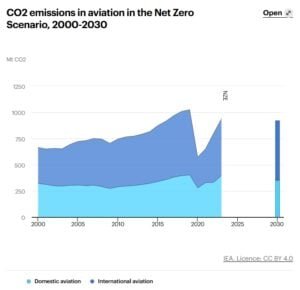
The aviation sector has made aircraft more fuel-efficient over the years, yet absolute emissions continue to rise. Growing demand for flights and global travel has offset many of the efficiency gains. According to the International Energy Agency, sustainable aviation fuel (SAF) accounts for less than 1% of the world’s jet fuel supply. Even worse, SAF still costs two to ten times more than conventional jet fuel, which limits its adoption.
Aviation contributes about 2% to 3% of global CO₂ emissions, but its overall climate impact is even larger. When scientists add the warming effects of contrails and other non-CO₂ emissions, the sector’s footprint increases significantly. Because of this, airlines face growing pressure from governments, investors, and passengers to show progress on climate goals.
However, without affordable SAF or next-generation aircraft, aviation must rely on other tools. This is where permanent carbon removal becomes important.
How Charm Industrial’s Carbon Removal Process Works
Charm Industrial offers a carbon removal method that blends natural carbon capture with engineered storage. The company:
- Collects agricultural and forestry residues, such as crop waste or wood scraps that would otherwise decompose or burn.
- It heats this waste in the absence of oxygen and converts it into bio-oil through a process called pyrolysis.
This bio-oil is thick, carbon-rich, and stable, and is then injected deep underground into old oil wells or EPA-regulated storage sites. Once underground, the bio-oil solidifies and remains trapped for hundreds or even thousands of years. Because the stored carbon is no longer exposed to fires, erosion, or land-use change, it becomes a form of permanent carbon removal.
This method differs from tree planting or traditional offsets. While forests can burn or be cut down, Charm’s storage approach avoids those risks. In addition, the process works year-round and does not depend on long-term maintenance.
Charm has already proven its capability at a commercial scale. Two years ago, the company delivered 112,000 tons of carbon removal to Frontier—a buyer coalition backed by companies like Stripe, Microsoft, and Alphabet. That deal was worth $53 million, with an approximate price of $470 per ton.
Over time, the company hopes to drive this cost down to around $50 per ton, which would make carbon removal accessible to a wider range of industries.
Peter Reinhardt, CEO of Charm Industrial, said,
“This collaboration helps scale our carbon removal technology while creating new jobs in rural communities and other locations.”
A Growing Customer List and New Projects
Charm Industrial’s client list now includes Google, JPMorgan Chase, and Microsoft. These companies are among the world’s largest purchasers of carbon removal and play a key role in scaling the industry. Their early investments help reduce costs and allow startups to build more storage capacity.
Recently, it expanded into Louisiana, where it converted an abandoned oil and gas well into a storage site capable of holding 500,000 tons of carbon. This move also supports local communities and uses existing industrial infrastructure in new ways.
As the model relies on materials like crop residues, it offers farmers new revenue streams. Instead of burning waste or leaving it unused, farmers can sell residues to Charm. This shift creates economic opportunities in rural regions and strengthens the link between agriculture and climate technology.
Economic Benefits Beyond Climate
The carbon removal sector is still developing, but it is already creating new types of jobs. Charm’s operations rely on rural workers who have experience with agricultural equipment, heavy vehicles, and industrial machinery. The company hires locally to run injection sites and manage biomass logistics. As carbon removal scales, it will bring more investment to the energy, forestry, and agriculture sectors.
Boeing’s agreement supports this emerging ecosystem. By signing long-term contracts with companies like Charm, Boeing helps create predictable demand, which is essential for climate startups planning to expand their supply chain and storage networks.
Boeing Targets Net Zero With SAF and Carbon Removals
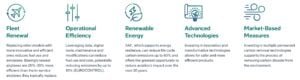
Boeing has been updating its environmental strategy as global pressure increases on aviation to reach net-zero emissions. The company follows an “avoid first, remove second” approach. This means Boeing prioritizes cutting emissions directly through efficiency improvements, renewable energy, and sustainable fuel use. After reducing what it can, Boeing uses permanent carbon removal for emissions that remain hard to eliminate.
Operational Emissions Targets
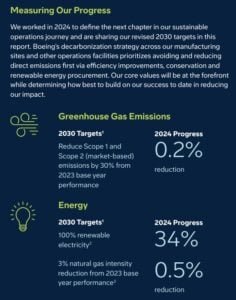
Boeing aims to cut Scope 1 and Scope 2 market-based emissions by 30% by 2030 from a 2023 baseline.
-
Move toward 100% renewable electricity.
-
Lower natural gas intensity across its facilities.
In 2024, Boeing made progress by achieving 34% renewable electricity through direct purchases and renewable energy credits. It also reduced its natural gas intensity by 0.5% reduction from 2023 levels.
Innovation and Sustainable Fuel
By 2030, Boeing wants all new commercial airplanes to be compatible with 100% SAF. The company co-led an international workgroup assessing how pure SAF affects aircraft structures, fuel systems, and components. It has also purchased 6.4 million gallons of blended SAF for U.S. operations.
Still, because SAF remains expensive and limited, Boeing understands that carbon removal must support its transition. Therefore, the company expects to sign more removal agreements in the coming year.
A Major Step Toward Scalable, Durable Climate Solutions
The Boeing–Charm Industrial partnership illustrates how aviation is beginning to support large-scale carbon removal. As clean fuels expand slowly and new aircraft technologies take years to reach the market, carbon removal helps bridge the gap between today’s operations and future net-zero targets.
Charm’s model brings together waste-to-carbon technology, permanent storage, rural job creation, and carbon-negative industrial processes. Meanwhile, Boeing’s investment provides financial stability to help the carbon removal sector grow.
Together, this agreement moves both companies—and the aviation industry—closer to a low-carbon future built on durable climate solutions, innovative technology, and long-term environmental responsibility.
The post Boeing Partners With Charm Industrial to Remove 100,000 Tons of CO₂ appeared first on Carbon Credits.


