
General Motors (NYSE: GM) reported stronger third-quarter 2026 earnings as higher profits and cash flow supported its business outlook. The automaker also recorded a milestone in China, where new energy vehicles (NEVs) accounted for more than 60% of its third-quarter sales.
- GM generated $50.02 billion in revenue, up 2.9% year over year, while net income attributable to shareholders rose to $3.34 billion from $1.33 billion a year earlier. Adjusted earnings per share (EPS) increased 32.2% to $3.70.
Alongside its financial performance, GM continues to invest in electrification, renewable energy and battery storage. Its progress highlights how the automaker is balancing profits from its core vehicle business with efforts to reduce emissions and develop new energy-related opportunities.
GM Q3 Earnings: Revenue and Profits Rise
GM’s third-quarter results showed stronger profitability across its core North American business.
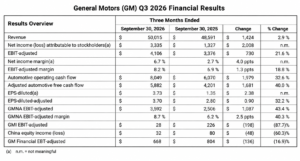
Adjusted earnings before interest and taxes (EBIT) reached $4.11 billion, compared with $3.38 billion in the third quarter of 2025. The adjusted EBIT margin improved to 8.2% from 6.9%.
North America remained the primary driver of earnings. General Motors North America (GMNA) generated $3.59 billion in adjusted EBIT, up 43.4% year over year. Its adjusted margin rose to 8.7% from 6.2%.
The improvement helped offset weaker results elsewhere. GM International reported adjusted EBIT of $28 million, down from $226 million a year earlier. Equity income from its China operations fell to $32 million from $80 million, while GM Financial’s adjusted earnings before taxes declined 16.9% to $668 million.
Despite these pressures, adjusted automotive free cash flow increased 40% to $5.88 billion. GM also ended the quarter with $23.1 billion in automotive cash, providing financial flexibility for investment and shareholder returns.
The company repurchased $2.5 billion of shares during the quarter and retired another 29 million shares. It subsequently completed its previous $6 billion buyback authorization and approved a new $20 billion multiyear program. GM also declared a quarterly dividend of $0.18 per share.
Updates Its 2026 Financial Outlook
GM narrowed its full-year guidance following the quarterly results. It now expects adjusted EBIT of $14.5 billion to $15.5 billion and adjusted automotive free cash flow of $11.5 billion to $12.5 billion.
The company also expects adjusted diluted EPS of $12.75 to $13.75. These forecasts reflect management’s current expectations, rather than guaranteed results.
GM expects several factors to support its business in the coming quarters, including the launch of new full-size pickups, increased production capacity for SUVs and crossovers, and growth in services such as OnStar and Super Cruise. Cost management across warranty expenses, EVs, and materials will also remain important.
For investors, the results show that GM’s earnings still depend heavily on its established vehicle business. Its ability to manage costs while expanding electric vehicles and energy-related services will help determine future profitability.
GM Stock: Buybacks Support Shareholder Returns
GM’s new $20 billion share repurchase authorization signals its willingness to return capital to shareholders. However, the authorization does not mean the company will spend the full amount immediately.
Investors will also monitor demand, margins, and the cost of developing new vehicles. While stronger earnings and cash flow provide support, GM stock’s longer-term performance will depend on sustained profitability and the company’s ability to manage industry risks.
Solid Q3 EV Sales in China
John Roth, GM senior vice president and president of GM China and Asia, said,
“We are strengthening a competitive and sustainable business in China, guided by our commitment to meeting the evolving needs of Chinese customers. Our improved product mix is building strong momentum for profitable growth across key segments.”
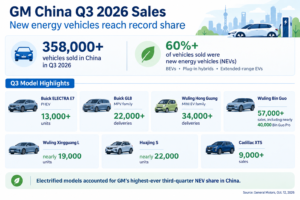
GM’s China business delivered more than 358,000 vehicles in the third quarter, with battery electric vehicles (BEVs), plug-in hybrid electric vehicles (PHEVs) and extended-range electric vehicles (EREVs) accounting for over 60% of sales. This was the company’s highest third-quarter NEV share in China.
Several models contributed to the performance. The Buick ELECTRA E7 plug-in hybrid SUV sold more than 13,000 units, while the GL8 premium multipurpose vehicle family delivered over 22,000 units. The Wuling Hong Guang MINI EV family recorded more than 34,000 deliveries.
The Wuling Bin Guo generated over 57,000 sales, including nearly 40,000 units of the Bin Guo Pro. Meanwhile, the newly launched Buick ELECTRA L7 expanded the brand’s all-electric lineup, and the Cadillac XT5 plug-in hybrid strengthened its position in the luxury SUV segment.
GM said its China joint venture recorded its eighth consecutive profitable quarter. The sales figures suggest that new models and a broader mix of electric and hybrid vehicles are helping the company compete in China’s fast-changing automotive market.
However, higher NEV sales do not automatically translate into higher profits. Competition, pricing, and development costs will determine whether GM can sustain profitable growth in the region.
GM Sustainability: Emissions, Renewable Energy and Battery Storage
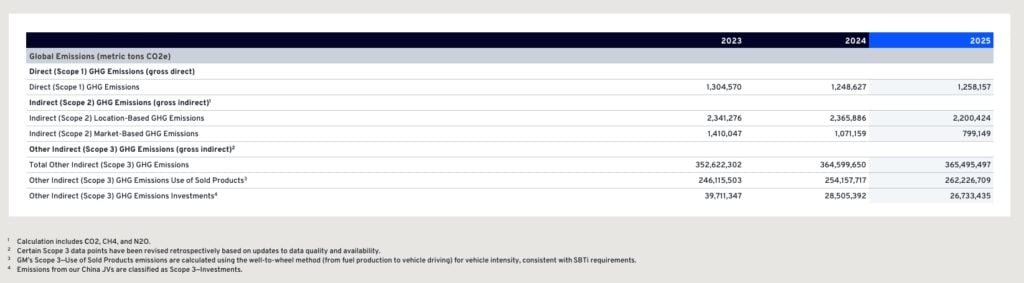
GM reduced its combined Scope 1 and Scope 2 emissions from 4.3 million metric tons in 2018 to approximately 2.1 million metric tons in 2025, a 52% decline. Its target is to cut these operational emissions by 72% by 2035 and achieve carbon neutrality across its global products and operations by 2040.
However, its wider emissions footprint remains substantial.
- It reported approximately 365.5 million metric tons of Scope 3 emissions in 2025, including 262.23 million metric tons associated with the use of sold products.
- This makes vehicle use a much larger climate challenge than factory operations alone.
GM also matched 100% of electricity consumption at its U.S. facilities with renewable electricity in 2025 and 70% of its global electricity consumption. It aims to reach 100% globally by 2035.
Battery storage offers another opportunity. Through GM Energy, the company sells home battery systems and supports vehicle-to-home technology for compatible vehicles. It has also explored stationary storage using repurposed EV batteries, which can extend battery life and support electricity reliability.
These initiatives could strengthen GM’s sustainability strategy, but their financial impact will depend on customer demand, operating costs and successful commercial expansion.
Can GM Sustain Its Earnings and Climate Progress?
GM’s third-quarter results show stronger profits, improved cash generation and rising demand for NEVs in China. Its renewable electricity progress and battery storage initiatives also support its longer-term transition.
The challenge is to turn these developments into lasting value. Investors will need to watch North American margins, China’s profitability, EV demand, and emissions across the vehicle lifecycle.
GM’s ability to combine financial discipline with lower-emission technologies will be central to its long-term competitiveness.
The post Can GM Stock Balance Strong Q3 Earnings With Its 365M-Ton Emissions Challenge? appeared first on Carbon Credits.


