
Canada is at a key moment in its fight against climate change. Carbon pricing has been the central tool used to cut emissions, but recent policy changes and differences across provinces have created uncertainty.
This article examines how Canada’s carbon pricing system works now. It covers expert concerns and what the key federal review in 2026 might mean for both industry and the country’s journey toward a lower-carbon future.
How Canada Prices Pollution
Canada uses carbon pricing to encourage companies and people to cut greenhouse gas (GHG) emissions. Under that system, there are two main parts.
For ordinary people and small businesses, there used to be a “fuel charge” or carbon tax on fossil fuels. For large industrial emitters, there is a program called the Output-Based Pricing System (OBPS).
Under the OBPS, factories or facilities that produce a lot of emissions get a limit based on how much they produce. If they emit more than their limit, they must pay; if they emit less, they earn credits that they can sell or use later.
This approach aims to reduce carbon pollution while trying to protect industries that compete globally. The goal is to cancel out the risk that companies might move to other countries with weaker climate rules.
From Gas Pumps to Smokestacks: A Major Policy Shift
In 2025, the federal government made important changes. It removed the “consumer-facing” carbon tax — the fuel charge — effective April 1, 2025. This means people pay no extra carbon tax when buying gasoline or heating fuel.
Instead, the focus shifted more clearly onto industrial carbon pricing. The government said it would review the carbon pricing “benchmark” in 2026. This review could change how industrial carbon pricing operates.
A recent analysis by ClearBlue Markets shows that Canada’s carbon pricing for industry is now fragmented. Fragmentation has caused uncertainty. This is a problem for companies that need stable cost signals before they invest in cleaner technology.
The ClearBlue report stated:
“The federal benchmark review will therefore trigger extensive engagement between the federal government and the provinces, aimed at aligning key benchmark elements such as coverage, pricing stringency, and competitiveness protections. Negotiations are likely to be complex and politically charged, particularly with provinces like Alberta and Saskatchewan, which have already taken strong positions. These types of unilateral decisions reflect ongoing tensions and highlight the difficulty of achieving a truly aligned national approach.”
Carbon pricing today: A patchwork across Canada
Because Canada is large and its provinces have different rules, carbon pricing for industry is not the same everywhere. ClearBlue Markets shows that credit prices—what companies pay or earn—vary a lot by province or system.
Here are specific examples:
In Alberta, the Environmental Monitoring, Evaluation and Reporting Agency has seen a big drop in credits under its Technology Innovation and Emissions Reduction Program (TIER). Despite a compliance price of CAD 95 per tonne, market credits trade at around CAD 18 per tonne. This shows a credit surplus and weak demand.
In British Columbia (B.C.), the new B.C. Output-Based Pricing System (B.C. OBPS) began to be applied recently. Credits are trading at about CAD 65 per tonne, a discount compared with the regulatory level of CAD 80.
In Ontario, the Emissions Performance Standards (EPS) system governs industrial emissions. Because the program does not allow offset credits, supply is tighter — units (EPUs) recently traded at around CAD 72 per tonne.
In areas where the federal OBPS still applies, like some territories and small provinces, cheap carbon offset credits from Alberta’s TIER have lowered prices. Now, they can be as low as about CAD 37.50 per tonne.
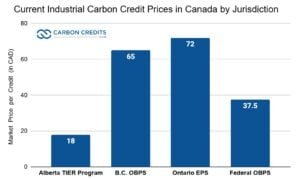
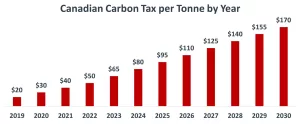
The true cost of carbon emissions differs greatly by industry and province. The federal government aims to raise the carbon price to CAD 170 per tonne by 2030 for direct pricing systems.
The 2026 Showdown: Can Canada Fix Its Carbon Market?
The upcoming review of the federal benchmark is seen as a turning point. It could lead to stronger, more aligned carbon pricing across all provinces. As ClearBlue Markets notes, the review may address issues such as:
- Align different provincial systems under a common design. This way, credits and compliance will act more alike.
- Improving transparency in reporting credit inventories, trades, and emission reductions.
- Possibly introducing a “floor price” — a minimum cost for carbon credits — to avoid extreme price drops like those seen in some programs.
- Setting a long-term carbon price path past 2030 helps industries plan investments more clearly. This is especially important for clean technologies.
All of these could make carbon pricing more predictable and effective. If the review doesn’t meet expectations, patchwork and uncertainty may persist. This could weaken the carbon price signal and confuse investment in clean technology.
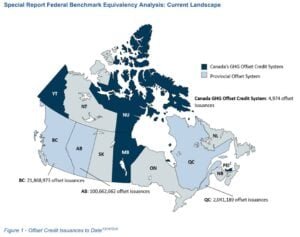
This patchwork of provincial and federal carbon pricing programs has created a corresponding patchwork of compliance offset markets. The image below shows how these offset markets are distributed across Canada.
Global Pressure Is Rising: Europe Could Hit Canada with Carbon Tariffs
One major external risk comes from the global trade environment. Starting in 2026, the European Union’s Carbon Border Adjustment Mechanism (CBAM) will impact imports based on their carbon emissions.
For Canadian exporters, this raises a key question:
- Will EU authorities accept the compliance credits or offsets generated under Canada’s various carbon pricing systems as evidence of “carbon price paid”?
If not, Canadian exports might face extra tariffs. This could double the carbon cost or hurt competitiveness.
This makes it even more important for Canada to standardize and strengthen its carbon pricing framework before 2026. This is to ensure that its pricing and credits are recognized internationally. Otherwise, Canadian industries like steel, aluminum, and cement might find it hard to compete. This is especially true in markets with strict climate-related import rules.
Strengths and Challenges of Canada’s Carbon Pricing
Carbon pricing works to link environmental costs with economic decision-making. For large emitters, it encourages improved efficiency. Carbon pricing revenue, especially from the OBPS, can fund clean energy projects. It also supports carbon capture and investments in low-carbon infrastructure.
A recent evaluation by the government highlights that industrial carbon pricing helps reduce emissions with minimal impact on households.
But there are major challenges too. The system varies by province, so many industries might have low carbon costs. This means there is little motivation for real change.
A 2022 report from the Office of the Auditor General of Canada (OAG) found that weak rules in provincial large-emitter programs lower the impact of carbon pricing. Also, the unclear use of carbon revenues and the long-term price outlook have made some firms hesitant to invest in cleaner technologies.
The Stakes: Canada’s Climate Credibility and Industrial Future
The 2026 benchmark review could reshape Canada’s carbon pricing for decades. Key signs to watch are:
- Whether the government sets a new, clear carbon price path beyond 2030 — possibly up to 2050, that would give firms confidence to invest in long-term clean solutions.
- Whether provincial carbon pricing systems become more harmonized. This means similar rules, credit prices, and transparency everywhere.
- Introducing a price floor or other methods can help prevent deeply discounted carbon credits. This ensures a strong carbon price signal.
- Will Canadian industrial credits and compliance be set up to gain recognition under global systems like CBAM? This could help keep Canadian exports competitive.
Canada’s carbon pricing, especially for industry, is at a crossroads. The removal of the consumer carbon tax in 2025 reflects a shift toward focusing on industrial emissions. Meanwhile, the upcoming 2026 benchmark review offers a chance to make this system stronger, fairer, and more predictable.
However, much depends on political and regulatory will. Without clear pricing, rules, and long-term certainty, the carbon price might be too weak. This puts Canada’s climate goals and global competitiveness at risk. But if the government and provinces act quickly, carbon pricing can help Canada shift to a low-carbon economy while also keeping industries competitive.
The post Canada’s Carbon Pricing Reset in 2026: Will Industry Step Up or Stall Climate Progress? appeared first on Carbon Credits.


