

Charted: How Many Years of Supply Life Are Left for Commodities?
Key Takeaways
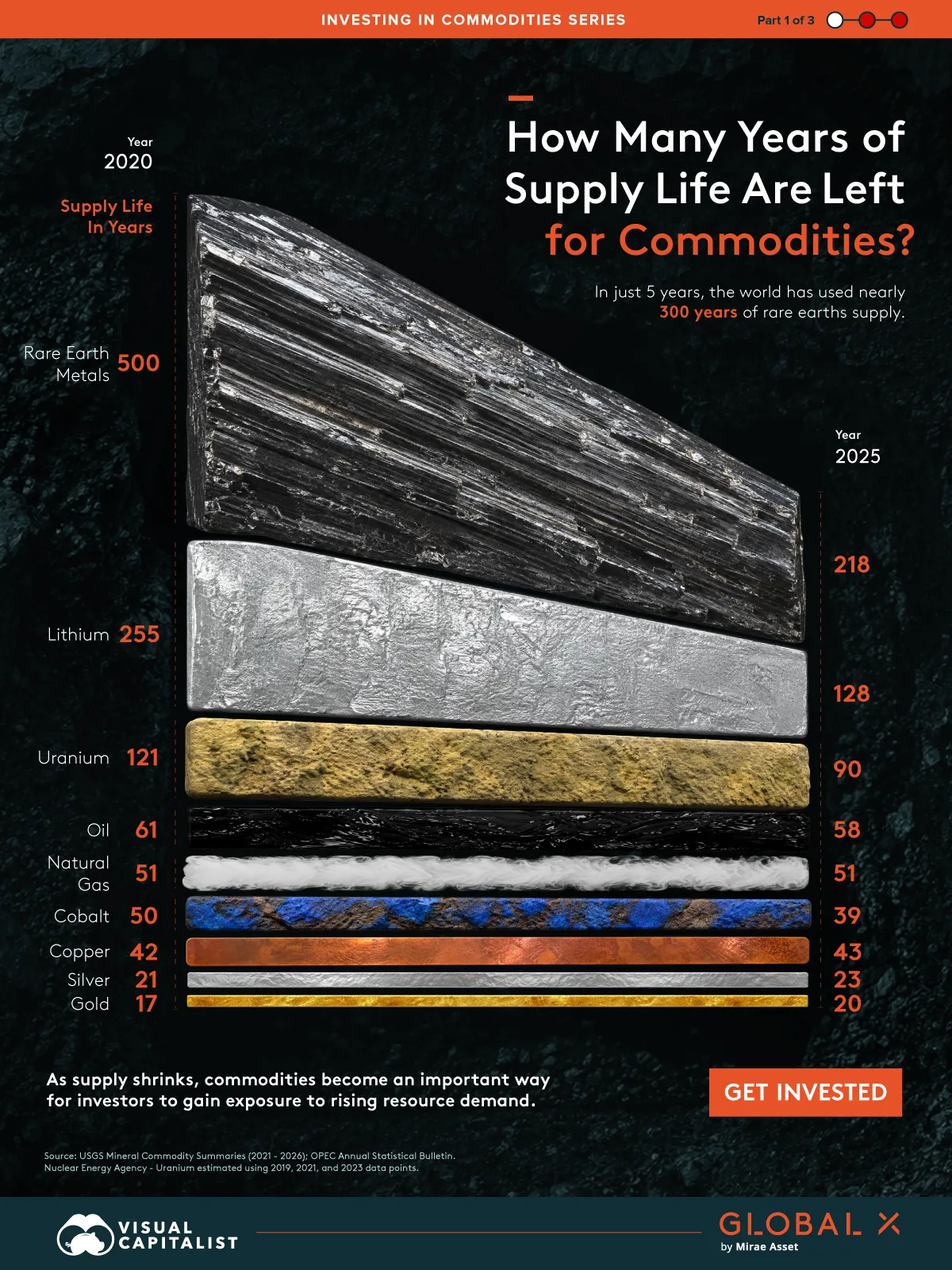
- Rare earth metals had the largest reduction in supply life, losing nearly 300 years worth of supply between 2020 and 2025.
- Lithium (-127 years) and uranium (-31 years) followed rare earths, while other commodities like oil & gas, copper, and gold all remained relatively stable.
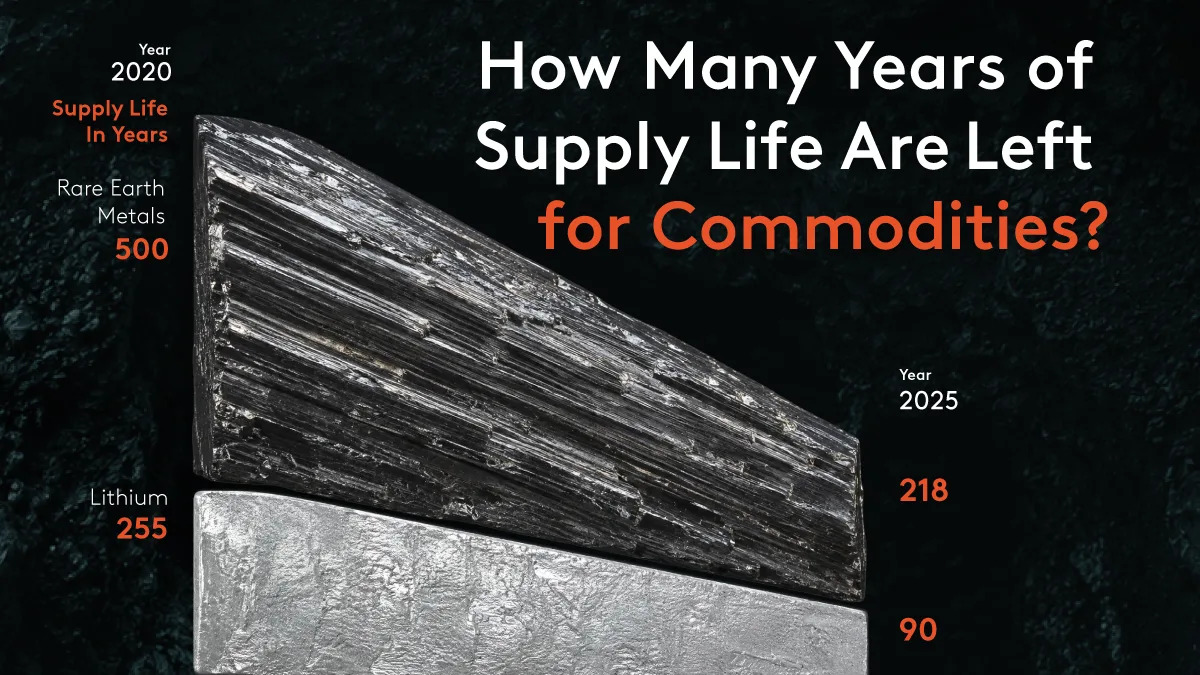
In just five years, the world has reduced the supply life of rare earth metals by nearly 300 years.
This graphic, in partnership with Global X Canada, is the first of three graphics in the Investing in Commodities series. It shows how the supply life of different critical commodities has changed between 2020-2025 using data from the USGS, OPEC, and NEA.
Rare Earths With the Steepest Drop
Rare earth metals recorded the biggest change between 2020 and 2025. Their estimated supply life fell from 500 years to 218 years, a drop of 282 years.
| Critical Commodity | 2020 | 2025 |
|---|---|---|
| Rare Earth Metals | 500 | 218 |
| Lithium | 255 | 128 |
| Uranium | 121 | 90 |
| Oil | 61 | 58 |
| Natural Gas | 51 | 51 |
| Cobalt | 50 | 39 |
| Copper | 42 | 43 |
| Silver | 21 | 23 |
| Gold | 17 | 20 |
Source: USGS Mineral Commodity Summaries (2021 – 2026); OPEC Annual Statistical Bulletin; Nuclear Energy Agency
For uranium, the 2020 and 2025 values are estimated from 2021 and 2023 NEA data points.
Lithium supply life declined by 127 years, while uranium had a smaller drop of 31 years. These drops matter for electric vehicles, wind turbines, and defense technologies that all rely on steady rare earths and other critical minerals.
Traditional Commodities More Stable
The sharpest supply-life shifts centered on critical minerals, not legacy commodities. Cobalt is the lone critical mineral with moderate change, having a decline of 11 years.
For legacy commodities, oil had a modest reduction of 4 years while the precious metals, silver and gold, saw slight increases in supply while others stayed essentially flat.
Investing in Commodities
For investors, shrinking supply life can signal where demand growth may collide with limited resource availability. It can also highlight geopolitical risk when supply remains heavily concentrated in just a handful of countries.
Commodity ETFs can offer diversified access without selecting individual producers. As demand grows, Global X Canada’s ETFs may help investors position around long-term resource trends.
To learn more, explore the Global X All-In-One Commodity Producers Equity ETF (COMX). Minimize the guesswork of trying to pick which commodity segment may outperform each year.

See how COMX offers diversified access across precious metals, energy, and base metals producers.
Commissions, management fees, and expenses all may be associated with an investment in products (the “Global X Funds”) managed by Global X Investments Canada Inc. The Global X Funds are not guaranteed, their values change frequently and past performance may not be repeated. Certain Global X Funds may have exposure to leveraged investment techniques that magnify gains and losses which may result in greater volatility in value and could be subject to aggressive investment risk and price volatility risk. Such risks are described in the prospectus. The prospectus contains important detailed information about the Global X Funds. Please read the relevant prospectus before investing.
Certain statements may constitute a forward-looking statement, including those identified by the expression “expect” and similar expressions (including grammatical variations thereof). The forward-looking statements are not historical facts but reflect the author’s current expectations regarding future results or events. These forward-looking statements are subject to a number of risks and uncertainties that could cause actual results or events to differ materially from current expectations. These and other factors should be considered carefully and readers should not place undue reliance on such forward-looking statements. These forward-looking statements are made as of the date hereof and the authors do not undertake to update any forward-looking statement that is contained herein, whether as a result of new information, future events or otherwise, unless required by applicable law.
This communication is intended for informational purposes only and does not constitute an offer to sell or the solicitation of an offer to purchase investment products (the “Global X Funds”) managed by Global X Investments Canada Inc. and is not, and should not be construed as, investment, tax, legal or accounting advice, and should not be relied upon in that regard. Individuals should seek the advice of professionals, as appropriate, regarding any particular investment. Investors should consult their professional advisors prior to implementing any changes to their investment strategies. These investments may not be suitable to the circumstances of an investor.
All comments, opinions and views expressed are generally based on information available as of the date of publication and should not be considered as advice to purchase or to sell mentioned securities. Before making any investment decision, please consult your investment advisor or advisors.
Global X Investments Canada Inc. (“Global X”) is a wholly owned subsidiary of Mirae Asset Global Investments Co., Ltd. (“Mirae Asset”), the Korea-based asset management entity of Mirae Asset Financial Group. Global X is a corporation existing under the laws of Canada and is the manager, investment manager and trustee of the Global X Funds.
-
 Mining2 weeks ago
Ranked: Which Countries Produce the Most Silver?
Mexico is the leading silver producer with 20% of global production in 2025, the most silver produced of any country. Which country follows?
-
 Space4 weeks ago
The Largest Public Space Companies by Country
Rocket Lab leads the public pure-play space companies, with a C$71.4 billion market cap exceeding the next five companies combined.
-
 Space1 month ago
Who Owns the Most Satellites?
SpaceX has the most operational satellites in the world, with Starlink’s scale showing how commercial networks now shape orbital infrastructure.
-
 Economy2 months ago
The Fastest Growing Space Economy Sectors by 2035
The space economy is set to reach C$2.5T by 2035, with supply chains, food, and defense leading growth in space-enabled industries.