Charted: Senior Populations of the World’s Largest Economies
See visuals like this from many other data creators on our Voronoi app. Download it for free on iOS or Android and discover incredible data-driven charts from a variety of trusted sources.
Key Takeaways
- Japan has the oldest population among major economies, with 30% of its population aged 65 and older.
- China has the world’s largest senior population, with over 211 million people aged 65+.
- India has more than 100 million seniors, despite having one of the youngest populations among major economies.
As populations age, growing senior populations are reshaping economic growth, healthcare systems, and public finances across the world’s largest economies.
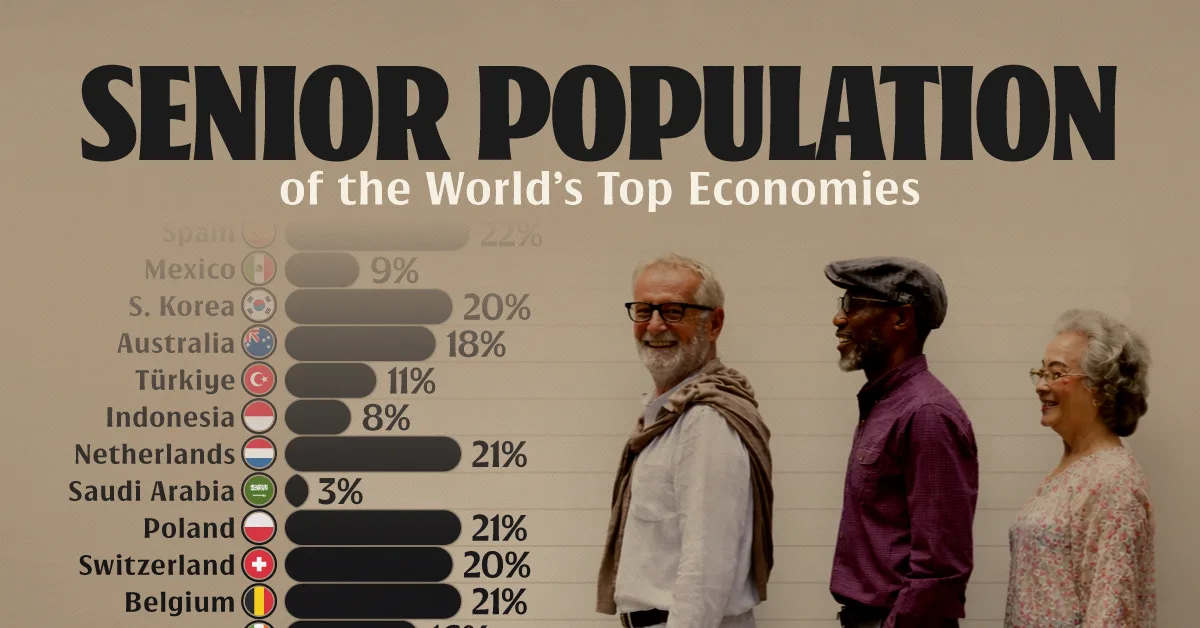
This infographic compares the senior population (aged 65 and older) across the world’s top 30 economies by nominal GDP in 2025, using data from the United Nations and the International Monetary Fund (IMF).
Which Major Economies are the Oldest?
Population aging varies dramatically across the world’s largest economies, reflecting differences in fertility rates, life expectancy, and stages of economic development.
The table below shows the share and total number of people aged 65 and older across the top global economies:
| Economy Rank by GDP | Country | Share of Population Aged 65+ | Senior Population |
|---|---|---|---|
| 1 | United States of America  |
18% | 61,219,978 |
| 2 | China  |
15% | 211,346,250 |
| 3 | Germany  |
24% | 20,042,628 |
| 4 | Japan  |
30% | 37,192,611 |
| 5 | India  |
7% | 101,565,505 |
| 6 | United Kingdom  |
20% | 13,845,200 |
| 7 | France  |
23% | 15,758,841 |
| 8 | Italy  |
25% | 14,746,506 |
| 9 | Russian Federation  |
18% | 25,836,093 |
| 10 | Canada  |
20% | 8,257,720 |
| 11 | Brazil  |
11% | 23,319,843 |
| 12 | Spain  |
22% | 10,737,570 |
| 13 | Mexico  |
9% | 11,777,491 |
| 14 | Republic of Korea  |
20% | 10,350,213 |
| 15 | Australia  |
18% | 4,896,866 |
| 16 | Türkiye  |
11% | 9,407,053 |
| 17 | Indonesia  |
8% | 22,679,034 |
| 18 | Netherlands  |
21% | 3,778,790 |
| 19 | Saudi Arabia  |
3% | 1,059,008 |
| 20 | Poland  |
21% | 7,676,488 |
| 21 | Switzerland  |
20% | 1,806,820 |
| 22 | Belgium  |
21% | 2,494,137 |
| 23 | Ireland  |
16% | 860,841 |
| 24 | Argentina  |
13% | 5,940,501 |
| 25 | Sweden  |
21% | 2,219,639 |
| 26 | Israel  |
13% | 1,296,672 |
| 27 | Singapore  |
14% | 845,160 |
| 28 | United Arab Emirates  |
2% | 217,540 |
| 29 | Austria  |
21% | 1,927,481 |
| 30 | Thailand  |
16% | 11,466,882 |
Japan stands out as the world’s oldest major economy, with 30% of its population aged 65 and above, equivalent to more than 37 million seniors. Low fertility rates and long life expectancy have driven Japan’s demographic shift, creating major challenges for its workforce and pension system.
Besides Japan, Europe makes up nine of the top 10 countries with the highest share of seniors on the list. Germany and Italy follow closely, with seniors accounting for roughly one-quarter of their populations. Many European economies now face shrinking working-age populations, raising concerns over long-term economic sustainability.
Meanwhile, China has by far the largest senior population in absolute numbers at more than 211 million. Similarly, in India, seniors make up only 7% of the population, yet the country already has over 101 million people aged 65 or older due to its sheer population size.
Economies That Skew Younger
Some large economies remain relatively young. Saudi Arabia and the United Arab Emirates have the lowest shares of seniors, at just 3% and 2% respectively, because of large migrant workforces.
Emerging economies like Indonesia, Mexico, and Türkiye also maintain lower senior shares, although these figures are likely to rise over the coming decades as life expectancy increases and birth rates fall.
Learn More on the Voronoi App 
If you enjoyed today’s post, explore more demographics and population insights on Voronoi, including Every Country’s Median Age.
- Source: https://www.visualcapitalist.com/charted-senior-populations-of-the-worlds-largest-economies/