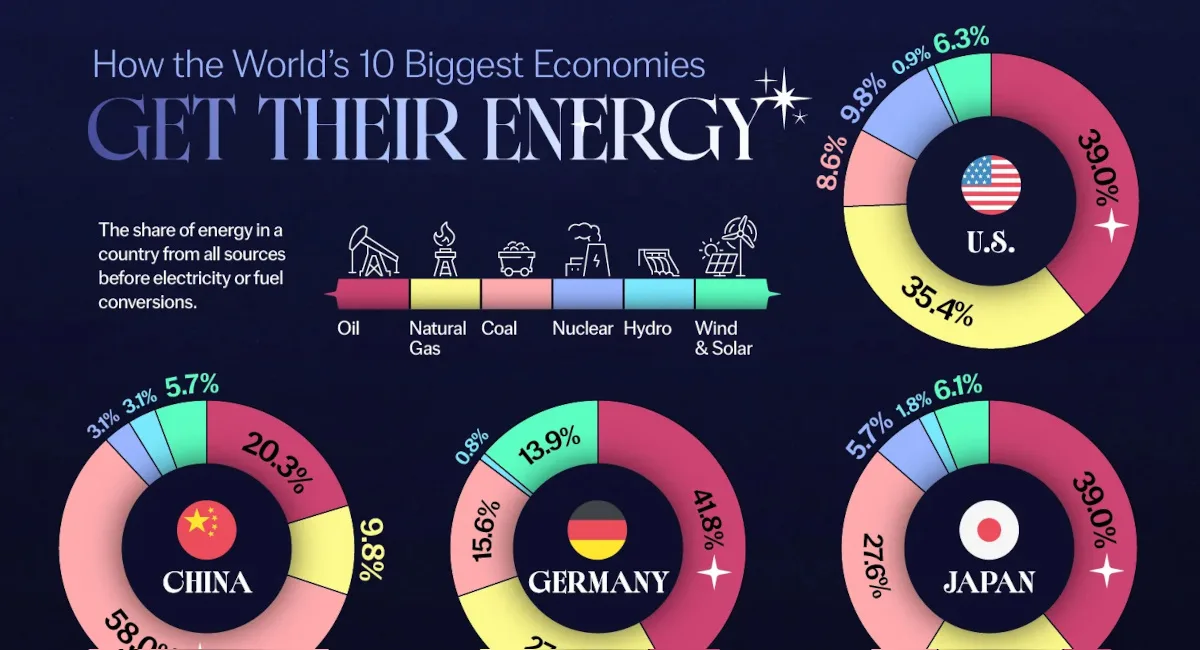
 See more visuals like this on the Voronoi app.
The Energy Mix of the World’s 10 Largest Economies
See visuals like this from many other data creators on our Voronoi app. Download it for free on iOS or Android and discover incredible data-driven charts from a variety of trusted sources.
Key Takeaways
- Oil is the largest energy source in six of the world’s 10 biggest economies, including the U.S., Germany, Japan, the UK, and Italy.
- Coal dominates energy supply in China and India, accounting for nearly 60% of their energy mixes.
- France stands out for nuclear power, which provides over 46% of its energy mix, the highest share among the group.
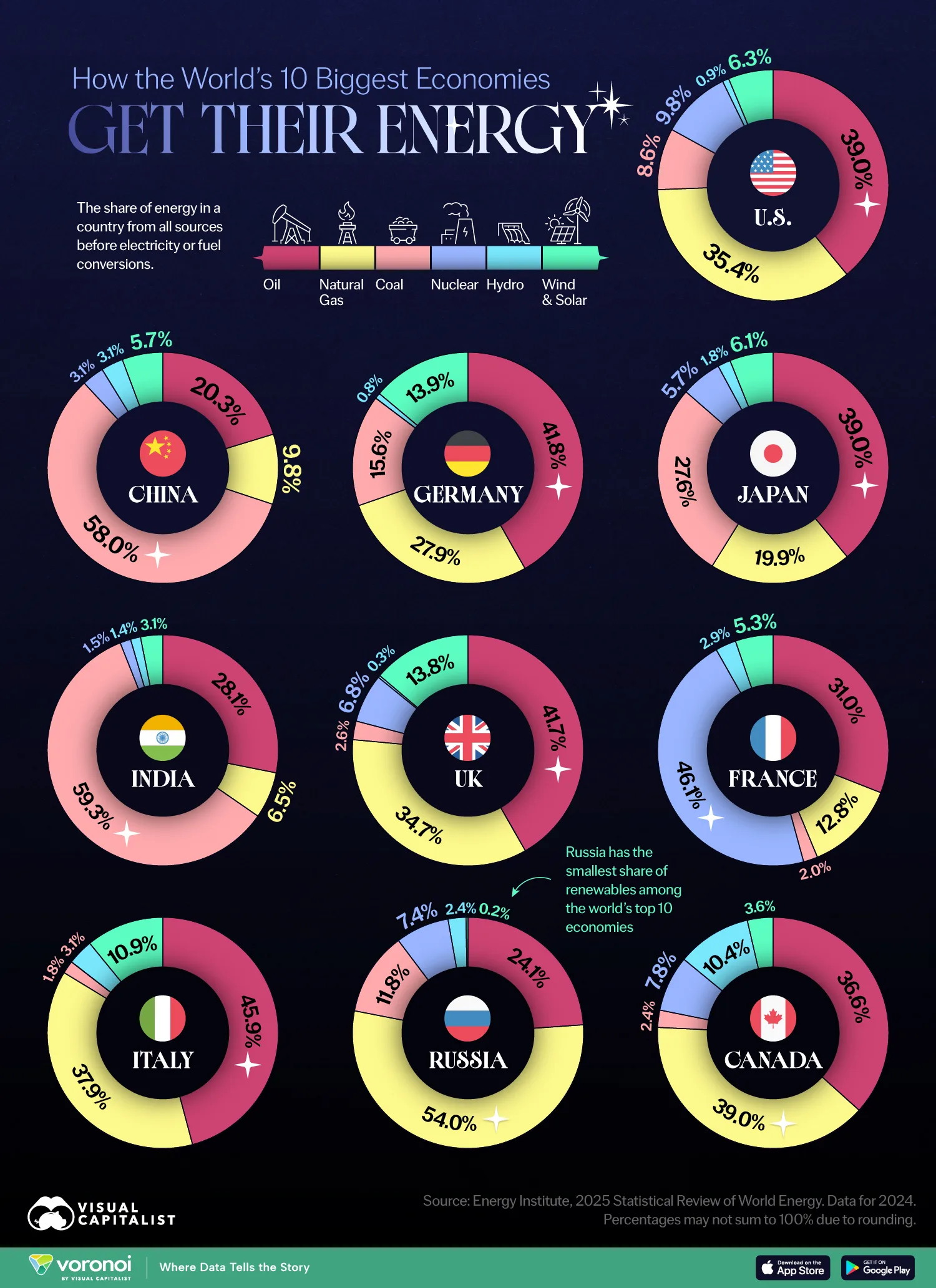
This graphic compares the energy mix of the world’s 10 largest economies, showing how much of their total energy supply comes from oil, natural gas, coal, nuclear, hydro, and other renewables.
The data for this visualization comes from the Energy Institute’s 2025 Statistical Review of World Energy, representing the most recent full-year data (2024).
Oil Still Dominates Many Advanced Economies
Oil remains the largest energy source in six of the 10 biggest economies, including the United States, Germany, Japan, the United Kingdom, and Italy. In these countries, oil plays a major role in transportation and industrial sectors.
Italy has the highest reliance on oil among the group, with nearly 46% of its energy coming from petroleum. Germany and the UK also depend heavily on oil, though both have been expanding renewable energy capacity in recent years.
The table below shows the energy mix of each of the world’s 10 largest economies.
| Country | Oil | Nat. Gas | Coal | Nuclear | Hydro | Renewables |
|---|---|---|---|---|---|---|
 U.S. U.S. |
39.0% | 35.4% | 8.6% | 9.8% | 0.9% | 6.3% |
 China China |
20.3% | 9.8% | 58.0% | 3.1% | 3.1% | 5.7% |
 Germany Germany |
41.8% | 27.9% | 15.6% | 0.0% | 0.8% | 13.9% |
 Japan Japan |
39.0% | 19.9% | 27.6% | 5.7% | 1.8% | 6.1% |
 India India |
28.1% | 6.5% | 59.3% | 1.5% | 1.4% | 3.1% |
 UK UK |
41.7% | 34.7% | 2.6% | 6.8% | 0.3% | 13.8% |
 France France |
31.0% | 12.8% | 2.0% | 46.1% | 2.9% | 5.3% |
 Italy Italy |
45.9% | 37.9% | 1.8% | 0.0% | 3.6% | 10.9% |
 Russia Russia |
24.1% | 54.0% | 11.8% | 7.4% | 2.4% | 0.2% |
 Canada Canada |
36.6% | 39.0% | 2.4% | 7.8% | 10.4% | 3.6% |
Even in highly developed economies with strong climate targets, oil remains difficult to replace due to its central role in global transport systems.
Coal Remains Critical for China and India
Coal continues to dominate the energy mix in the world’s two most populous countries. In China, coal accounts for 58% of total energy supply, while India relies on coal for roughly 59%.
This reliance reflects both countries’ large industrial bases and the availability of domestic coal resources. Coal remains a relatively cheap and reliable energy source for powering manufacturing and electricity generation.
However, both China and India are also investing heavily in renewable energy and nuclear power as they attempt to balance economic growth with emissions reductions.
Different Paths to Low-Carbon Energy
Some economies rely more heavily on nuclear or hydropower rather than renewables alone. France stands out for its heavy dependence on nuclear power, which provides more than 46% of its total energy mix.
Canada, meanwhile, benefits from abundant hydropower resources, with hydro accounting for over 10% of its energy supply. The country also maintains a relatively balanced mix between oil and natural gas.
Russia shows the lowest share of renewables in the group at just 0.2%, reflecting its vast reserves of fossil fuels and heavy reliance on natural gas, which makes up more than half of its energy mix.
Learn More on the Voronoi App
If you enjoyed today’s post, check out Countries With the Most Oil Reserves on Voronoi, the new app from Visual Capitalist.