 See more visualizations like this on the Voronoi app.
Charted: U.S. War Support Hits Record Lows
See visuals like this from many other data creators on our Voronoi app. Download it for free on iOS or Android and discover incredible data-driven charts from a variety of trusted sources.
Key Takeaways
- U.S. support for new wars has fallen to its lowest level on record.
- WWII saw near-unanimous backing at 97%, versus just 41% for Iran in 2026.
- Public approval has steadily weakened since the early 2000s.
- Major crises can still drive spikes, but support fades faster than before.
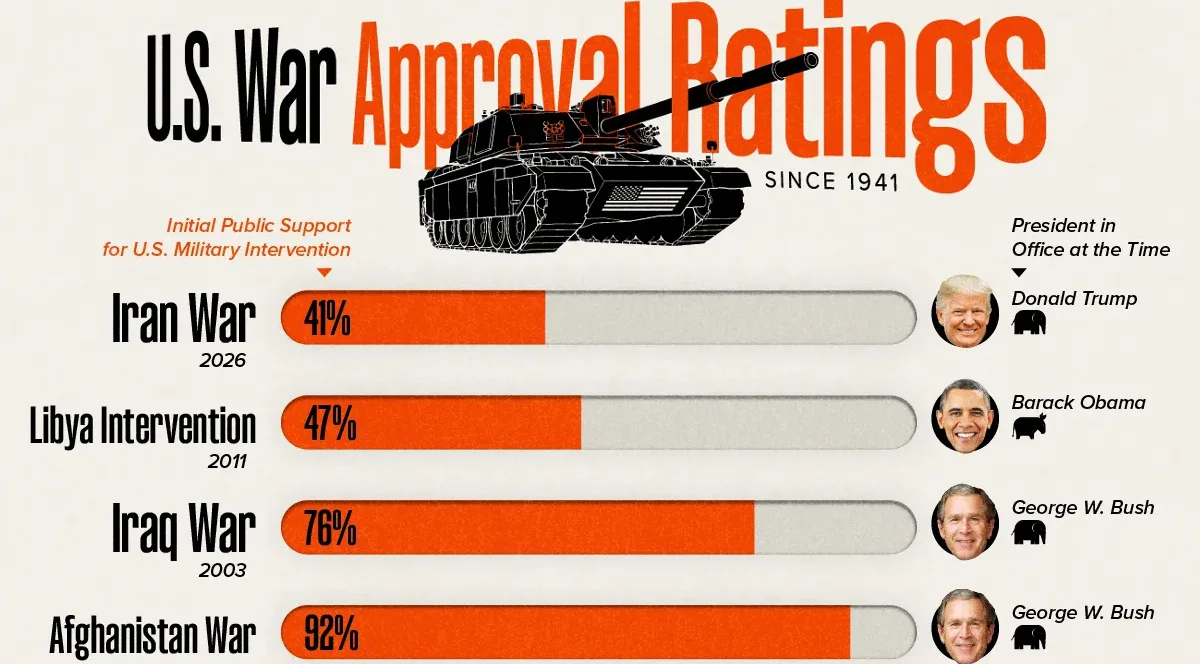
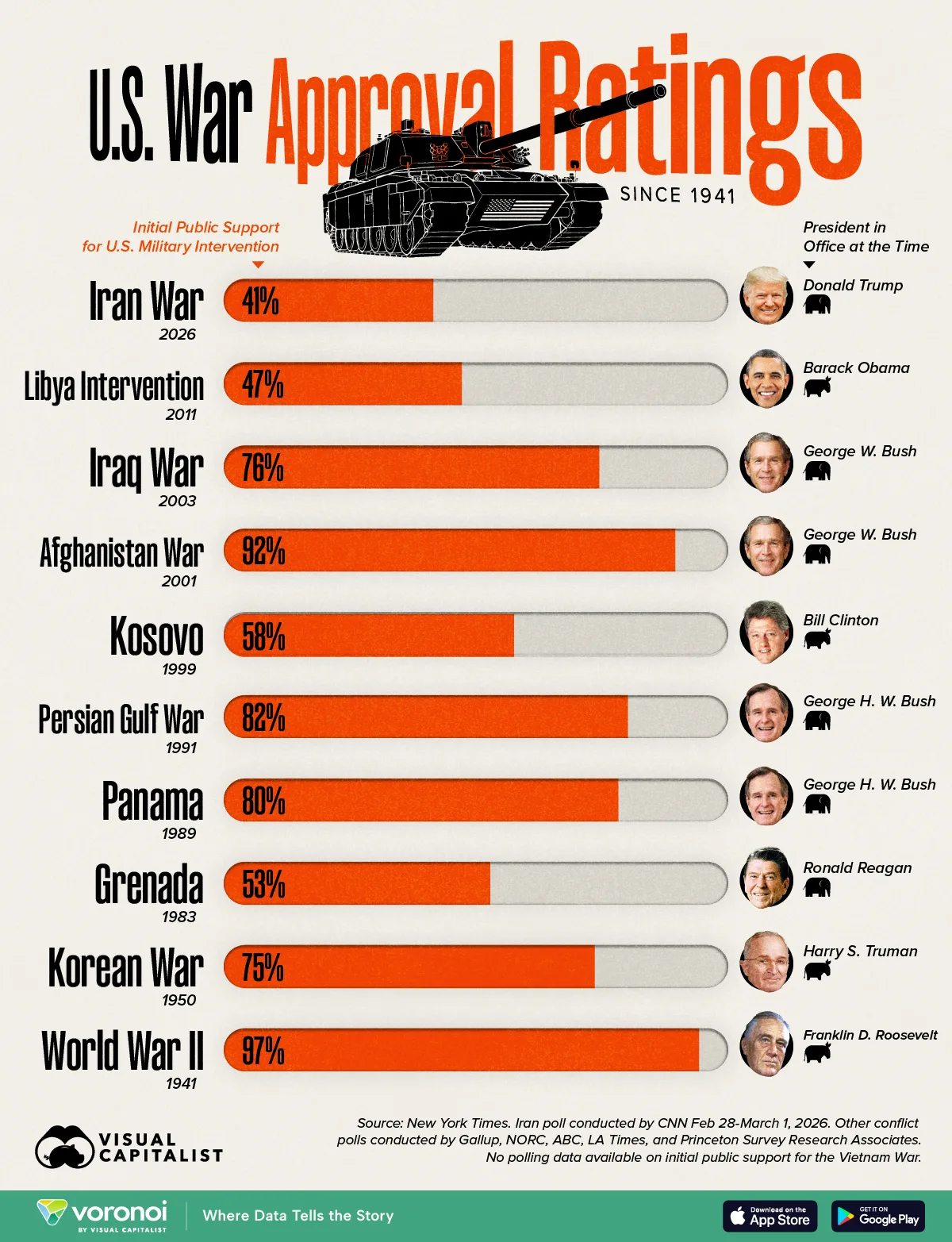
At the start of World War II, 97% of Americans supported military action. In 2026, just 41% back the Iran conflict, the lowest level recorded for any U.S. intervention.
This graphic compares initial public approval across major U.S. conflicts since 1941 based on polling data from the New York Times, highlighting how war support has evolved, from near-unanimous backing during global conflicts to far more divided sentiment today.
A Broad Downward Trend in War Support
Public support for U.S. military interventions has generally declined over the past 85 years.
During the 1940s and 50s, U.S. wars saw strong majority backing. World War II (97%), and the Korean War (76%) each had widespread approval at the outset.
The table below shows how public trust in military intervention has clearly weakened, especially in the post-Iraq and post-Afghanistan era. Data on initial public support for the Vietnam War is not available for comparison.
| Conflict | Initial Public Support for U.S. Military Intervention |
Year | President |
|---|---|---|---|
| Iran War | 41% | 2026 | Donald Trump |
| Libya Intervention | 47% | 2011 | Barack Obama |
| Iraq War | 76% | 2003 | George W. Bush |
| Afghanistan War | 92% | 2001 | George W. Bush |
| Kosovo | 58% | 1999 | Bill Clinton |
| Persian Gulf War | 82% | 1991 | George H. W. Bush |
| Panama | 80% | 1989 | George H. W. Bush |
| Grenada | 53% | 1983 | Ronald Reagan |
| Korean War | 75% | 1950 | Harry S. Truman |
| World War II | 97% | 1941 | Franklin D. Roosevelt |
Support for the Libya intervention stood at just 47% in 2011, and the 2026 Iran conflict sits even lower at 41%, suggesting a growing reluctance among Americans to back new wars.
For Iran in particular, approval ratings are hindered by several strategic and domestic factors. First, the purpose of the war is opaque, with Iran posing no immediate threat or danger to the American public preceding the attacks. Secondly, ambiguity surrounding how—and when—it will end complicates measurements of success.
Beyond these variables, affordability and the cost of living ultimately remain the most central political concerns among Americans, rather than foreign policy.
Moments That Drove War Support Higher
While the long-term trend points downward, major events can still trigger sharp spikes in support.
The clearest example is the Afghanistan War, which began in the aftermath of 9/11. Initial approval reached 92%, reflecting a moment of national unity and urgency. Yet by 2021, 47% said America’s longest war in history was a mistake.
Similarly, the Iraq War in 2003 launched with 76% support, though public opinion would later shift significantly as the conflict dragged on.
These cases show that context matters, especially when Americans perceive a direct threat. But even these surges have become less durable over time, with support often eroding faster than previous conflicts in history.
Learn More on the Voronoi App
To learn more about this topic, check out this graphic on the world’s most militarized economies by three metrics.