 See more visualizations like this on the Voronoi app.
Charted: Where the World’s Oil Comes From, by Region
See visuals like this from many other data creators on our Voronoi app. Download it for free on iOS or Android and discover incredible data-driven charts from a variety of trusted sources.
Key Takeaways
- North America is the world’s largest oil-producing region in 2025, generating over 31 million barrels per day, equal to nearly 30% of global supply.
- The Middle East produces over 29% of the world’s oil, led by Saudi Arabia and Iran.
- Europe, excluding Russia, produces less than 4% of total oil production, the smallest share by region.
The world produced roughly 106 million barrels of oil per day in 2025, according to estimates from the U.S. Energy Information Administration (EIA).
Just two regions dominate global supply. North America and the Middle East together produce nearly 60% of the world’s oil, underscoring their outsized influence on energy markets.
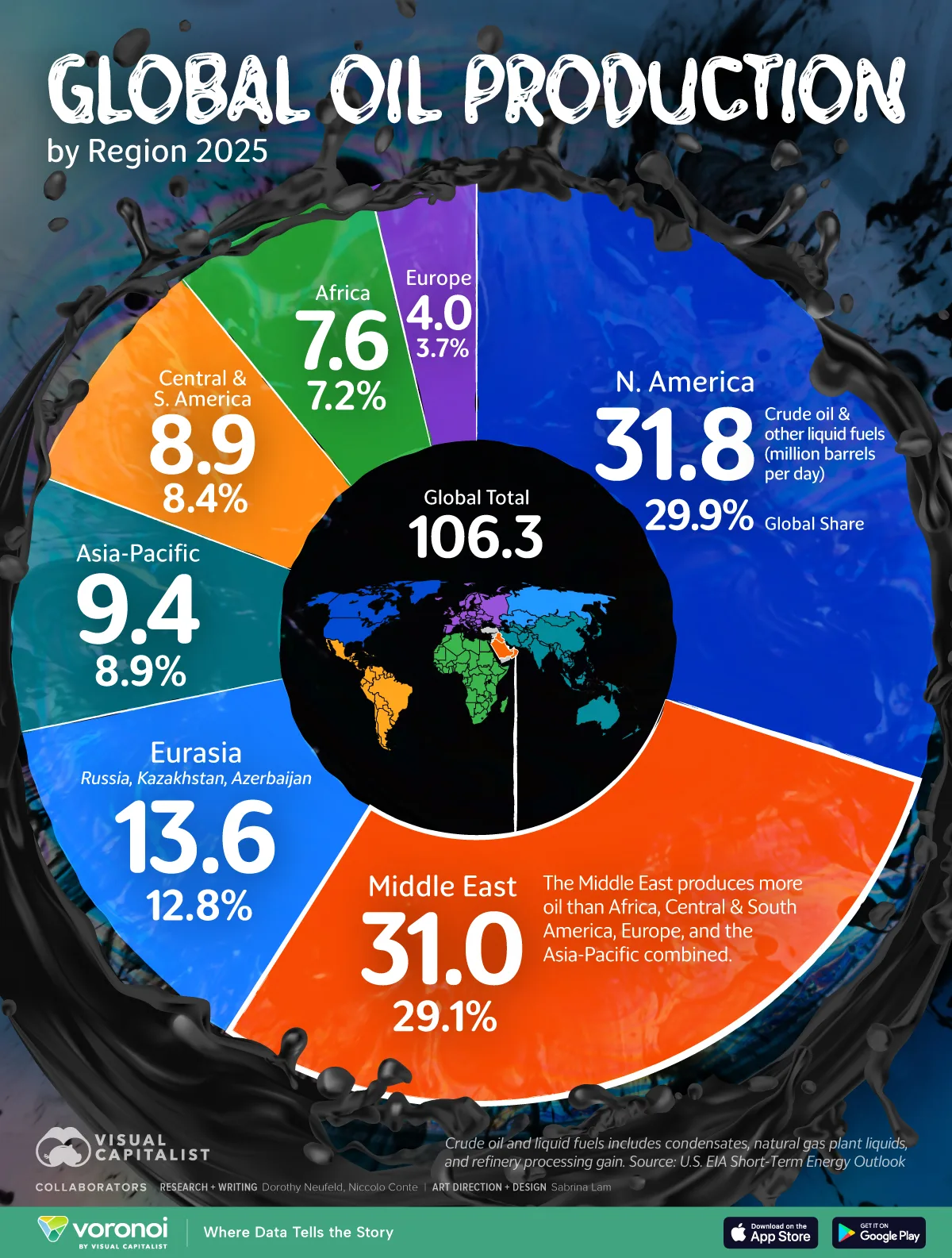
This graphic breaks down global oil production by region in 2025, based on EIA data.
North America Leads Global Oil Production
The table below breaks down global oil production by region, including crude oil and other liquid fuels.
| Region | Crude Oil and Other Liquid Fuels (Million Barrels Per Day 2025) |
Global Share |
|---|---|---|
| North America | 31.8 | 29.9% |
| Middle East | 31.0 | 29.1% |
| Eurasia (Russia, Kazakhstan, Azerbaijan) | 13.6 | 12.8% |
| Asia-Pacific | 9.4 | 8.9% |
| Central & South America | 8.9 | 8.4% |
| Africa | 7.6 | 7.2% |
| Europe | 4.0 | 3.7% |
| Global Total | 106.3 | 100.0% |
North America is the world’s largest oil-producing region, accounting for 29.9% of global output in 2025, averaging 31.8 million barrels per day.
Much of this supply is driven by the U.S., where oil production reached record highs in 2025. Output has more than doubled over the past two decades, largely due to the expansion of shale drilling. Canada also hit record levels, producing 5.0 million barrels per day in December 2025.
The Middle East’s Massive Oil Output
The Middle East is the second-largest oil-producing region, generating 31 million barrels per day in 2025.
Saudi Arabia remains the region’s largest producer at 9.6 million barrels per day. However, the country saw its active oil rig count fall to a 20-year low in 2025, as energy investment increasingly shifts toward natural gas production. By 2030, natural gas production is set to expand 60%.
Iran produced 3.1 million barrels per day in 2025, still below its peak of 4.0 million in 2007.
Even so, the Middle East remains a dominant force in global oil markets. In 2025, it produced more crude oil than Africa, Europe, Central and South America, and Asia-Pacific combined.
Global Oil Trade and Strategic Stockpiles
The Strait of Hormuz remains one of the world’s most important oil chokepoints, handling roughly 20% of global petroleum trade.
While only 7% of U.S. crude exports pass through the corridor, Asian economies depend heavily on these shipments, accounting for nearly 90% of flows through the strait. To protect against supply disruptions, many countries maintain strategic petroleum reserves.
Members of the International Energy Agency, including European importers, Japan, and South Korea, must hold reserves equal to at least 90 days of net imports. Meanwhile, China has built some of the world’s largest stockpiles.
In short, the global oil market depends on a small number of regions—and a few critical trade routes—while strategic stockpiles help guard against supply shocks.
Learn More on the Voronoi App
To learn more about this topic, check out this graphic on all the world’s oil reserves by country.