What Are Your Chances of Reaching 100?
Key Takeaways
- Under 2024 U.S. mortality rates, 3.0% of women and 1.2% of men would survive from birth to age 100.
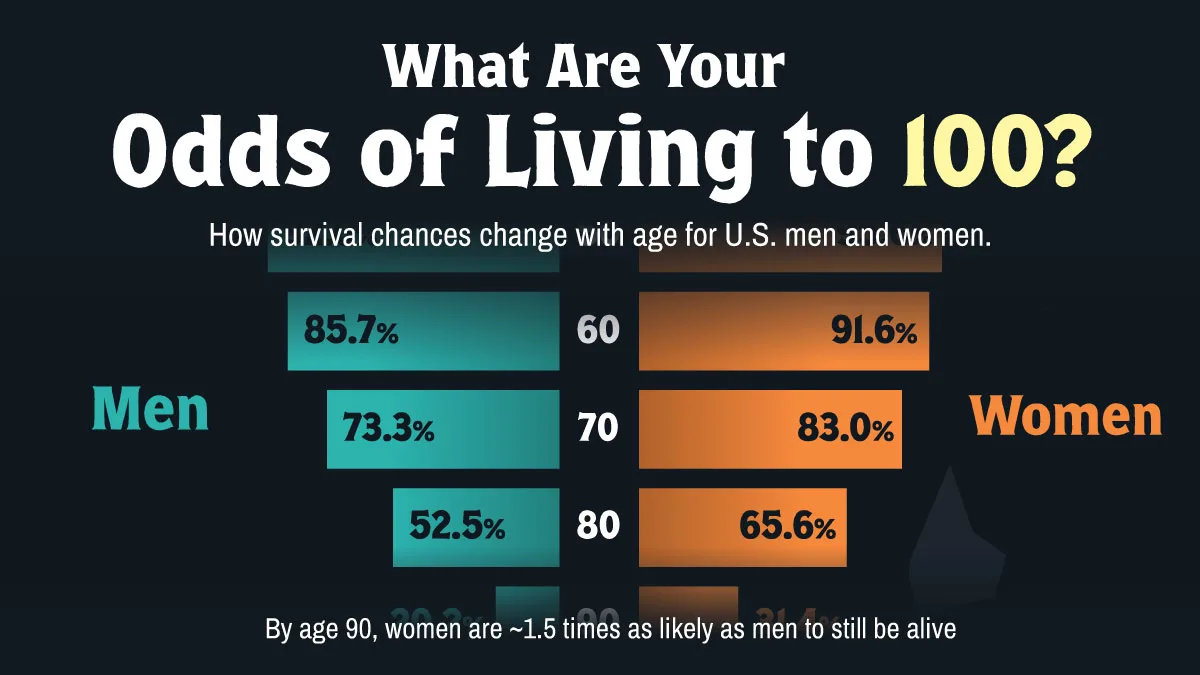
- By age 90, nearly one-third of women (31.4%) and one-fifth of men (20.2%) would still be alive.
- Women have higher survival probabilities than men at every age shown, with the gap becoming particularly pronounced later in life.
Living to 100 is a milestone many people hope to reach, but what are the odds of making it to that age?
The answer depends partly on sex and how far into life someone has already made it. While most Americans would reach age 60 under current mortality conditions, relatively few would survive to their 100th birthday.
This visualization uses the CDC’s National Center for Health Statistics 2024 U.S. life tables to show survival probabilities for men and women at seven ages, from 40 to 100.
The estimates assume that 2024 age-specific death rates remain unchanged throughout a hypothetical lifetime. They are not personalized forecasts or predictions of future medical advances.
How Survival Chances Change For Different Age Milestones
Survival remains relatively high through middle age. Under the life table’s assumptions, 95.3% of men and 97.6% of women would reach age 40.
By age 60, those figures decline to 85.7% and 91.6%, respectively. The difference between men and women becomes more pronounced at older ages.
The table below shows the share of each hypothetical birth cohort expected to survive to selected ages.
| Age | Men: Survival Rate | Women: Survival Rate |
|---|---|---|
| 40 | 95.3% | 97.6% |
| 50 | 92.0% | 95.6% |
| 60 | 85.7% | 91.6% |
| 70 | 73.3% | 83.0% |
| 80 | 52.5% | 65.6% |
| 90 | 20.2% | 31.4% |
| 100 | 1.2% | 3.0% |
By age 80, just over half of men (52.5%) and nearly two-thirds of women (65.6%) would still be alive.
The gender gap becomes especially striking at age 90. Women would be about 55% more likely than men to survive from birth to this milestone under the life table’s assumptions.
Why Women Are More Likely to Reach 100
The longevity gap between men and women reflects a combination of biological, behavioral, and environmental factors.
Researchers have linked women’s longer lifespans to differences in sex hormones, immune function, and genetics. Estrogen, for example, is associated with certain cardiovascular benefits before menopause, although these advantages change with age.
Heart health is another important factor. Men tend to develop cardiovascular disease at younger ages, increasing their risk of premature death. Because cardiovascular disease is a leading cause of death in the United States, these differences can substantially affect survival over a lifetime.
Behavior and exposure to risk also matter. Men have historically experienced higher rates of fatal workplace injuries, accidental deaths, and certain risk-related behaviors. Women are also generally more likely to use preventive healthcare services, which may help identify some health conditions earlier.
Together, these factors help explain why the survival gap persists across the lifespan. However, no single factor accounts for the entire difference, and individual outcomes depend on many circumstances beyond biological sex.
What These Odds Mean for Your Lifespan
Your chances of reaching 100 depend partly on how old you already are. Someone who has reached age 80 has already survived decades of mortality risks, meaning their remaining odds of reaching 100 are higher than the birth-to-100 probabilities shown in the chart.
This distinction matters because the figures describe a hypothetical birth cohort rather than the probability that someone currently aged 40, 60, or 80 will live to 100.
Using the life table figures, approximately 4.6% of women who reach age 80 would subsequently reach 100, compared with roughly 2.3% of men who reach 80.
A similar principle applies to life expectancy, which changes as people get older. Our visualization of how much time Americans have left to live at different ages explores this relationship in more detail.
These estimates offer a snapshot of longevity under 2024 mortality conditions, not a forecast of how long today’s Americans will live. Improvements in healthcare, medical technology, and living conditions could change the odds for future generations.
For individuals, factors such as genetics, lifestyle, and access to healthcare also shape the likelihood of reaching advanced ages.
Learn More on the Voronoi App
If you enjoyed today’s post, check out Countries with the Highest Obesity Rates on Voronoi.