

The battle between OpenAI’s ChatGPT and Google’s Gemini is one of the most talked-about stories in technology today. These two artificial intelligence (AI) chatbots dominate the market for generative AI tools. They power smart responses, summaries, writing help, and more.
As users and businesses rely on AI more, questions about market competition and environmental impacts have grown. This article compares the two leaders in terms of market share, energy use, carbon footprint, and water consumption to give a clear picture of where the AI landscape stands in 2026.
Market Share: Where ChatGPT and Gemini Stand
As of early 2026, ChatGPT still leads the AI chatbot market. ChatGPT has around 68% of the market share based on visits and user interactions. This is less than its previous dominance.
In comparison, Google Gemini accounts for about 18.2% of the market share, showing rapid growth over the past year. This shift marks a major change in how users choose AI tools worldwide.
ChatGPT has maintained a large user base with around 800-900 million weekly active users and billions of monthly visits. But Gemini is also growing fast. Its user numbers have increased as Google adds it to more services.
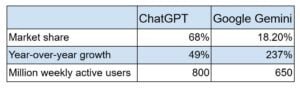
Other AI platforms, such as DeepSeek, Grok, Perplexity, and Claude, hold smaller shares of the market but are growing in niche areas. ChatGPT and Gemini lead the global chatbot market. This shows a duopoly trend, with two main players in control.
The market positions of ChatGPT and Gemini reflect their different strategies. OpenAI built ChatGPT as a standalone AI platform with powerful language skills. It became popular early and gained millions of users quickly.
Google, meanwhile, embedded Gemini into search engines, Android devices, and other Google apps. This gives Gemini a wide reach, helping it grow faster in recent years as users encounter it automatically.
For users, this means choice. Some prefer ChatGPT’s deep text-generation and creative outputs. Others choose Gemini for quick answers tied to search and Android use.
As both platforms grow, competition will likely push innovation in AI quality, safety, and usefulness. And for climate-conscious and environmentalists, this means taking a closer look at the platforms’ growing energy use, carbon emissions, and water use.
AI’s Energy Footprint: Data Centers and Electricity
As AI use expands rapidly, the energy footprint of the technology has become an important topic. AI models like ChatGPT and Gemini run on large networks of servers housed in data centers. These facilities use electricity to power computing tasks and to keep equipment cool.
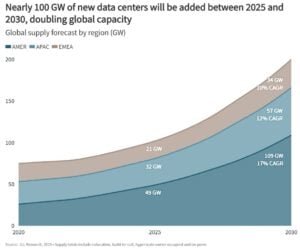
In 2024, data centers used around 415 terawatt-hours (TWh) of electricity. This is about 1.5% of the world’s total electricity consumption. AI workloads are a growing part of this total.
- The International Energy Agency predicts that data center electricity use may double to around 945 TWh by 2030.
This increase comes as AI and other digital services grow. Another research shows the same trend:
AI electricity use varies by task. Training large models—such as initial versions of GPT and other deep learning systems—can consume very large amounts of power. For example, training early large language models used tens of gigawatt-hours of electricity.
- Running the model for user queries (called inference) uses much less energy per request but occurs far more frequently.
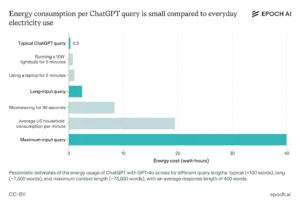
In a direct comparison of per-prompt energy use, Google found that a typical Gemini text prompt consumes about 0.24 watt-hours (Wh) of electricity. This is roughly equivalent to the energy used by a small household device running for a few seconds.
ChatGPT queries, on the other hand, use about 0.34 Wh of electricity. That’s similar to running a lightbulb for a short time. This makes per-query energy costs relatively low but still significant when scaled to billions of daily uses. Over time, improvements in hardware and software have greatly reduced energy and carbon use per prompt.
Carbon in the Cloud: Emissions of AI Systems
Carbon emissions from AI are tied closely to electricity use. Where the electricity comes from—renewable sources versus fossil fuels—greatly affects emissions. Data centers powered by coal or gas produce more carbon than those using wind, solar or hydroelectric power.
Global AI and data centers are currently responsible for a small but growing share of carbon emissions. Combined data center emissions contribute to the broader trend of digital technologies impacting climate change.
Projections show that by 2035, AI’s carbon footprint may vary greatly. This depends on future energy mixes and how AI is deployed. Estimates suggest possible annual emissions ranging from 300 to 500 million tonnes of CO₂ by the mid-2030s. The exact share attributable to AI specifically will vary based on how much AI workloads grow within overall data center use.
ChatGPT and Google’s Gemini differ in their carbon footprints per query. A typical ChatGPT query generates about 0.15 grams of CO₂ per text prompt. In comparison, a typical Google Gemini query emits around 0.03 grams of CO₂ per prompt. This means Gemini’s per-query carbon footprint is about five times lower than ChatGPT’s based on current estimates.
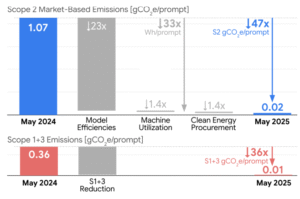
Both companies promise to cut carbon intensity. They plan to do this by improving data center efficiency, buying renewable energy, and upgrading hardware.
For example, Google reported dramatic reductions in energy and carbon footprints for Gemini queries over a one-year period due to efficiency gains and cleaner energy sourcing.
Cooling Costs: Water Use in AI Data Centers
Water consumption is another environmental concern for AI because data centers use water for cooling. Keeping servers cool in large facilities often requires water-cooled systems, especially in warmer climates.
Global AI-related water withdrawal has been rising. Estimates suggest that AI data centers might use 4.2–6.6 billion cubic meters per year by 2027, which is equivalent to 4.2–6.6 billion tonnes of water. This amount is similar to the yearly water use of medium-sized countries.
At the individual query level, water use is very small. For example, OpenAI’s CEO has stated that a single ChatGPT query uses about 0.000085 gallons of water (or ~0.32 ml)—a tiny amount comparable to a few drops. But at scale, with billions of queries each day, total water demand becomes significant in the context of data center cooling systems.
Google’s data reveals that a typical Gemini text prompt uses about 0.26 milliliters of water. That’s about the same as a few drops, considering data center operations.
The Bigger Picture: AI’s Environmental Footprint
AI’s environmental footprint extends beyond individual models and queries. Data centers are expanding rapidly because of increased AI adoption and other online services. Data center electricity use might reach almost 3% of global demand by 2030. This growth highlights the importance of sustainable practices in the tech industry.
While per-query energy and carbon figures can seem small, the aggregate impact of billions of daily AI interactions adds up. Power use and cooling needs can stress local energy grids and water supplies. This happens if companies don’t use renewable sources and efficient technologies.
Major tech companies have made public commitments to use renewable energy and improve energy efficiency at data centers. Experts say that real transparency in environmental impacts needs better reporting. It also requires standardized metrics throughout the AI industry.
So, Who Wins the AI Race?
In the AI chatbot market, ChatGPT continues to lead with about 68% market share in 2026, while Google’s Gemini holds approximately 18.2% and is growing fast. Their competition reflects differences in strategy, reach, and integration into broader technology ecosystems.
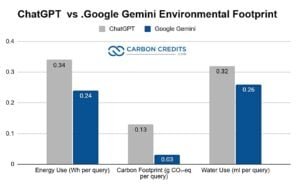
On environmental performance, both AI systems contribute to energy use, carbon emissions, and water consumption through data centers. Per-query measurements such as 0.24–0.30 Wh of electricity and tiny amounts of water per request show that individual impacts are small.
However, the aggregate resource use of running AI at scale is significant and growing. Global demand for electricity in data centers is expected to rise sharply by 2030. Water use might also increase as AI adoption expands.
Understanding these footprints and market dynamics helps users, developers, and policymakers see the costs and benefits of AI. AI tools like ChatGPT and Gemini will keep changing tech markets. They will also influence talks about sustainability in our digital world.
- MUST READ: AI Drives a Transformative Wave in Global Data Centers – and Energy Is the Real Bottleneck
The post ChatGPT vs. Gemini: Who Leads the AI Race and at What Environmental Cost? appeared first on Carbon Credits.


