

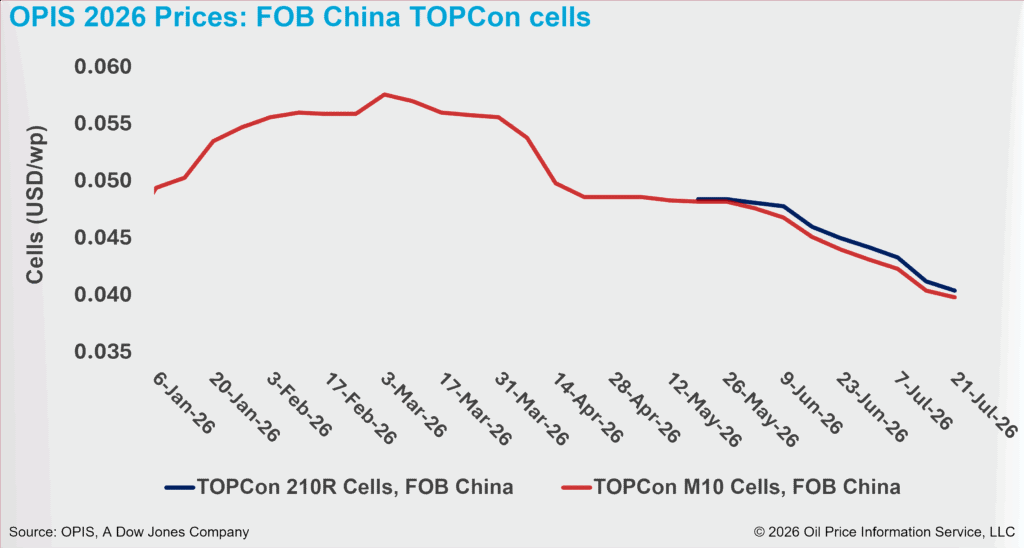
Free-on-board (FOB) China TOPCon cell prices continued to decline, pressured by weak end-user demand, cautious procurement and persistent oversupply, according to industry sources. Export demand also remained subdued, with overseas buyers continuing to seek lower offers and purchasing only limited volumes, market participants said.
According to the OPIS Global Solar Markets Report released July 21, FOB China TOPCon M10 cell prices fell 1.49% week on week to $0.0404/W. FOB China TOPCon 210R cell prices declined 1.94% to $0.0412/W.
Upstream wafer prices also remained under pressure, limiting cost support for cells.
The Silicon Industry Branch of the China Nonferrous Metals Industry Association (CNMIA) said weak demand from cell manufacturers had restricted wafer procurement largely to small-volume purchases for immediate production needs. Wafer producers, meanwhile, maintained broadly stable operating rates, keeping overall supply largely unchanged.
According to the association, two leading wafer producers were operating at 54% and 56%, respectively, while integrated manufacturers were running at 58%-60% and other producers at 56%-78%, broadly in line with the previous week.
CNMIA said falling polysilicon prices had weakened cost support for wafers, while elevated inventories and subdued downstream demand continued to weigh on the market. Expectations of further price declines also discouraged purchasing and reinforced bearish sentiment. The association expects wafer prices to remain under pressure in the near term.
Demand from India, however, is expected to provide some support for FOB China cell exports during the remainder of 2026.
India’s Ministry of New and Renewable Energy (MNRE) has postponed the implementation of its Approved List of Models and Manufacturers (ALMM) List-II domestic-cell requirement for open-access and net-metering projects until Jan. 1, 2027.
Projects in the two categories commissioned by Dec. 31, 2026, may continue using India-made modules containing imported cells that are not listed under ALMM List-II.
An Indian manufacturer said the extended window would likely prolong cell procurement from China and delay part of India’s transition toward modules made with domestically manufactured cells, supporting imported-cell demand through the second half of 2026.
However, market sources said additional demand from India would be insufficient to offset weak consumption and excess supply across the broader export market.
Separately, China will introduce a consumption tax on photovoltaic cells from April 1, 2027, beginning at 2% before increasing to 4% from April 1, 2028.
The tax will also apply to the cell-manufacturing portion of finished modules, including modules produced by vertically integrated manufacturers. Emerging technologies including perovskite, tandem and gallium arsenide cells will remain exempt through Dec. 31, 2028.
Market participants said the measure could put upward pressure on cell offers and temporarily strengthen demand if buyers bring forward purchases ahead of its implementation.
However, sources cautioned that manufacturers may struggle to pass the additional cost fully to customers because of persistent oversupply and weak margins across the supply chain.
Some export-oriented manufacturers could also consider shifting a greater share of cell and module production outside China to reduce their exposure to the tax. Industry participants said producers would need to compare the potential tax burden on orders after April 2027 with the cost differential between domestic and overseas production before determining whether such a strategy is economically viable.
OPIS, a Dow Jones company, provides energy prices, news, data, and analysis on gasoline, diesel, jet fuel, LPG/NGL, coal, metals, and chemicals, as well as renewable fuels and environmental commodities. It acquired pricing data assets from Singapore Solar Exchange in 2022 and now publishes the OPIS APAC Solar Weekly Report.
The post China TOPCon cell prices extend decline on weak demand and oversupply appeared first on pv magazine Global.


