
Growing Degree Days (GDD) are a foundational metric in agriculture, used to predict when crops will germinate, flower, and reach harvest. Yet for many growers and food companies, turning GDD data into something useful still means wrestling with spreadsheets, manual calculations, and fragmented forecasts.
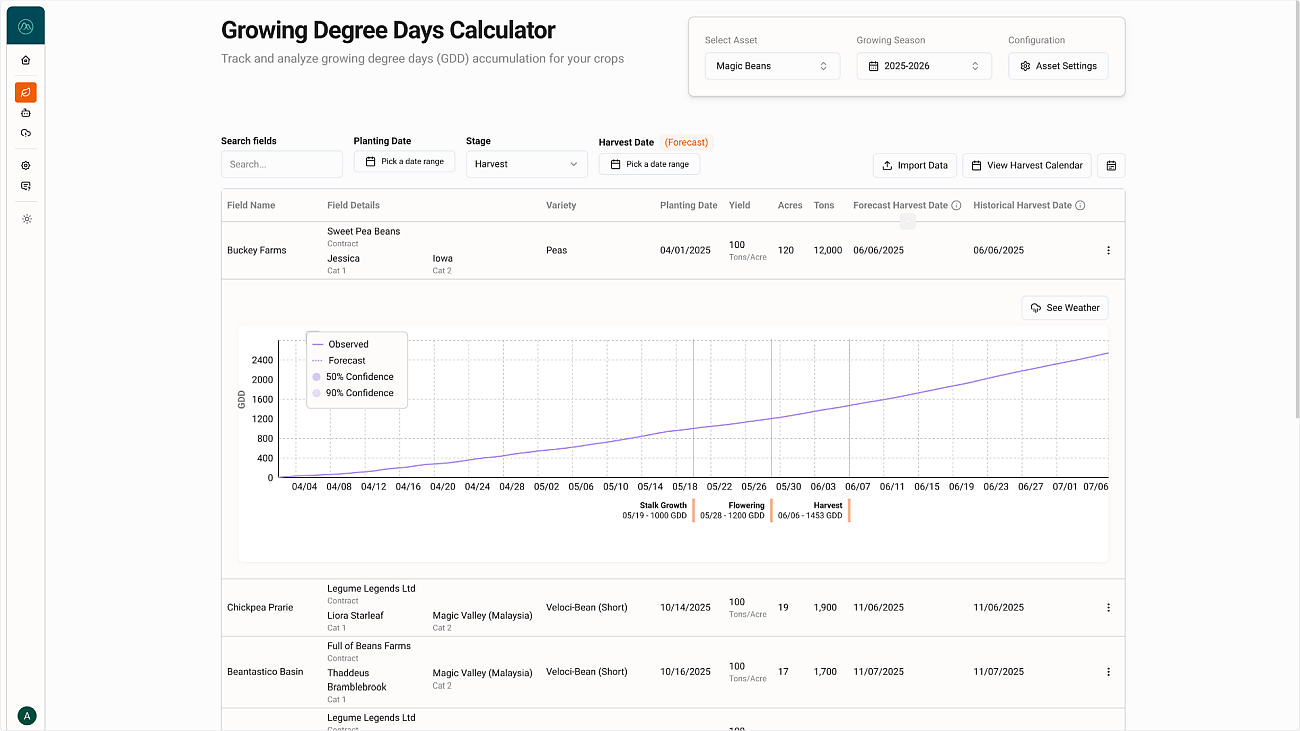
That pain point prompted California-based ClimateAi to build a new tool that combines visualization, forecasting, and agentic AI to help customers plan harvest windows, manage disease risk, and coordinate labor—without relying on Excel.
“When we were talking to customers, it became clear that GDD was a meaningful pain point, with one saying that if you can get me off my Excel spreadsheet, I’ll be a customer for life,” COO Will Kletter told AgFunderNews.
“Our first step was [enabling] visualization of GDD accumulation with graphs and field-level maps that track specific crop varieties and locations with daily updates. The next question was, ‘Can agentic AI move this from an automated monitoring tool to something enabling our customers to take action or for the platform itself to take action?’”
What are Growing Degree Days?
👉 Growing Degree Days are used to estimate the timing of flowering, fruiting, and harvest and predict when specific pests are likely to emerge based on accumulated heat over time.
👉 They work by tracking the number of days where temperatures exceed a certain baseline or threshold, with more GDDs usually corresponding with faster plant growth, although rapid accumulation can also lead to early maturation, crop stress, or increased pest activity.
👉 Historical GDD data can also be used to help estimate optimal harvest times. However, climate change is making historical averages less reliable.
Coordinating harvests, trucks, and capacity
More accurately predicting when a given crop is ready to harvest matters for farmers, “but also for folks at a processing facility to say what volumes are going to be ready on a given day,” said Kletter.
“In the case of a frozen vegetables customer, they’re trying to figure out how many peas might come to the factory on a truck on a given day, and whether they are going to have the right capacity to get these peas frozen at the peak of freshness and nutrition.”
He added: “We invited anyone who participated in a recent webinar to have a free trial and got over 20 signups immediately, which allowed us to get a lot of feedback from row crop segments, potatoes, specialty vegetable crops, and wine producers.”
One of the company’s food processing customers has a software platform that tracks all of its contracts with growers for the upcoming season with field names and locations, what crop is being grown, and how much has been planted, he explained.
Previously, it was downloading all this info into a spreadsheet, manually adding growing degree days and trying to run calculations on Excel, he said. Now all the calculations are done on Climate Ai’s platform, which predicts when a crop might reach a certain stage with a corresponding confidence level and how this may differ from previous years. It then “collects data from multiple fields so you can look at things like how many trucks are going to show up on a given day at a certain processing facility,” he said.
ClimateAi can also overlay crop-specific risk alerts emerging from its platform around events such as extreme rainfall to further assist the planning process, he added.
Embedding climate intelligence into workflows with AI
Best-known for its long-range weather forecasting, ClimateAi originally targeted big seed and ag chem companies but has recently gained the most traction from firms “sourcing agricultural commodities from dozens, hundreds or thousands of fields,” said Kletter.
A steady “organizational shift” within the food industry, whereby procurement and sustainability teams have started to merge, “defines a real shift in the thinking around how climate has become a core business variable,” he suggested.
Originally, ClimateAi was trying to start a conversation about how extreme weather and climate is becoming a core business variable in operational and strategic planning, he said. “The key question now is how does this become deeply integrated into our customers’ day-to-day workflows?”
He added: “Over the past year it has been clear how important it is to be able to roll out AI tools very quickly to our customers.”
While this has involved bringing in some new talent, AI-assisted coding tools have also empowered subject matter experts within ClimateAi’s team to build tools without necessarily needing “pure-play” AI expertise, he said. “Data scientists can now become software engineers.”
AI agronomy agents
When it comes to AI workflow tools, he said, “We can now have customers train their own AI agronomy agent, so that when a sourcing manager, production manager or grower sees [predicted] high rainfall during planting, the platform is not just informing them that this might occur, but [advising] what they could do about it.”
While customers appreciate ClimateAi’s detailed graph-laden reports, meanwhile, they also like to see information presented in “plain English, with natural language summaries that focus on the key information, including recommended action from an AI agronomist,” he said.
Asked whether the firm is profitable, he said: “Investing in our technical team to stay competitive on AI has become more important than being immediately profitable, and we’re OK with that as long as the unit economics of the business remain favorable.”
Further reading:
🎥 Helios taps AI agents for ag insights at ‘worst time’ for procurement pros
The post ClimateAi targets key ag pain point with new GDD tool, embeds AI into workflows appeared first on AgFunderNews.


