
A new phase in global climate governance is emerging, with a growing number of initiatives operating alongside, rather than within, the formal UNFCCC negotiation framework. The 2026 Santa Marta Summit on Transitioning Away from Fossil Fuels marked the creation of the Santa Marta Process, a structured plurilateral forum designed to support countries seeking to accelerate the implementation of fossil fuel phase-out strategies beyond the constraints of consensus-based negotiations.
Held from 24th to 29th April 2026 in Santa Marta, Colombia, the Summit brought together more than 50 countries, alongside the European Union, international initiatives, researchers, Indigenous leaders, and civil society actors. Rather than serving as a space for new ambition-raising commitments, the Summit focused on developing implementation and investment plans, strengthening cooperation among frontrunner countries, and establishing practical mechanisms to support fossil fuel transition strategies ahead of COP31. While not a formal negotiating body, the Summit signals a growing shift toward implementation-focused coalitions, particularly in areas where multilateral consensus has proven difficult to achieve.

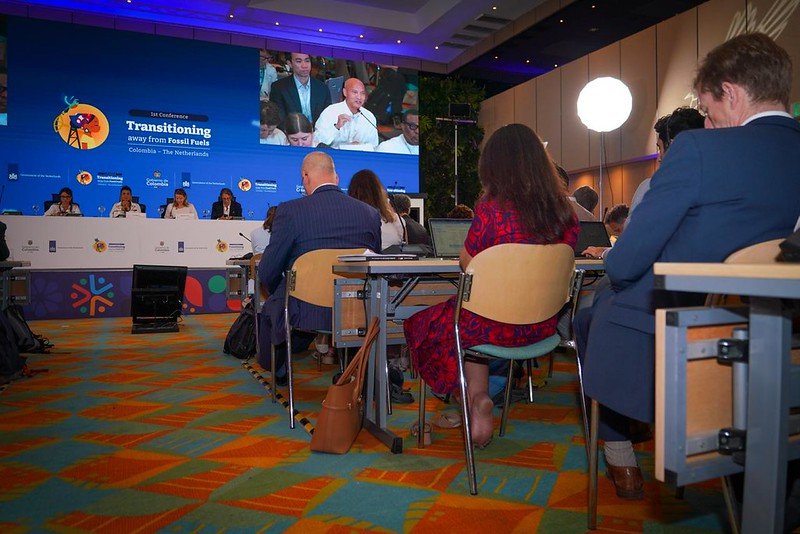
The Santa Marta Summit emerged against the backdrop of a widening gap between high-level climate commitments and the pace of real-world energy transition. Global greenhouse gas emissions reached a record 57.7 gigatons of CO₂e in 2024, rising 2.3% year-on-year while fossil CO₂ emissions alone are projected to hit a new peak of 38.1 billion tonnes in 2025. To align with the Paris Agreement’s 1.5°C pathway, emissions must fall 42% by 2030 and 57% by 2035, yet current pledges put the world on track for 2.6–3.1°C warming. Meanwhile, the climate finance gap yawns wider: developing countries’ adaptation needs ($310–365 billion/year in 2023 prices, rising to $440–520 billion by 2035), and fossil fuel subsidies remain staggering at $6.7 trillion annually (5.8% of global GDP) in implicit support.
So, the core premise of the Summit, and a broader evolution in climate diplomacy, is that countries willing to move faster on fossil fuel phase-out can and should coordinate through complementary forums that operate alongside consensus-based UN negotiations. Countries such as France, Colombia, the Netherlands and Ireland are among those pushing for a faster transition away from fossil fuels. France presented a roadmap to phase out coal by 2030, oil by 2045 and gas by 2050, while Colombia is developing a national strategy focused on renewable energy, electrification and reducing dependence on fossil fuel revenues. The Netherlands is also advocating for stronger international cooperation and policies to accelerate the shift toward clean energy. Within the Santa Marta Process, these roadmaps are framed as implementation and investment plans, intended to identify concrete pathways, financing needs, and policy mechanisms required to accelerate fossil fuel phase-out rather than establish new ambition-raising commitments.
This reflects how coalitions of the willing can demonstrate feasibility, build political momentum, and gradually shape norms that diffuse into wider climate governance processes. Rather than replacing the UN system, these initiatives act as complementary accelerators, testing policy approaches, aligning narratives, and reinforcing the direction established under COP28 to transition away from fossil fuels.
Progress on this ambition remains uneven across regions and sectors, and the overall pace of change continues to fall short of what is required to meet climate targets. In this context, the Santa Marta Summit was designed less as a space for new declarations and more as a platform for practical cooperation, bringing together actors already committed to accelerating fossil fuel phase-out in order to strengthen coordination, align strategies, and support implementation efforts.
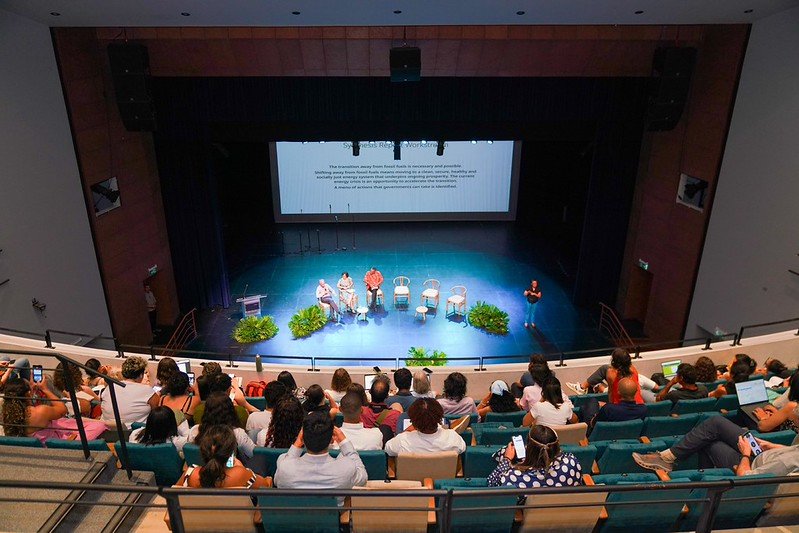
A central dimension of the Summit was the question of justice. Participants repeatedly emphasized that energy transitions must be fair and inclusive, highlighting the importance of Indigenous leadership, the protection of affected workers and communities, and the need to address deep structural inequalities embedded in the global energy system. This framing reinforces the understanding that fossil fuel phase-out is not only a technical or economic challenge, but also a social and political transformation requiring inclusive governance and long-term coordination.
Another important outcome of the Summit was the creation of the Santa Marta Network, the collaborative platform sustaining the Santa Marta Process between major international climate negotiations. The Network connects governments, scientists, experts, and civil society organizations to facilitate knowledge exchange, strengthen policy coordination, and maintain momentum on fossil fuel transition strategies. By creating a permanent structure for cooperation, the Network ensures that the commitments and technical work developed through the Summit continue beyond the event itself.
The Santa Marta Process also established three new inter-conference workstreams designed to contribute to the broader UNFCCC Global Climate Action Agenda. These include the newly created Science Panel for Global Energy Transition (SPGET); analysis of macroeconomic dependencies linked to fossil fuel reliance, supported by the International Institute for Sustainable Development (IISD); and work on trade and investment considerations, supported by the OECD. Together, these workstreams aim to address the technical, economic, and financial barriers that continue to slow fossil fuel phase-out efforts. The creation of the SPGET, in particular, highlights the importance of scientist-led expertise in guiding evidence-based transition pathways.
As attention turns toward COP31, to be held in Antalya, Turkey this November, the relevance of the Santa Marta Process will likely be assessed in terms of its ability to generate tangible policy shifts and expand participation in fossil fuel transition initiatives. Outcomes from the Santa Marta Summit can inform preparations for COP31, and indications that this parallel process is working may include the expansion of coalitions, the strengthening of national climate commitments, increased action on fossil fuel subsidy reform, and the scaling up of climate finance mechanisms that support countries in their transition pathways.
Looking beyond COP31, the continuation of the Santa Marta Process will be supported by the announcement that Tuvalu and Ireland will co-host the 2027 edition of the Summit, reinforcing the intention to maintain momentum and expand international cooperation on fossil fuel transition.
Beyond these measurable outcomes, however, the Summit’s true value may lie in what it represents for the broader climate governance landscape: an increasingly complex system in which multiple actors and platforms contribute to a shared objective, and where progress depends not only on formal negotiations, but also on the ability of coalitions to accelerate action, build trust, and translate ambition into implementation. The Santa Marta Process offers an important example of how climate leadership is being redefined, highlighting a shift toward more distributed and action-oriented forms of cooperation, shaped by experimentation with new governance models, and offering a glimpse into how international climate action may continue to evolve in the lead-up to COP31 and beyond.


