
Ontario pork producers are being urged to step up efforts to the reduce the risk of viruses that can take hold in colder weather, particularly Porcine Epidemic Diarrhea (PED) and Porcine Deltacoronavirus (PDCoV).
Last winter, Ontario’s swine industry saw a significant spike in diagnoses of both viruses, and the industry is hoping to prevent a repeat in 2026.
Why it matters: Both PED and PDCoV enter a greater state of stability in cold, wet environments.
Both PED and PDCoV can affect pigs of all ages, and PED is often fatal to newborn pigs under seven to 10 days of age.
Dr. Conor Voth, a veterinarian with Demeter Veterinarian Services, says that clinical signs in finishing can be mild and missed easily, although in some cases a watery scour will move through the barn and pigs will go off feed for a day or more. He adds that often mild clinical signs can be assumed to be due to a feed change, old crop corn, ileitis, or colitis.
Timing is key to bringing an infection under control. Voth notes that these viruses spread extremely quickly; often once clinical signs are seen, it is too late to contain it in any part of the barn.
“Pigs begin shedding the virus in as little as 12 to 48 hours after they are infected, and when they begin shedding, they shed large quantities,” he says.
The viruses are extremely stable in the environment, and only a small amount is needed to infect a pig. All of these qualities make it easy to track around and spread. “It is often tracked through all areas of the barn before it is noticed,” he said.
Although PDCoV is generally considered less severe overall, Voth says it can be difficult to differentiate between the viruses based on clinical signs.
“This is definitely true in piglets on the sow, although in older animals, like finishing pigs and sows, PDCoV can have more severe clinical signs; it should have little to no impact on mortality, similar to PED,” he said.
He says it’s best to send samples to the lab for PCR testing, which not only can identify whether the sample is positive, but how much a virus is present.
Samples can include feces, intestines, rectal swabs, saliva and environmental swabs. Voth notes that saliva may seem odd for an enteric virus, adding that it is also like an environment test because pigs have their environment in their mouths.
He says while some veterinarians may be comfortable making a diagnosis on-farm, particularly on sow farms where the severity and rapid spread of piglet scour can be close to pathognomonic, nursery barns may be the most challenging. “Scour can actually be somewhat limited and an increase in fallbacks may be the main health issue seen.”
Need for biosecurity protocols
Voth says having proper barn entries and known lines of separation between dirty and clean areas is effective at reducing risk of entry of these viruses. He explains that PED and PDCoV do not aerosolize as well as some common respiratory pathogens such as PRRS, so having good entry protocols for staff and visitors can help ensure the viruses are left at the door.
Good entry protocols include:
-No outside boots or clothes are worn in the barn
-All items brought in are thoroughly disinfected
-Talk to contractors and any visitors about biosecurity expectations and ensure they understand all biosecurity processes on the farm
High-risk factors
Voth adds deadstock removal is a high-risk activity, and it’s good practice to assume deadstock trucks and bins, as well as the area around the bins, are positive for these viruses and all other pathogens.
“Anything that comes in contact or goes near them may be picking up these pathogens,” he said.
Having clean, disinfected trucks used for transport of animals to and from the farm also helps significantly. “Having farm staff and truckers do their best not to allow backtracking of animals or debris back into the barn helps but can be challenging to do in practice.”
Voth reminds farmers that these viruses can survive for a long time in the manure pit, with instances of them lasting more than 60 weeks. To be safe, he believes contaminated pit manure can be considered positive forever.
“If you have contract manure hauling, discuss with the customer operator what biosecurity protocols should be in place, and ensure they are not coming directly from a farm that is or was recently positive for PED,” he says.
He adds proper biocontainment of positive farms and managing the movement of positive pigs will help mitigate the spread of the virus across the countryside.
“Being open about having the virus will help neighbours and suppliers ensure they are doing everything they can to prevent spread,” he added.
Voth believes that Ontario is making effective strides in reducing outbreaks.
Swine Health Ontario has developed the Swine Health Area Regional Control (SHARC) to track the virus with the help of the animal health lab, producers and suppliers. Voth says producers can sign up for SHARC, see where infected farms and receive important alerts when new positive cases arise, adding that this makes it much easier to see where the virus currently is and overall pressure in the industry.
He says SHO brings the industry together to work in union and determine the best courses of action, and in his personal experience all producers with farms that break with the viruses have been willing to be open about it to help protect the industry.
“It is important to let all neighbours, and suppliers know, such as the feed company, semen supplier, transporter, and dead stock removal.”
Voth says PED can be emotionally hard on producers and staff, and as vet he tries to support them by explaining euthanizing piglets is best course of action for the farm and industry.
He also recommends that farmers explore the SHARC tool as a resource to know about new cases and track current positive sites, noting it becomes more powerful as more producers join.
Additionally, he would like to see packing plant testing used as a way to look at a large number of pigs and get some idea of infection pressure in the province.
“I would like to see this used even more frequently in the industry than it currently is,” he said.
On-farm protection
TJ Murray operates a wean-to-finish farm in Oxford County. He has been farming for 15 years and also runs a trucking company, moving pigs and equipment through the province.
Murray says his farm has been taking steps to enhance biosecurity protocols for more than a decade.
“In 2014, our farm built a wash bay to ensure all of our trucks are washed and disinfected in a controlled space for every load of pigs we transport. We also stepped up biosecurity at our barn doors through the use of Danish entries and showers where required,” he said.
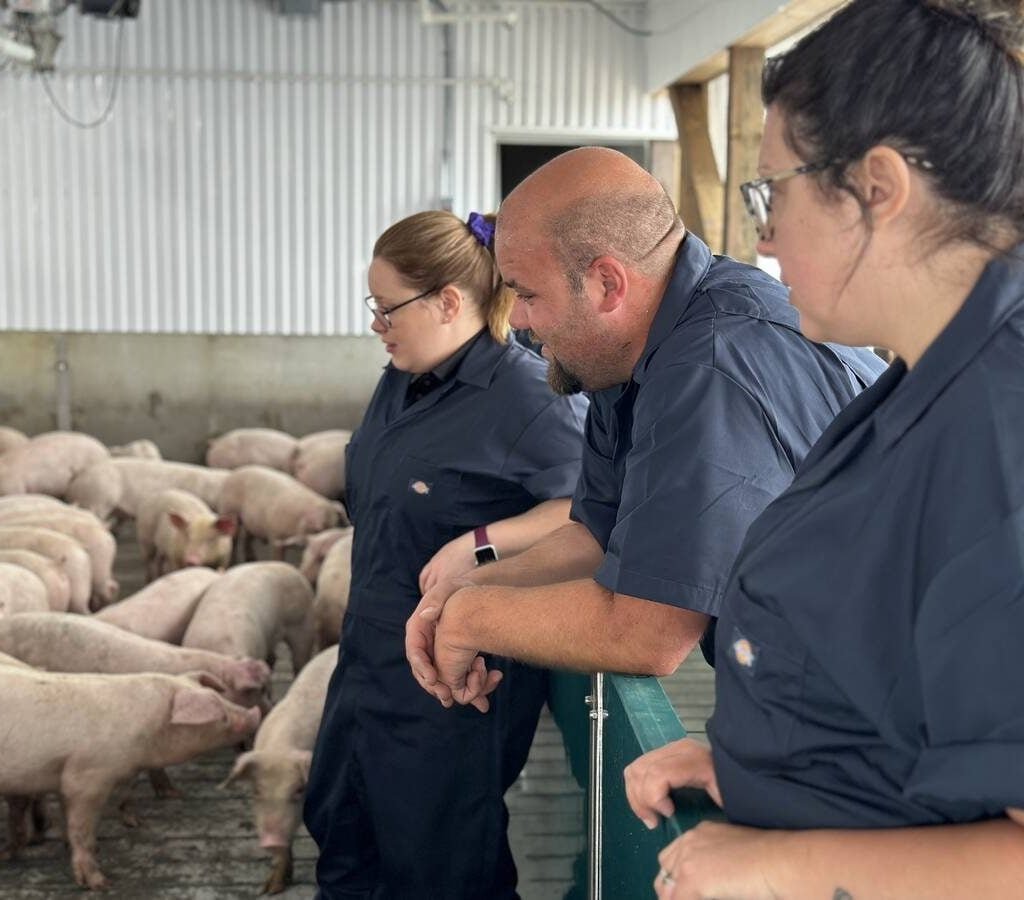
Oxford Country swine farmer TJ Murray (centre) is one of many operators who are working to decrease the risk of PED transmission across the supply chain. Photo: Ontario Pork
Murray shared that from his experience, identifying PED has been fairly obvious.
“When we had our PED challenge, it was in 60-pound pigs and was very evident. We had our vet do a site visit immediately and developed a plan to isolate and move forward,” he says, noting that the result was a 1.8 per cent death loss in the barn.
“Our veterinarian was called immediately when we were suspicious of an outbreak. Testing was completed on-site and through our entire system to ensure it hadn’t spread further than we were aware of,” he explains.
To ensure there are no future outbreaks, Murray says he chooses service suppliers very carefully and takes into account the risk they bring with them.
“Most companies have been great at increasing their biosecurity when visiting multiple sites,” he notes.
These strategies, paired with a solid working relationship with his veterinarian are irreplaceable. He adds that communication and planning are crucial to the spread of the virus.
To mitigate risk, Murray says he uses provincial tracking systems such as SHARC to keep informed of disease pressures in our area.
“We also communicate with neighbours directly when a disease has been present on our sites,” he said.
Murray says progress in control and mitigation comes from producers openly talking about managing the disease.
“Using SHARC and Swine Health Ontario’s resources is helpful in the short term, but producers speaking up early makes the biggest difference,” he said.
“We need to raise awareness of how to prevent these diseases from spreading, especially during the winter.”
The post Cold weather raises PED threat for Ontario swine farms appeared first on Farmtario.


