

Welcome to Townsville, a community located in California’s Central Valley. You have been tasked with working with a few of your fellow residents to implement cropland transition projects around Townsville. There are opportunities to protect the town’s drinking water, develop renewable energy, restore the environment, and encourage your neighbors to adopt more sustainable farming practices to benefit Townsville. Along the way, you must collaborate with your fellow residents to decide which projects to pursue and negotiate with the neighboring landowners to implement a vision for the future of Townsville while facing additional hurdles from extreme weather brought on by Climate Change. You also have to consider the side effects of the current land uses that often seem invisible but have real and ongoing consequences for your community.
This is the world of ‘Common Ground,’ a video game developed by a team of students at Harvey Mudd College in partnership with UCS, to explore just land transition, climate change, and the decisions involved in transitioning cropland in California’s Central Valley.
Drought, extreme heat, and floods
Townsville is fictional, but the problems players must grapple with are based on real challenges Californians are facing today.
California is home to more than 60 thousand farms, covering more than 20 million acres of land. Unfortunately, California’s highly profitable agricultural industry comes at a cost to water security, air quality, and health for nearby residents, farmworkers and small farmers.
Agricultural water demand has taken a toll on the long-term sustainability of California’s groundwater. During the 2012-2016 drought, surface water deliveries were restricted and groundwater pumping in the Central Valley increased, in part due to agricultural demand. Heavy groundwater pumping in the San Joaquin Valley caused thousands of private domestic wells to go dry and contributed to subsidence—a phenomenon where so much groundwater is removed that the land sinks.
The San Joaquin Valley faces challenges from poor air quality, exposure to pollution from pesticides and fertilizers in the air and water, and extreme heat conditions. With climate change, these challenges are becoming more pressing. We’ve already begun to experience the weather whiplash that will become more frequent from flooding in some years to California’s snowpack at historic lows in other years.
Addressing these challenges will require fundamentally changing the systems that govern how we use natural resources and transitioning to practices that rejuvenate, rather than strain, lands and water resources.
The Opportunity—just land transition
California’s commitment to groundwater sustainability means that cropland transition is already underway in California’s Central Valley.
Following the 2012-2016 drought, California adopted new laws and incentive programs to encourage sustainable water practices. In 2014, the Sustainable Groundwater Management Act (SGMA), was passed to regulate California’s groundwater basins and require them to be managed for long-term sustainability. California has also committed to investing roughly a quarter of a billion dollars through the Multibenefit Land Repurposing Program to assist groundwater sustainability agencies with planning and implementing groundwater resilience projects, including groundwater recharge, stormwater capture, and cropland repurposing.
To accomplish California’s groundwater sustainability goal, more than 500,000 acres of irrigated cropland may be repurposed in the San Joaquin Valley alone. Where and how this transition takes place will shape the future of California’s agricultural industry and Central Valley communities.
Instead of allowing market forces to guide where and how agricultural land is taken out of production, a just land transition ensures that communities impacted by the transition are part of the decision-making process. A just land transition based on strategic and intentional cropland repurposing can help shift from practices and systems that are unsustainable and extractive, to those that support communities and local economies. By repurposing cropland inside and around rural communities, we can also reduce public health exposures and provide public benefits. In our recent report, “Working with Nature to Protect California’s Agricultural Regions,” we offered examples of how to use nature-based solutions improve water sustainability and increase public health, climate resilience, and economic benefits.
This transition has the potential to reshape the Central Valley and help communities adapt if public investment dollars are spent on projects that center community decision-making and provide direct and meaningful benefits to frontline communities.
UCS scientists have found that repurposing cropland near communities can produce multiple benefits for communities. Reducing pesticide and fertilizer applications, dust and emissions from agricultural operations, and groundwater withdrawals in proximity to communities can reduce the public health risks faced by frontline communities.
When land is transitioned to projects that provide multiple benefits, including, for example, energy reliability, habitat restoration, flood risk reduction, and groundwater recharge, communities can benefit from land transition. There is enormous potential benefit in exploring nature-based solutions to accomplish climate adaptation and resilience, along with groundwater sustainability.
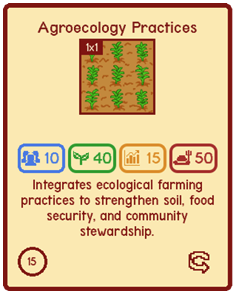
A card from the Common Ground video game. Harvey Mudd College/UCS
Welcome to Townsville
In ‘Common Ground’ players can explore these challenges as they collaborate to implement cropland transition projects in Townsville. Players make spending decisions, negotiate with landowners, and work against unpredictable extreme weather to protect their community.
Players can explore different types of cropland transition opportunities and their benefits in a conceptual way and see how the community, environment, and economy of Townsville respond to their choices.
To develop this game, UCS partnered with an incredible team of students at Harvey Mudd College. Laura, Mia, Nicole, Ria, and Vibhu, led by Professor Kirabo, worked with us over the course of the academic year. We started out with a goal of creating a fun, multiplayer cooperative game, grounded in the idea of transitioning cropland around communities to reduce the negative externalities (e.g. pesticide exposure) and provide meaningful benefits (e.g. improved groundwater levels, access to parks and nature, renewable energy, etc.). The students learned about cropland transition and took on the task of adapting these scientific concepts into game mechanics.
Informed by the real-world effects of nature-based solutions, the students created a range of potential project types in the game, each with different benefits for the environment, community well-being, economy, and local farmers
Over the course of the year, the students sought more feedback through playtests with their peers, UCS staff, and even came to Sacramento to share an early version of the game with the State Agencies and staff working directly on groundwater sustainability and cropland transition.
After a year of hard work, we are so excited to be able to share Common Ground—which is now available for you to play online! This game is designed so that anyone can play—all you need is 3 friends and an internet connection. We hope that the game can be used as an educational tool for anyone and everyone to learn about cropland transition and nature-based solutions, to simulate collaboration and negotiation throughout the project design and selection process and see the benefits and tradeoffs of climate resilience planning.


