

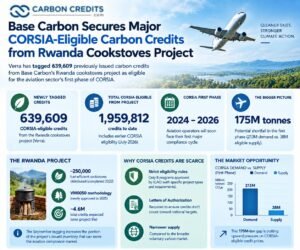
Toronto-based Base Carbon has secured a major expansion of its aviation-compliance carbon inventory. Verra tagged 639,609 previously issued carbon credits from its Rwanda cookstoves project as eligible for the first phase of CORSIA.
The tagging, announced September 28, 2026, brings the total number of CORSIA-eligible credits issued to date from the project to 1,959,812. The credits use Verra’s VM0050 Energy Efficiency and Fuel-Switch Measures in Cookstoves methodology.
The timing is important. The first phase of CORSIA covers 2024–2026, and aviation operators will soon face their first major compliance cycle under the scheme.
At the same time, the supply of eligible units remains much smaller than expected demand. IATA’s June 2026 estimate shows first-phase CORSIA demand at 213 million tonnes of CO2. In contrast, there’s only 38 million tonnes of eligible-unit supply. This creates a potential shortfall of 175 million tonnes.
That shortage gives eligible credits a different market value from ordinary voluntary carbon credits.
One Rwanda Project Nears the 2M-Credit Mark
The newly tagged credits come from Base Carbon’s Rwanda Cookstoves Project, developed with the DelAgua Group. The company funded the distribution of about 250,000 fuel-efficient cookstoves to rural Rwandan households. Distribution was completed in late 2022. The project has since moved to Verra’s VM0050 methodology and is now in its issuing phase.
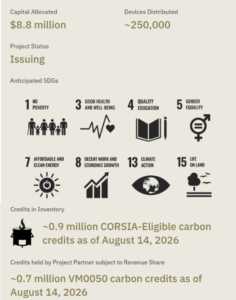
Base Carbon shared that the project was re-quantified under VM0050 after Verra approved the methodology change in 2025. The revised project is expected to generate about 4.6 million carbon credits over its crediting period.
The September tagging is therefore more than a registry milestone. It increases the portion of the project’s issued inventory that can potentially serve an aviation compliance market.
Base Carbon had already received CORSIA eligibility for earlier credits. In July, Verra tagged 342,356 more credits. This raised Base Carbon’s CORSIA-eligible inventory to about 1.1 million credits. The latest issuance pushes the project’s cumulative CORSIA-eligible tagged volume to almost 2 million tons.
Michael Costa, Chief Executive Officer of Base Carbon, said:
“Today’s announcement further demonstrates the maturity and reliability of our Project through the regular cadence of issuance and eligibility. DelAgua’s consistent operational expertise and execution of the Project continue to strengthen our market position, with fully CORSIA-eligible inventories available to meet aviation compliance demand.”
Why CORSIA Credits Are in Short Supply
The market opportunity comes from CORSIA’s strict eligibility rules. CORSIA is the International Civil Aviation Organization’s global market-based system for addressing the growth of international aviation emissions. It is being implemented in phases, with the first phase running from 2024 to 2026 and the second phase beginning in 2027.
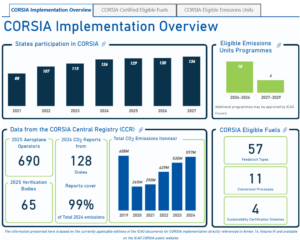
Under CORSIA, airlines must cancel approved eligible emissions units to meet their offsetting obligations, but not every carbon credit qualifies. ICAO approved eight emissions-unit programs for the first phase. These include:
- Verra’s Verified Carbon Standard
- Gold Standard
- American Carbon Registry
- Architecture for REDD+ Transactions
- Climate Action Reserve
- Global Carbon Council
- Isometric
- Thailand’s voluntary program
Even within those programmes, only certain credits and project types are eligible. For credits generated from 2021 onward, host-country requirements can also apply.
ICAO encourages governments to issue Letters of Authorization. These letters will confirm that credits used under CORSIA won’t count toward national climate targets. This makes CORSIA-eligible supply much narrower than the broader voluntary carbon market.
A 175M-Ton Gap Puts a Premium in Play
The shortage is already attracting market attention. IATA’s June estimate showed 213 million tonnes of first-phase demand against 38 million tonnes of supply.
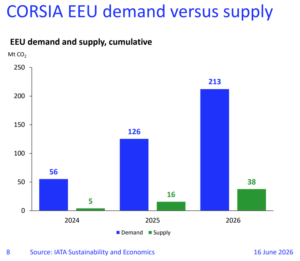
The forecast showed annual demand climbing from around 56 million tonnes in 2024 to 126 million tonnes in 2025. By 2026, it could hit 213 million tonnes. However, supply was only about 38 million tonnes.
Base Carbon also reported in July that its market data showed the ICE December 2026 CORSIA Phase 1 futures contract had risen about 39% since June 30. The company said the European Commission’s proposal to integrate CORSIA into EU law had added confidence to the market.
Base Carbon said the new EU framework might create at least 29 million tonnes of CORSIA demand in the first phase. This is compared to an estimated 40 million tonnes of globally tagged Phase 1 supply announced in July. These figures suggest why tagging can materially change the commercial value of previously issued credits.
A credit once just for voluntary use can now benefit a smaller group of regulated aviation buyers if it meets CORSIA requirements.
Beyond Aviation: The Climate Case for Cookstoves
The Rwanda project also illustrates why clean-cooking projects remain important to carbon markets. Traditional cooking with wood and other solid fuels can drive deforestation while creating high levels of household air pollution.
Verra states that its VM0050 methodology offers a better way to measure emissions reductions. This is specifically for improved cookstoves and fuel switching. The Integrity Council for the Voluntary Carbon Market (ICVCM) approved the methodology under its Core Carbon Principles framework.
Verra states that improved cookstoves in its Rwanda projects can cut firewood use by about 71%. This helps lower household air pollution and eases pressure on forests.
- READ MORE: Verra Approves Rwanda’s 5.69 Million Article 6 Carbon Credits, A Major Boost for Clean Cooking
The climate benefit comes from lower fuel consumption and the resulting reduction in greenhouse gas emissions. That makes the Rwanda project relevant to both the climate and development sides of the carbon market.
The Credits Are Not All Held by Base Carbon
Another important detail is ownership. As of May 2026, Base Carbon held around 1.1 million VM0050 credits from the project. Additionally, about 700,000 credits were issued to project partner DelAgua through its revenue-sharing agreement.
The September announcement talks about the 639,609 credits issued from the project. It doesn’t say that Base Carbon owns all 639,609 now. This distinction matters because the project’s economics are shared between Base Carbon and DelAgua.
Base Carbon has already monetized part of the eligible inventory. In early 2026, DelAgua sold around 200,000 CORSIA-eligible credits. This marked the first time credits were monetized after the VM0050 transition. The new tagging could create more opportunities to sell credits into the aviation market.
More Rwanda Credits Could Follow
Base Carbon expects the project to continue generating credits. The company estimates that about 2.6 million more credits could be issued. These would be released every six months for the rest of the project’s crediting period. It expects those future credits to become CORSIA-eligible as well.
That potential future supply is significant when compared with the current market. If delivered as expected, the additional volume would exceed the 1.96 million CORSIA-eligible credits already issued from the project. However, future issuance remains a company forecast. Actual volumes will depend on project performance, verification and continued compliance with CORSIA and Verra requirements.
The company has also warned that future results can differ from its projections because of factors outside its control.
CORSIA Phase Two Could Expand the Demand Pool
The Rwanda tagging arrives just months before CORSIA’s second phase begins. From 2027, participation will expand based on ICAO’s criteria, with 134 states participating according to the current ICAO list.
The second phase will run from 2027 through 2035, with some countries exempt under the programme’s rules. That broader participation could increase the need for eligible units.
ICAO has approved four programs to provide credits for the 2027–2029 second phase:
- American Carbon Registry
- Architecture for REDD+ Transactions
- Gold Standard
- Verra’s Verified Carbon Standard/Jurisdictional Nested REDD Programme.
However, the eligibility window and project-level requirements still apply. This means the market could face a continuing difference between the number of carbon credits in existence and the number that airlines can actually use.
CORSIA Is Turning Eligibility Into a Market Asset
Base Carbon’s latest announcement highlights a major change in the carbon market. For years, the key question for a credit was whether it represented a credible emissions reduction. Increasingly, another question matters: where can that credit legally and credibly be used?
CORSIA eligibility can turn an ordinary voluntary market credit into a unit with access to a regulated aviation market. As CORSIA moves deeper into its first compliance cycle and prepares for broader participation from 2027, credits with verified eligibility could become an increasingly important segment of the global carbon market.
The post CORSIA Credit Crunch: Base Carbon Adds 640,000 Rwanda Credits to Aviation Market appeared first on Carbon Credits.


