
Costa Rica reported more than 10.2 million tonnes of net carbon dioxide equivalent (CO2e) removals from REDD+ activities between 2020 and 2023, according to a new United Nations technical review.
The latest UNFCCC report found that Costa Rica’s reported results totaled 10,277,856 tonnes of CO2e across the four-year period. The results came from efforts to reduce deforestation and forest degradation and increase forest carbon stocks.
The report is important for Costa Rica’s forest carbon strategy. It confirms that the country’s data and methods are broadly consistent with UNFCCC requirements. It also shows how Costa Rica is building on its long-running forest conservation and payments-for-ecosystem-services programs.
However, the results should not be confused with 10.2 million carbon credits already issued for sale. They are REDD+ results reported for the purpose of accessing results-based payments. That distinction is important as governments place greater focus on high-integrity forest carbon markets.
Costa Rica’s Forests Deliver More Than 10M Tons of Net Removals
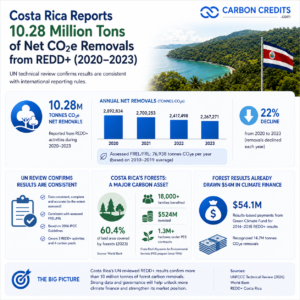
Costa Rica’s reported net removals declined each year during the 2020–2023 period. The UNFCCC technical report lists:
- 2020: 2,892,834 tonnes of CO2e
- 2021: 2,700,253 tonnes
- 2022: 2,417,498 tonnes
- 2023: 2,267,271 tonnes
Together, the four years produced about 10.28 million tonnes. The annual total fell by about 22% between 2020 and 2023. Even so, Costa Rica reported net removals in every year covered by the review.
The UN assessment measured the results against Costa Rica’s assessed forest reference emission level (FREL) and forest reference level (FRL) of 76,938 tonnes of CO2e per year. That reference level is based on average historical emissions and removals from 2010 to 2019. It covers Costa Rica’s national territory except Cocos Island.
UN Review Finds the Results Consistent
The new report provides an important layer of independent technical review. UNFCCC experts concluded that Costa Rica’s data and information were consistent, complete and accurate to the extent that they could be judged, while describing the information as mostly transparent.
The experts also found that the reported results were consistent with the assessed FREL/FRL.
Costa Rica used the 2006 IPCC Guidelines for National Greenhouse Gas Inventories to estimate emissions from deforestation and forest degradation and removals from enhanced forest carbon stocks. The country’s national approach covers three REDD+ activities:
- Reducing emissions from deforestation,
- Reducing emissions from forest degradation, and
- Enhancing forest carbon stocks.
The assessment covers four carbon pools: above-ground biomass, below-ground biomass, deadwood, and litter. This broad coverage gives the reported results a stronger technical basis than a project-level estimate alone.
Costa Rica’s Forests Remain a Major Carbon Asset
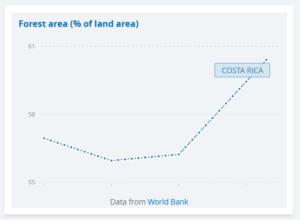
Costa Rica’s forest resources give the country a strong base for nature-based climate finance. World Bank data show that forests covered 60.4% of Costa Rica’s land area in 2023. The country has spent decades developing policies that link forest conservation with economic incentives.
Its Payments for Environmental Services (PES) program began in 1996 and pays landowners for environmental services from forests. The UNFCCC says the program has benefited more than 18,000 families, with $524 million invested and more than 1.3 million hectares covered by PES contracts.
In May 2026, the Food and Agriculture Organization also highlighted Costa Rica’s efforts to improve monitoring of its PES program and integrate newer tools such as results-based payments and carbon markets.
That history is important because REDD+ does not operate as a stand-alone carbon credit project. It forms part of a wider national forest-management system.
Forest Results Have Already Drawn $54M in Climate Finance
Costa Rica has already used forest results to attract international climate finance. For its earlier 2014–2015 REDD+ results, the country reported 14,794,747 tonnes of CO2e. Those results were assessed against a reference level of about 4.37 million tonnes of CO2e per year.
The Green Climate Fund approved $54.1 million in results-based payments linked to those earlier results. Costa Rica’s REDD+ platform says the payments recognized 14.7 million tonnes of removals from its forests during 2014 and 2015.
The latest 2020–2023 results could therefore provide another basis for results-based climate finance, subject to the relevant financing and authorization processes. That is different from automatically creating tradable credits.
Forest Carbon Buyers Are Raising the Quality Bar
The Costa Rica results arrive as the global carbon market puts more emphasis on quality and transparency.
The World Bank’s State and Trends of Carbon Pricing 2026 found that global carbon credit issuance increased 8% from 2024 to 2025. However, overall credit prices declined slightly. High-rated forest conservation and reforestation credits continued to receive price premiums.
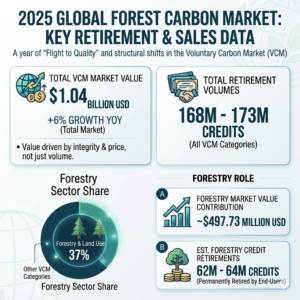
The market is also seeing stronger demand for credits with clear quality attributes. The World Bank reported that companies signed about $12 billion in offtake agreements for future carbon credits in 2025, three times the amount recorded in 2024.
For forest projects, this trend makes credible measurement and national oversight increasingly important. Costa Rica’s UN-reviewed REDD+ results can help demonstrate that its forest accounting system follows international rules.
UN Review Also Flags Areas for Improvement
The UN assessment was positive, but it did not say the system was perfect. Costa Rica reported uncertainty of 62% for its results, using a Monte Carlo simulation and a 90% confidence interval.
The UN experts said Costa Rica had taken steps to assess uncertainty and improve future estimates. They also identified several areas for future improvement. These include better methods for separating human-caused forest changes from natural disturbances, improving estimates of forest degradation and enhancing national registry systems.
The registry issue is especially relevant to carbon markets.
The UN experts said stronger registry systems would help ensure that the same emission reductions are not counted more than once across REDD+, national climate targets and Article 6.4 of the Paris Agreement.
This is becoming a central requirement as countries move toward international carbon trading.
Costa Rica’s Forest Carbon Strategy Enters a New Phase
Costa Rica’s latest REDD+ results show that forest conservation remains a significant part of its climate strategy. The country reported 10.28 million tonnes of net removals between 2020 and 2023, with the UNFCCC finding the results consistent with its assessed reference level and international reporting requirements.
The numbers also build on Costa Rica’s earlier REDD+ results and its long-running PES program. However, the next step will require more than producing large removal figures.
Costa Rica will need strong monitoring, clear accounting, and safeguards against double counting if it wants to expand results-based finance and participate more deeply in international carbon markets. That matters because the global market is increasingly rewarding credits and projects that can demonstrate stronger integrity.
Costa Rica’s latest UN-reviewed results give its forest carbon strategy a stronger technical foundation. With more than 10 million tonnes of net removals reported over four years, the country has another significant body of results that could support future climate finance while strengthening its position in the growing market for high-integrity forest carbon.
- READ MORE: BTG Pactual Closes Record $1.24B Reforestation Fund as Forest Carbon Markets Enter the Big Leagues
The post Costa Rica’s Forests Deliver 10.3M Tons of Net Removals in UN-Backed REDD+ Review appeared first on Carbon Credits.


