

Winning a purchase order from a major retailer is a milestone for any brand. However, between 50-page compliance manuals and specific labeling specs, the requirements can be a nightmare. Before a single unit moves, brands have to solve barcode placement, carton marking, and structural standards that vary wildly from one retailer to the next.
For years, retailers and platforms often absorbed some minor errors by offering prep services or corrective handling at the warehouse. That era is over.
Amazon’s January 2026 policy is the clearest signal yet. The company discontinued all FBA prep and item labeling services in the U.S. Shipments created after January 1 without proper prep and labeling are ineligible for damage or loss reimbursement.
This isn’t just an Amazon trend. Across big-box retail, the direction is consistent: tighter vendor requirements, less tolerance for errors, and faster chargebacks when shipments fall short. Packaging compliance is no longer a back-office concern. Brands that treat it as a core operational priority are the ones avoiding chargebacks, rejected shipments, and lost buyer credibility.
The Business Impact of Packaging Compliance
In the world of high-volume retail, non-compliance is not a one-time setback. It is a recurring tax on every shipment that falls short, and the numbers accumulate faster than most brands expect.
Take Walmart’s SQEP (Supplier Quality Excellence Program) as a case. Walmart doesn’t just issue a flat fine; they stack fees on top of each other for a single mistake:
- Pallet Violations: A $200 administrative fee per purchase order (PO), plus $4 for every individual pallet.
- Load Violations: Another $200 fee per PO, plus $20 per load.
Because these fees stack, a single shipment with minor labeling or packaging errors across a few pallets easily clears $250 to $500 in penalties before Walmart even calculates your On-Time In-Full (OTIF) dynamic chargebacks.
For brands running regular replenishment cycles, these deductions stop being a nuisance—they become a structural threat to your profit margins.
How Automated Scorecards Track Packaging Compliance
The financial hit is only part of the problem. Both Walmart and Amazon use automated scorecards to track supplier performance continuously. These systems don’t just issue fines; they assign a “health score” to brands. If the compliance score drops consistently, these algorithms automatically deprioritize the listings or, in extreme cases, begin the off-boarding process.
The Hidden Cost of Poor Custom Packaging
At a warehouse-club level like Costco, the stakes are even more personal. When a pallet arrives damaged or un-brandable, it disrupts their high-velocity floor operations. Brands aren’t just losing money on damaged goods; they are also losing the trust of the buyer.
Packaging errors don’t stay in the warehouse — they follow the brand into the next buying conversation. In retail, packaging is a reflection of how seriously a brand takes the partnership.
Amazon FBA Packaging Compliance
With Amazon’s prep services gone, packaging compliance is now entirely the seller’s responsibility, and the fee structure makes that point financially unmistakable.
The SIPP Program
The Ships in Product Packaging (SIPP) program allows products to ship in their own branded packaging, with no Amazon overbox added. In 2026, small and Large Bulky products not enrolled in SIPP now incur a packaging fee averaging $2.07 per unit.
For enrolled sellers, base fulfillment fees on bulky products decreased. At high order volumes, that gap becomes significant. To enroll in SIPP, packaging must meet ISTA-6 durability standards.
FNSKU and Dimensional Accuracy
Every unit entering a fulfillment center must carry a scannable FNSKU label (this is an Amazon-specific barcode) on an outer surface. Products arriving without proper labels or packaging face shipment rejection, penalty fees, or both.
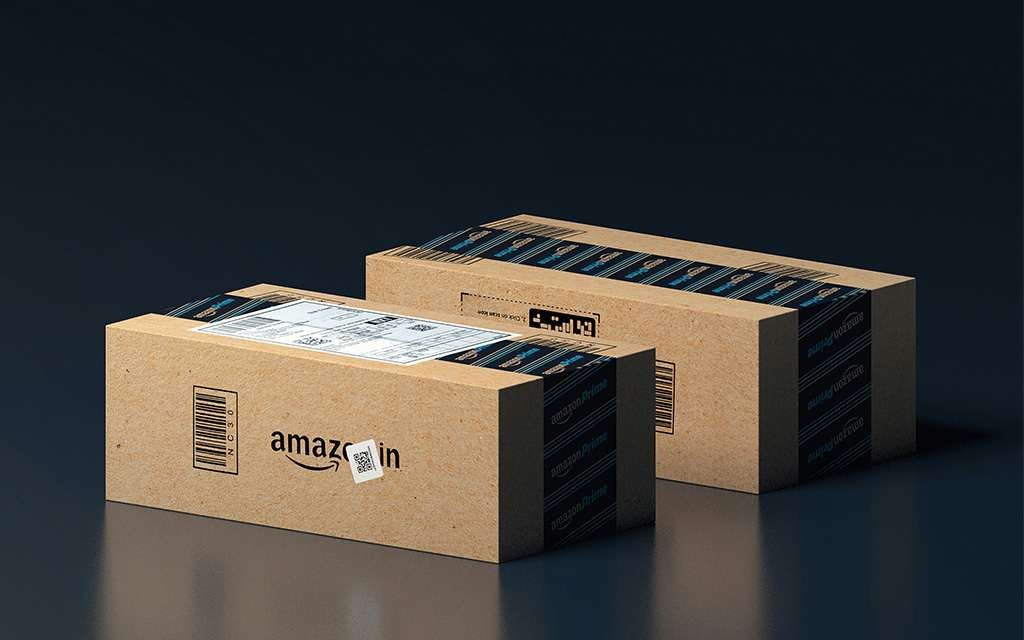
Dimensional accuracy carries equally direct cost consequences. Amazon now charges brands based on how much space the box takes up. If the box is 1 cm too long and bumps into the “Large” category instead of “Medium,” the fees could double. So, make sure the box size is just right to house the product is no longer just a design preference, but a financial decision.
Walmart’s Packaging Compliance
Walmart’s compliance framework is not flexible, they expect sellers’ shipments to arrive exactly as ordered, every single time.
GS1 Barcodes
Every product entering Walmart’s supply chain must carry GS1-certified barcodes. This is how Walmart’s systems identify and reconcile every incoming shipment. If a barcode is in the wrong position, or fails to scan at a distribution center, Walmart will automatically charge back under the Supplier Quality Excellence Program.
OTIF: On-Time In-Full
Walmart grades its suppliers on a strict pass/fail system called OTIF, which stands for On-Time In-Full.
On time means shipments must arrive on time and contain the correct quantity. Miss either, and Walmart charges back 3% of the cost of goods for each non-compliant case. As for “In-Full”, it means every single item ordered shows up, and none are broken.
This is where packaging design actually becomes a financial variable. If brands use cheap, weak cardboard for their custom packaging, the boxes might crush under the weight of a heavy pallet during transit. Damaged units arriving at a distribution center are rejected inventory.
Walmart’s definition of “In-Full” is a strict 100% perfection. If a brand was supposed to deliver 1,000 units, and 10 are crushed, the delivery score drops to 99%, and it as now failed the “In-Full” requirement. That triggers penalties on the entire shipment, not just the damaged portion. The cost is 3% of the full order value. It also leaves a mark on the supplier scorecard that buyers review every week.
Costco: Merchandising and Custom Packaging Structural Standards
Costco operates differently from every other retailer. There are no shelves to stock, no employees to arrange products. The pallet your factory packs is the exact same pallet the customer shops from.
The Three-Side Shoppable Requirement
A three-side shoppable display means brand name, product name, and main selling point must be clearly printed on the front, the left side, and the right side of the packaging. This gives flexibility for endcap placement and allows members to shop from any angle.
This ties directly into Costco’s famous 5×5 Rule: A customer walking down the aisle must be able to tell what product is and why they should buy it from 5 feet away within 5 seconds. If they have to twist their neck or guess what’s inside the box, the packaging has failed.
Structural Requirements
The journey a product takes to get to Costco is brutal. Before it ever reaches the store floor, the boxes will be stacked on top of each other in a hot truck, driven over 500 miles, and squeezed tightly by giant mechanical forklift clamps with up to 2,300 pounds of pressure per square inch (psi).
Costco warehouses are huge and can reach 80% to 90% humidity. Standard cardboard acts like a sponge in humidity—it absorbs moisture, gets soggy, and collapses under the weight of the boxes stacked above it.
To survive, Costco requires High-ECT (Edge Crush Test) cardboard, engineered with reinforced vertical ridges inside the cardboard layers. It acts like tiny structural pillars, giving the box the strength to handle thousands of pounds of pressure without crushing the product inside.
To partner with Costco, packaging compliance is both a branding requirement and an engineering requirement. Both must be solved before the first shipment leaves.
4 Steps to Retail-Ready Custom Packaging Compliance
Amazon, Walmart, and Costco each test packaging differently and measure performance differently. Meeting one retailer’s standard does not mean the others are covered. Brands that succeed treat compliance as a design decision, built in from the start, not fixed after the first rejection.
Step 1: Design a Universal Custom Packaging
The most efficient path to multi-retailer compliance is a single packaging architecture that satisfies all three channels from the beginning. Brands should combine the hardest rules from each retailer into a single blueprint: Costco’s heavy-duty cardboard thickness so the box never crushes, Amazon’s strict packaging size tiers, and Walmart’s exact barcode placement rules. By designing for the toughest rules first, the box automatically passes the easier tests.
Step 2: Prototype and Test Before Production
Assumptions about durability are expensive to correct after production. ISTA 3A testing simulates real-world parcel shipping conditions. ISTA 6-Amazon certifies packaging specifically for Amazon’s fulfillment network. Testing before production confirms performance and removes the guesswork that leads to damage claims, rejected shipments, and lost SIPP certification.
Step 3: Use Sustainability to Minimize Compliance Surcharges
Extended Producer Responsibility surcharges are now embedded in cost models across multiple states. Fees are tied directly to material type and recyclability. Hard-to-recycle plastics incur higher costs. Easily recyclable materials incur lower ones. Multi-material plastic structures generate recurring surcharges on every unit shipped into EPR-active states. Switching to mono-material formats reduces that exposure directly.
Step 4: Partner with a Custom Packaging Compliance Specialist
Zenpack engineers packaging systems with compliance built into the brief. Structural design, ISTA validation, labeling architecture, and sustainability requirements are addressed together, before production begins.
Conclusion
Packaging compliance is not a single checklist. It is a moving set of requirements that varys by retailer, tightens over time, and penalizes brands that treat it as an afterthought.
By designing custom packaging that meets the strictest structural, digital, and environmental rules from day one, not only avoid chargebacks, but also build operational credibility with buyers.
At Zenpack, we specialize in turning retail compliance from a logistical nightmare into your brand’s competitive advantage. We handle the structural engineering, material sourcing, and certified testing required to satisfy Amazon, Walmart, and Costco simultaneously.
Contact Zenpack today for a custom packaging compliance audit
The post Custom Packaging Compliance Guide for Amazon, Walmart, and Costco appeared first on Zenpack Blog.


