
Green Chem., 2026, Advance Article
DOI: 10.1039/D5GC05611J, Paper
DOI: 10.1039/D5GC05611J, Paper
 Open Access
   This article is licensed under a Creative Commons Attribution 3.0 Unported Licence.
Qiangbing Shi, Kaige Jia, Xiangping Zhang, Chuan Wang, Paul Cobden, Anna-Maria Beregi Amnéus, David Muren, Xiaoyan Ji
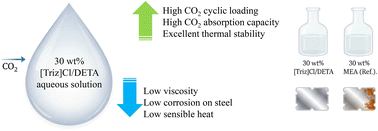
Deep eutectic solvents (DESs) have attracted considerable attention as promising alternatives to conventional solvents for mitigating CO2 emissions due to their tunable structures, low volatility, and promising physicochemical properties.
To cite this article before page numbers are assigned, use the DOI form of citation above.
The content of this RSS Feed (c) The Royal Society of Chemistry
Deep eutectic solvents (DESs) have attracted considerable attention as promising alternatives to conventional solvents for mitigating CO2 emissions due to their tunable structures, low volatility, and promising physicochemical properties.
To cite this article before page numbers are assigned, use the DOI form of citation above.
The content of this RSS Feed (c) The Royal Society of Chemistry


