

The European Union’s solar market continued to grow in the first half of 2026, with at least 33.8 GW of new capacity installed between January and June. The figure represents a 1.9% increase from the 33.2 GW deployed during the same period in 2025, according to SolarPower Europe’s EU Solar Market Update 2026: Mid-Year Analysis.
The result exceeded forecasts published in late 2025 that had pointed to a market contraction, but does not yet indicate a clear acceleration in growth. Demand remained resilient despite worsening market conditions, supported in part by renewed concerns over fossil fuel supplies stemming from the conflict in the Middle East. Higher energy prices and energy security concerns have strengthened the economic case for solar across several EU member states.
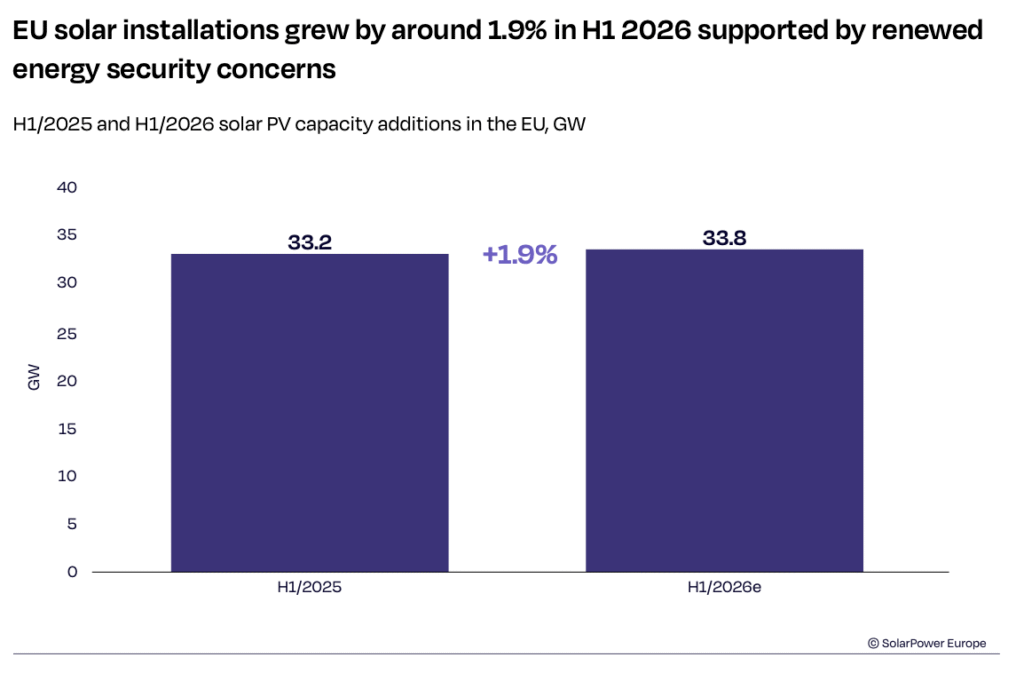
Germany and Spain, the EU’s two largest markets, maintained high installation levels, while France, Italy, Poland, Romania, and Greece recorded slight year-on-year growth. Some smaller markets, such as Finland and Latvia, experienced rapid expansion driven by the commissioning of large-scale photovoltaic projects.
Conversely, the Netherlands, Czechia, Belgium, and Hungary fell short of the levels recorded in 2025. The structure of the European market is not expected to change significantly during 2026: utility-scale projects will account for approximately 56% of new capacity, compared to 44% for rooftop installations. Within the latter segment, residential demand weakened in several markets, whereas the commercial and industrial segment demonstrated greater resilience.
Photovoltaics reduce the gas bill
Beyond the growth in installed capacity, solar generation is playing an increasingly strategic role in European energy security. In the six months following the escalation of the conflict in the Middle East — starting March 1 — EU solar generation is estimated to have avoided around €30 billion in gas import costs for electricity generation, equivalent to more than €1 billion per week.
Photovoltaics met over 20% of the EU’s electricity demand in May, June, and July, reaching a record 25% in June, when it became the Union’s primary source of electricity generation.
High solar output also helped meet the increased demand for cooling during summer heatwaves. During these months, high river temperatures and low water levels limited the availability of nuclear and hydroelectric power generation.
The association notes that these factors are reshaping the role of photovoltaics within the European electricity system. “In addition to being a key technology for decarbonization, solar power is establishing itself as an energy security asset capable of reducing Europe’s exposure to fossil fuel imports,” explains SolarPower Europe.
Bottlenecks
However, the growth of photovoltaics is highlighting the limitations of Europe’s electricity infrastructure. Rising renewable energy curtailment, falling solar capture prices, episodes of negative pricing, and increased price spikes during evening hours indicate that grids, storage, and other flexibility mechanisms are not keeping pace with the expansion of solar generation.
“Without a faster rollout of these technologies, Europe risks wasting an increasing share of low-cost solar electricity during the middle of the day and subsequently remaining dependent on expensive fossil-fuel generation when solar output drops,” the report states.
Outlook for 2026
The outlook for 2026 has improved substantially. SolarPower Europe’s central scenario now projects 68.1 GW of new solar capacity in the EU this year, 6.6 GW above its December 2025 forecast and just 2.1% below the revised 2025 record of 69.6 GW.
Uncertainty remains high, however. The association’s low scenario puts new installations at 62 GW, while its high scenario projects 74.1 GW. The final figure will depend on market developments in the second half of the year and potential revisions to preliminary installation data.
Meanwhile, reduced policy support in several member states, growing regulatory uncertainty and grid constraints continue to pose structural risks to market growth.
The post EU deploys 33.8 GW of solar in H1 appeared first on pv magazine Global.


