

A group of 45 major institutional investors, managing about €11.4 trillion in assets, has urged EU leaders to protect the EU Emissions Trading System (ETS). They warn that weakening this carbon market could damage investor confidence and slow Europe’s clean-energy transition.
This appeal arrives weeks before a key review of the ETS, one of the world’s biggest carbon markets. As per reports, these investors shared their message before the European Council summit on June 18-19. At this summit, EU leaders will discuss carbon pricing.
Signatories include Allianz SE, L&G Asset Management, Nordea Asset Management, Sampension, Erste Asset Management, and the Church of England Pension Board. The Net-Zero Asset Owner Alliance supports this initiative.
Investors Want Stability, Not Policy Reversals
The investors believe a stable carbon market is crucial for channeling private funds into clean technologies, renewable energy, and low-carbon projects.
They see this moment as key for Europe’s competitiveness and energy security. Investors need clear, long-term policies before committing billions of euros to projects that often take decades to pay off.
Since its start in 2005, the EU ETS has been vital in cutting emissions. Emissions from sectors under the system have dropped by about half. Recent data show the ETS is on track to reduce emissions by 62% by 2030 compared to 2005 levels, with a 5% drop expected in 2024 due to declines in the power sector.
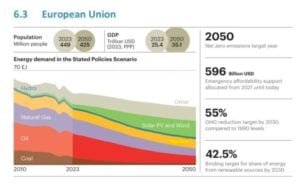
Investors warn that weakening the ETS now could send the wrong message, discouraging private investment when Europe needs significant funding for its energy transition.
Industry Pushes for Relief
This appeal comes amid rising calls from EU member states and industrial groups for relief from carbon costs.
Countries like Italy and Germany argue that high carbon prices hurt the competitiveness of European manufacturers facing high energy costs and global competition.
Reuters reports that the European Commission is considering changes to let industries keep free emissions permits if they invest within the EU. This proposal aims to balance climate goals with industrial competitiveness.
The EU’s main business lobby has urged Brussels to continue free carbon allowances for energy-intensive industries. Companies claim carbon costs put European manufacturers at a disadvantage compared to regions with weaker climate rules.
However, investors argue that weakening carbon pricing won’t solve Europe’s competitiveness issues. They point to deeper problems like high electricity prices, slow grid expansion, and limited access to affordable clean energy.
They believe carbon pricing sends a critical market signal that fosters innovation and investment while helping industries prepare for a low-carbon future.
- MUST READ: EU Plans Major Carbon Pricing Overhaul and €30B Clean Tech Boost to Drive Decarbonization
The ETS Remains Central to EU Climate Strategy
The EU ETS uses a cap-and-trade model. It sets limits on greenhouse gas emissions from covered sectors and gradually lowers those limits over time. Companies must surrender allowances for their emissions, creating a financial incentive to reduce pollution.
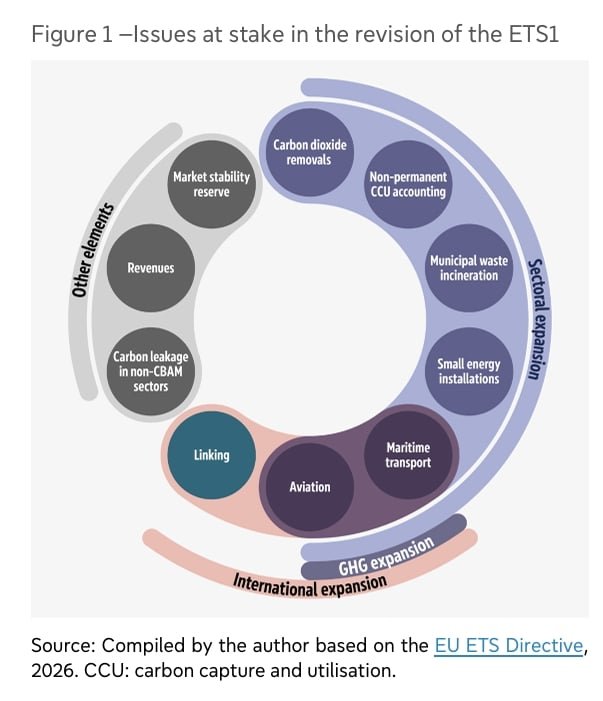
The European Commission is expected to present its formal ETS revision proposal in July 2026. This review will address key issues, including carbon dioxide removals, carbon capture accounting, and the potential inclusion of more sectors.
The July review will make changes to the EU carbon market to help meet the bloc’s goal of cutting emissions by 90% by 2040. Officials will also look at ways to keep carbon prices stable and prevent companies from moving production outside Europe to avoid carbon costs.
- Notably, in May, the EU proposed giving industries more free carbon permits to help cover electricity-related emissions. This support could be worth around €4 billion to businesses by 2030.
EU Emissions Hit Record Low
Recent data from the European Environment Agency shows that EU greenhouse gas emissions fell by another 3% between 2023 and 2024.
They are now 40% below 1990 levels, while the EU economy has grown more than 70% during this time. The EU’s net emissions are at their lowest since records began in 1990.
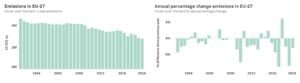
The energy sector has played a major role in these reductions. Emissions from electricity and heat production have dropped sharply as renewable energy increased and coal use fell. In 2024, emissions covered by the ETS were about 50% below 2005 levels, keeping the system on track for its 2030 targets.
Airlines Resist Expansion of Carbon Costs
Aviation has become a hot topic in the upcoming ETS review.
According to Reuters, Europe’s largest airlines have asked the European Commission not to extend carbon pricing to international flights from Europe.
In a letter to European Commission President Ursula von der Leyen, CEOs from Air France-KLM, IAG, Lufthansa, and Ryanair argued that expanding the ETS would raise ticket prices and cargo costs for passengers and businesses. Other airlines, like easyJet and TUI, also signed the letter.
Currently, the ETS mainly covers flights within Europe. A temporary arrangement delays including flights between European Economic Area countries and destinations outside until the end of 2026.
The Commission must evaluate how effective the International Civil Aviation Organization’s Carbon Offsetting (ICAO) and Reduction Scheme for International Aviation (CORSIA) is by July 2026. If it’s deemed insufficient, the EU might expand the ETS to cover international departures starting in 2027.
Airlines argue this could create competitive disadvantages and weaken support for CORSIA. They want ETS costs for international flights to align more closely with CORSIA requirements.
Environmental advocates and some policymakers disagree. They argue the EU ETS is more ambitious than CORSIA, creating stronger incentives for airlines to cut emissions instead of relying on carbon offsets.
The aviation debate may expand in the coming years. The Commission is also considering whether to include non-CO2 aviation impacts—like contrails and nitrogen oxides—into the ETS framework.
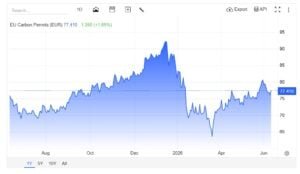
EU carbon permit pricing data
A Test for Europe’s Carbon Market
The upcoming ETS review is a major test for Europe’s climate and industrial strategy.
Investors need policymakers to maintain a strong and steady carbon market. This will help attract private capital for long-term decarbonization. At the same time, industrial groups are seeking protections to help companies manage rising costs and global competition.
The European Commission must balance climate goals, industrial competitiveness, and energy security, according to Reuters. The July review will determine if the EU ETS remains central to Europe’s climate policy or shifts to a more flexible system to meet economic needs.
Trillions of euros depend on future carbon prices. This review matters for more than just the environment. It could shape Europe’s industrial competitiveness, clean energy investments, and the journey to climate neutrality for many years.
The post EU Emissions Trading System (ETS) Under Pressure Ahead of Landmark 2026 Review appeared first on Carbon Credits.


