
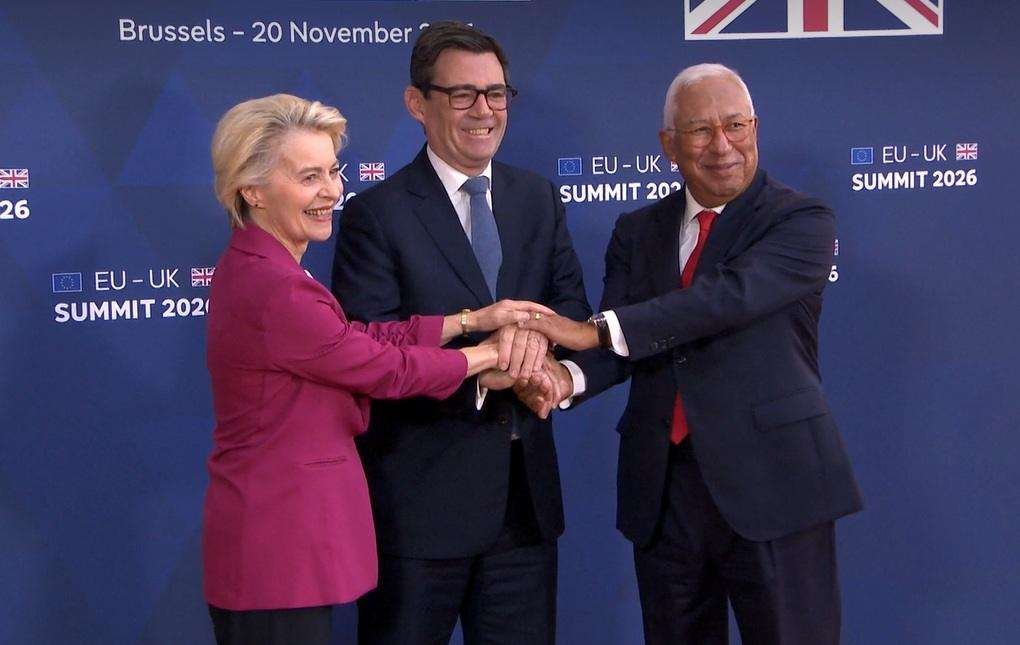
The European Commission and UK government announced an agreement to link their Emissions Trading Systems (ETS), reuniting their respective carbon markets that have operated separately since Brexit, in a deal aimed at eliminating a major barrier for trade in goods subject to carbon pricing and import taxes, and creating a larger, more liquid carbon market.
Under the new agreement, which formed part of the EU and UK bilateral summit, the Commission and UK government are aiming for the ETS link to become effective from the beginning of 2028, with ETS allowances issued in either market able to be used for compliance purposes across both systems.
EU Commission President Ursula von der Leyen said:
“The agreement will cut emissions and generate investment in cleaner industries. This will help us advance our shared climate goals.”
Established in 2005, the EU ETS puts a price on carbon emissions for key GHG intensive sectors, including electricity and heat generation, oil refineries, steel, cement, paper, chemicals, and commercial aviation, among others. The EU ETS is expected to generate revenues of approximately €40 billion from 2020-2030. In 2023, the EU Commission adopted the Carbon Border Adjustment Mechanism (CBAM), effectively a carbon tax on imported goods, aimed at avoiding “carbon leakage,” a situation in which companies move production of emissions intensive goods to countries with less stringent environmental and climate policies, by equalizing the price of carbon paid for EU products operating under the EU ETS with that paid for products produced in other countries.
Following Brexit, the UK launched its own Emissions Trading Scheme in 2021 to replace its participation in the EU’s ETS. The UK has also announced plans to introduce its own CBAM in 2027.
EU member states agreed last year to open negotiations with the UK towards an agreement to link the ETS systems, forming part of efforts to re-align the EU and UK in key areas that have been developing separately since Brexit.
The new agreement includes an obligation for each party to recognize emissions allowances under each others’ ETS, meaning that companies in one jurisdiction will be able to purchase allowances in the other jurisdiction’s ETS, to satisfy its obligations in its home system.
Under the agreement, the UK also agreed to expand its ETS for the maritime and aviation sectors to align with the EU ETS, resulting in an additional 10 million tonnes of CO2 emissions included in the system. The agreement also provides for a possible future mutual exemption from the EU and UK CBAMs.
The UK government said that the agreement will add up to £3.8 billion to the UK economy each year by 2040, and create the conditions for an exemption for UK companies from the EU CBAM for £6.5 billion worth of exports.


