
European Union agricultural policy can keep you up at night — and in other moments, put you to sleep.
Two of the bloc’s latest policies — the reduction in maximum allowable residue limits (MRLs) for products already banned by the EU, and the potential phasing out of the use of soybeans in biofuel production — embody how European policymakers manage to spur such contradictory physiological responses in those of us trying to make sense of the situation.
Europe has long taken a different approach to biotechnology and pesticides, opting for a hazards-based regulatory system where the potential for harm by a given technology, rather than the likelihood such harm will occur, is what determines its permissibility. This approach has led the EU to ban the use of many products still available to farmers in other parts of the world, including Canada.
Crucially, agricultural goods imported into Europe could by-and-large still be produced with products banned in the EU. This has worked for us (we maintain access to a large market) as well as our European friends who remain heavily reliant on agricultural imports — particularly for livestock feed. The move to begin restricting the importation of agricultural goods with any trace of EU-banned product (0.01 parts per million being the threshold for rejection) poses a significant problem.
This matters for Canadians because we could (at least theoretically) lose significant access to a large market, at a time when we really could use markets other than the United States. And assuming the rest of the world doesn’t fold to Europe’s coercive approach to banned product residues, the Europeans may face further complications in sourcing much-needed agricultural products.
In an effort to level the playing field for their own farmers — themselves in a comparatively handicapped position because of Europe’s hazard-based approach to regulation — the EU is making it harder on themselves despite already facing multiple economic crises stemming from Russia’s war on Ukraine; Trump’s tariff addiction and general transactional nature; the war in Iran and closure of the Strait of Hormuz; overbuilt domestic livestock industries requiring significant feedstock imports; regulations restricting land use, and so on.
Then there’s the move to stop using soybeans in the production of biofuels, ostensibly to help prevent further environmental degradation from indirect land use changes.
Using a new analytics methodology, the U.S. Department of Agriculture reports palm oil, and now soybeans, are considered crops with a high risk of having been produced on land recently cleared for agriculture, what the EU calls “high indirect land use change risk” and “therefore, soybeans will not be able to count towards the EU’s targets for biofuel use by 2030.”
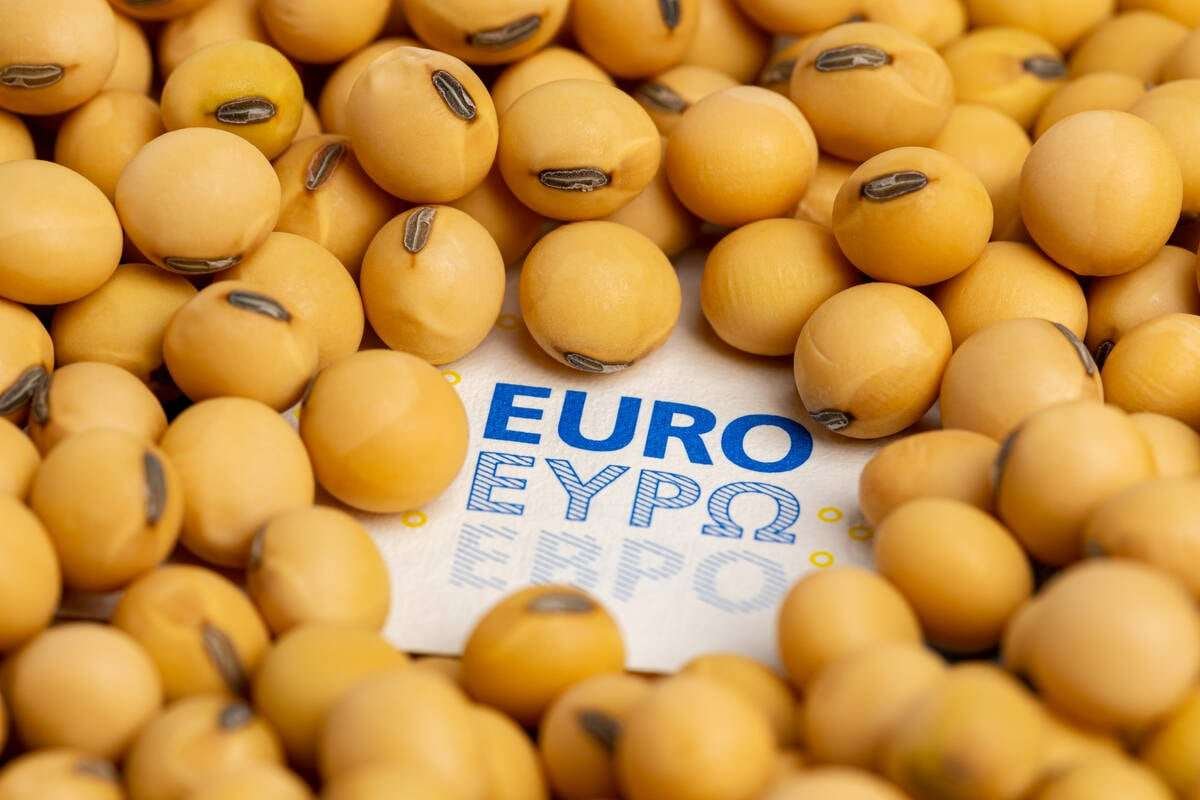
The EU proposes to halt the use of soybeans in the production of biofuels, ostensibly to limit environmental degradation from indirect land use changes. Photo: JJ Gouin/iStock/Getty Images
‘Would need every last drop’
I regularly speak with Al Mussell, economist and founder of Agri-Food Economic Systems, about trade and policy issues. His take: Europe is adding to its own “screwed up situation.”
“The rationale for the EU is indirect land use change. It seems completely tone deaf, as you would expect that the EU would need every last drop of whatever they can use to power a diesel engine just now, and going forward. And the land use change they are worried about happens in other places, not in the EU,” Mussell says, adding there are also diplomatic considerations.
“If the EU stops making biofuels from soybeans, the United States will lose much of the EU soybean market, which may happen anyway due to the EU-Mercosur agreement (assuming it ever gets ratified). If the U.S. loses some of its EU soybean export business, I assume that this will further amp up the U.S. crush.”
Mercosur — a trade deal with Brazil, Paraguay, Uruguay and Argentina where a huge proportion of import duties will be dropped — is another somewhat confusing move. Why would a political bloc as protectionist as the EU opt for such a deal given its concerns about greenhouse gas emissions, rainforest destruction (see indirect land use change again), animal welfare and the overall longevity of its own farm sector? The prospect of a near-free trade deal with South America has raised concerns across Europe’s farm country.
It’s all a bit hard to understand. These are complicated policies bringing far-reaching ramifications. A person can easily find their eyelids getting heavy with all the acronyms and technical descriptions within them. It’s hard to know what the true motivations are behind EU policies, or indeed, if there is a coherent strategy anywhere to be found.
Perhaps there isn’t one.
To paraphrase Melanie Epp, a colleague and fellow agriculture journalist now based in Belgium, maybe European policymakers are simply continuing to make policy individually, without proper industry consultation. On the face of it, they certainly don’t seem to understand the complexity inherent in the global agricultural trade, let alone vulnerabilities within their own borders.
The post Europe’s contradictory trade policies a puzzle for world’s farmers appeared first on Farmtario.


