
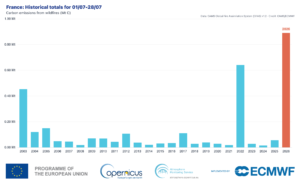
Wildfires have released an estimated 27 million metric tons of carbon dioxide (MtCO2) across Europe so far in 2026, with France accounting for a record amount of emissions, according to the European Union’s Copernicus Atmosphere Monitoring Service (CAMS).
The fires are creating a growing climate risk. They are not only releasing carbon stored in forests and other ecosystems. They can also weaken Europe’s ability to absorb emissions through its land and forests.
France has been one of the clearest examples. CAMS reported that French fires produced 0.89 million tons of carbon (Mt C) during July alone, the highest July level in its record. The previous July record was 0.64 Mt C in 2022.
France’s Fires Set a Record as Europe Burns
The scale of France’s fires reflects an unusually hot and dry summer across parts of Western Europe. CAMS uses satellite observations and its Global Fire Assimilation System to estimate emissions from fires in near real time. Its data showed that France had its highest annual fire emissions through the end of July in the available record.
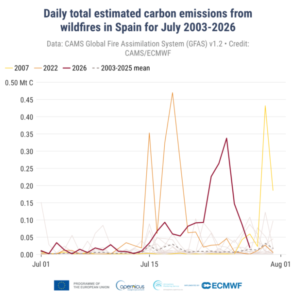
The wider 2026 fire season has also been severe. EU data from the European Forest Fire Information System showed that 647,375 hectares had burned in the EU by September 2. This was due to 1,913 fires, each larger than 30 hectares.
The burned area in 2025 was lower than in the past, which was the EU’s worst year. Still, it was above the average of about 328,000 hectares from 2006 to 2025. This means the 27 MtCO2 emissions figure is part of a broader pattern of widespread fire activity rather than a single extreme event.
Climate Change Is Raising Fire Risk
Researchers say climate change is increasing the conditions that allow large fires to develop.
A World Weather Attribution study found that human-caused warming made extreme fire conditions in southwest France and central Spain more likely in 2026. The analysis linked the high fire risk to a combination of extreme heat, unusually low rainfall and severe soil moisture deficits.
In southwest France, conditions of similar severity are now expected about once every 20 years. In central Spain, they are expected roughly once every six years.
Researchers found that climate change has boosted extreme fire weather. In southwest France, such severe conditions are now at least twice as likely. In central Spain, they are at least 20 times more likely.
Land management can also affect fire behavior. Forest structure, vegetation, population patterns, and land use all influence how quickly fires spread. This means climate change is an important driver, but not the only one.
Europe’s Forest Carbon Sink Is Losing Strength
The wildfire problem matters to carbon markets because forests and other land ecosystems are a major part of Europe’s climate strategy.
The EU’s land-use, land-use change and forestry sector, known as LULUCF, removed a net 198 MtCO2e in 2023, equal to about 6% of EU greenhouse gas emissions. The European Environment Agency (EEA) noted that the sector’s carbon sink has weakened. The average annual sink from 2014 to 2023 is about 30% lower than in the previous decade.
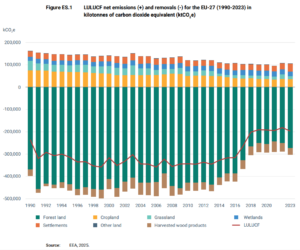
Wildfires are one factor behind that decline. Fires can quickly release carbon stored in vegetation and soils, reducing the amount of carbon that land can absorb.
The EEA has warned that more frequent and severe disturbances, including wildfires and drought, are affecting Europe’s forest carbon stocks. That creates a challenge for Europe’s climate goals.
- The EU aims for a 310 MtCO2e net-removal target for the LULUCF sector by 2030. However, current national projections show that existing measures won’t meet this goal.
Wildfires Put Forest Carbon Credits to the Test
The growing fire risk has serious implications for nature-based carbon projects. Forest and reforestation initiatives depend on carbon remaining stored for decades.
However, a major wildfire can instantly destroy that stored carbon. When projects burn, carbon standards do not penalize individual corporate buyers. Instead, registries rely on “buffer pools”—shared insurance reserves of carbon credits that are permanently retired to cancel out the losses.
Real-world data shows that these safety nets are under severe strain from modern climate realities. Actuarial analyses of the California Air Resources Board (CARB) compliance program reveal that wildfires have triggered massive credit cancellations. For example, a single event—the Lionshead Fire—alone reversed 963,534 credits.
This is part of a much larger systemic threat. A landmark study by CarbonPlan and UC Berkeley found that California’s program set aside about 6.8 million credits. This amount covers wildfire risk for a century across its entire portfolio.
By 2024, cumulative losses from devastating fire seasons had blown past 10.7 million credits. The program effectively exhausted its hundred-year wildfire insurance pool decades ahead of schedule.
VCM registries face similar pressure. Premier international registries like Verra maintain global buffer accounts comprising tens of millions of tons of CO2.
When major projects fail, like the Colville Indian Reservation forest project in Washington, registries must freeze or cancel millions of credits. This helps keep corporate buyers protected.
Future Fire Risk Could Surge Nearly 200%
New research suggests that Europe’s wildfire problem could become significantly worse later this century without stronger climate action and fire management.
A study in Global Change Biology, led by the Potsdam Institute for Climate Impact Research, found that intense fire weather could raise Europe’s annual burned area by 39% by the end of the century in a low-emissions scenario. Under a high-emissions scenario, the increase could reach about 192%, or nearly three times current levels.
The researchers also found that better prevention, early detection, and firefighting could greatly reduce the increase. Improvements in fire management can cut burned area by 72% to 92%. This depends on the situation. Even so, stronger fire management would not fully offset the effects of severe climate change.
The study highlights an important point for carbon markets. Protecting forests cannot rely only on planting more trees. Projects also need to consider whether those forests can survive increasingly severe climate hazards.
Europe Faces a Tougher Fight to Protect Its Carbon Sinks
The 27 MtCO2 estimated from European wildfires in 2026 adds another layer to the region’s climate challenge. The immediate issue is the carbon released by fires. The longer-term concern is the loss of forests and other ecosystems that would otherwise remove CO2 from the atmosphere.
Europe’s land carbon sink remains an important tool for reaching climate neutrality, but the EEA says its capacity is already declining. For carbon markets, that means the focus must extend beyond how many credits a forest project can generate. The durability of those removals matters just as much.
More resilient forests, stronger fire prevention and better land management can help protect Europe’s carbon sinks. Yet, the latest research shows that these measures will have to work alongside major cuts in greenhouse gas emissions.
As extreme heat and drought increase fire risk, Europe faces a difficult cycle: climate change can make wildfires more severe, fires can release more stored carbon, and damaged forests can become weaker carbon sinks. Breaking that cycle will be critical to both the region’s climate targets and the future reliability of nature-based carbon removal.
- READ MORE: BTG Pactual Closes Record $1.24B Reforestation Fund as Forest Carbon Markets Enter the Big Leagues
The post Europe’s Wildfires Release 27 Million MT of CO2 as France Sets New Emissions Record appeared first on Carbon Credits.


