
Last year, Canadian hay exports were trending stronger than they did in 2024, with exports to Japan up 34 per cent over the first seven months, offsetting some decreases in the United States, South Korea and other markets.
WHY IT MATTERS: Export markets are important to many Canadian hay farmers and have an effect on domestic hay prices.
That’s despite continuing trade and economic uncertainly which has affected the hay market, said Josh Callen, owner of The Hoyt Report, who specializes in hay market insights and analysis. He presented at the Canadian Forage and Grassland Association 16th Annual Conference in November.
Callen started his presentation by reflecting on last year, when the big question was, “What is Trump going to do?”
“The answer was he was pretty antagonistic,” Callen said. “That had a big impact on the market, starting with a trade war the first of April.”
He said what many producers were hoping would be a rebound year, was impacted by trade challenges, poorly timed weather and a strong U.S. dollar.
Canola prices dropped by more than half over the past 18 months, which impacted alfalfa markets as U.S. dairy producers switched to adding canola meal, which is about 35 per cent protein, to dairy rations as a substitute for protein-rich alfalfa.
Chinese dairy producers are in a downturn. Milk production and cattle numbers are down five per cent, which means less hay was imported as the need for feed decreased.
Japan has reclaimed the spot as the biggest forage importer.
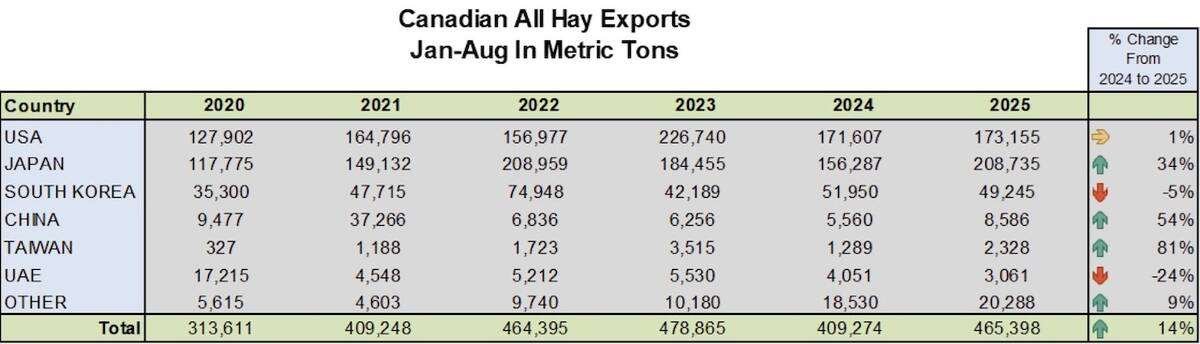
“Much of what exports to Japan is middle- to lower-grade hay,” he said, calling out that timothy is in demand, which is a benefit to growers in Prairie regions. “Over the past five months shipments to Japan have outpaced shipments to the U.S.”
There are still shipments of timothy heading south of the border, specifically to Florida to the horse market. Callen said he’s heard from one buyer who is buying smaller quantities than normal, and stocking less due to the politics currently at play.
Callen speculated more fields in the U.S. are being planted in timothy, which could impact Canadian export prices.
Cubes and pellet exports have fallen by about three per cent, partially due to tariffs and shipping costs.
When looking at forage exports by the four major countries — the U.S., Spain, Australia and Canada — he points to Spain as the only country significantly increasing the amount of forage exported this year. He said new drying technology using heat pumps makes it easier for them to process their hay which is mostly shipped to the Middle East, including the United Arab Emirates.
Weather challenges
Weather in 2025 was mixed, with a dry start to the season in the western U.S.
“June was really dry, then a lot of guys kind of got going in July and we were hit with a lot of rainstorms,” Callen said. “Arizona had one of the rainiest summer’s they’ve had. We kind of had spotty weather that affected the quality as well.
“Southern Alberta had the wettest July since 2016, which messed up the timing of harvest.”
He added this may impact the amount of hay getting shipped to Florida, which is a key market due to the horse industry.
Currency
Currency can have an impact on foreign markets and when the U.S. dollar is high, it’s better for Canadian and Australian producers, which is part of what impacted trade to Japan.
The biggest challenge on the table Callen said, is the Canada/U.S. trade relationship.
“How will trade relationships adapt?” Callen asked. “How will grain markets react to new trade deals?”
He speculated there seems to be some lobbying by farmers in Washington to improve trade partnerships and pointed out that the Saudi Arabian crown prince was visiting.
“Saudi Arabia is a buyer of U.S. alfalfa,” he said.
He added he feels the U.S. unpredictability is probably an advantage to the rest of the world.
As for market drivers going into the next year he says to keep an eye on dairy prices.
“Will the herds lower following milk prices or will cow numbers remain high?”
He added dairies are selling day-old bull calves for between $1,200 and $1,600 a head, which is supporting dairy producers. “Will beef ranchers start to rebuild herds?”
“Overall, I think things are going to a little bit better,” he said.
He suggested Canadian producers have an opportunity to capitalize on the South Korean market, which is changing its quota system and allowing for more imported feed.
“Vietnam, Indonesia, both are looking for high-quality alfalfa,” he added.
He also pointed to new technology as an opportunity. Dryer innovations, mitigate the risk of rain, dual balers improve production and allow for producers to bale for retail sales as well as export.
The post External forces continue to keep forage markets in flux appeared first on Farmtario.


