
Federal funding and greater co-operation between conservation authorities in the Lake Erie region have helped spur a significant jump in the number of farms participating in environmental programming.
According to those delivering the programming, the volume of interest is at times straining their capacity to process applications. It’s a good problem to have, however, as more interest in farm country means positive environmental outcomes are more likely.
Participation triples
Conservation authorities have long maintained agri-environmental cost-share programs for best management practices, says Tatiana Lozier, integrated watershed management manager for Upper Thames Conservation Authority. But the funding for those programs has historically “been pulled together from different sources,” and thus been somewhat limited in scope and scale.
Starting in 2024, the Canada Water Agency provided six conservation authorities — Upper Thames, Lower Thames, St. Clair, Essex, Long Point and Grand River — with a combined $44.5 million over four years to combat nutrient pollution through agri-environmental programming. The investment meant significantly more could be done to incentivize the adoption of best management practices best suited to the agricultural landscape in each region.
“This opportunity was really the time for us to take everything we’ve heard from agriculture producers over the years and expand the types of actions we are supporting, and the rate of adoption,” says Lozier.
As of May 22 this year, 979 farms across the six conservation authorities are participating in Canada Water Agency-funded programs — double the number of farms involved in the first year of the program, and significantly more than the number accessing cost-share funding in years prior.
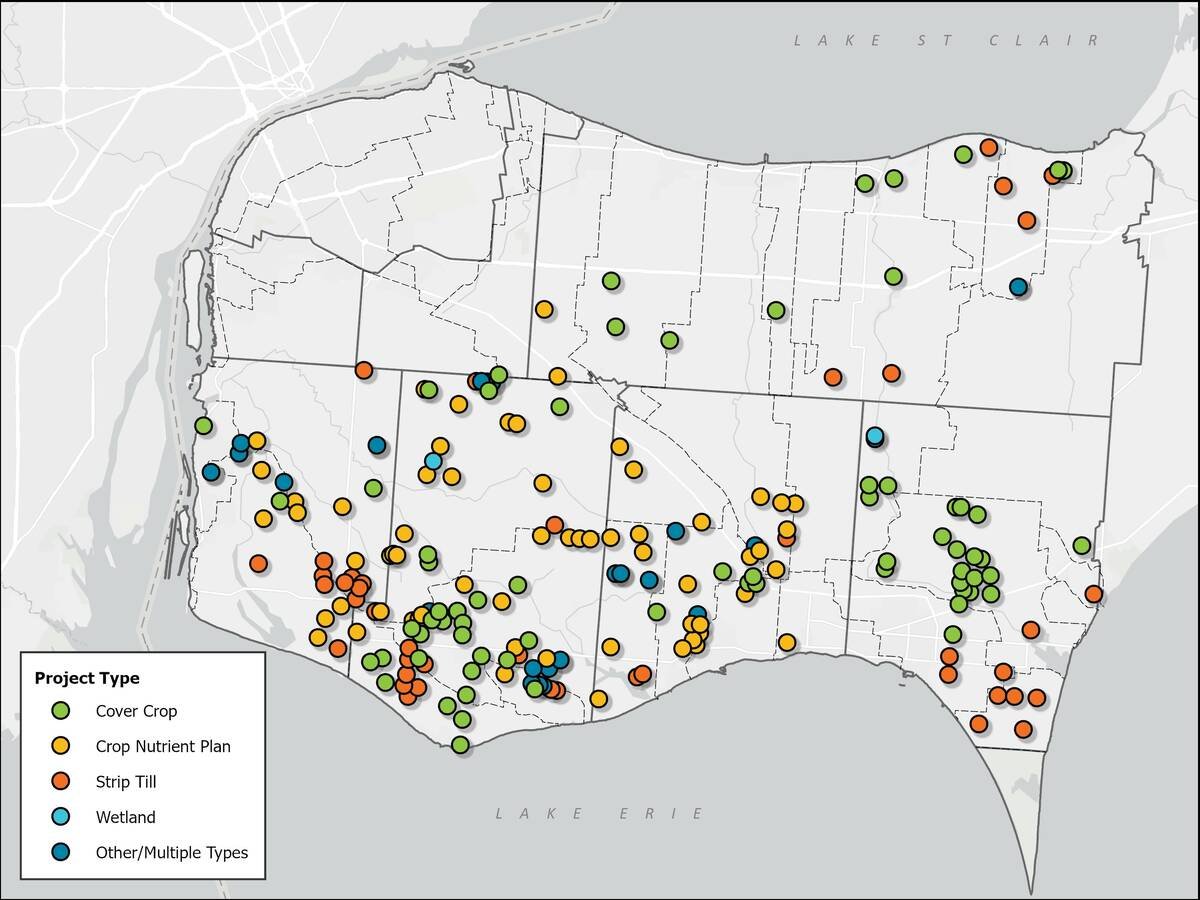
“We also doubled the number of projects since last year, with 4,825 individual best management practice projects funded this past year,” she says.
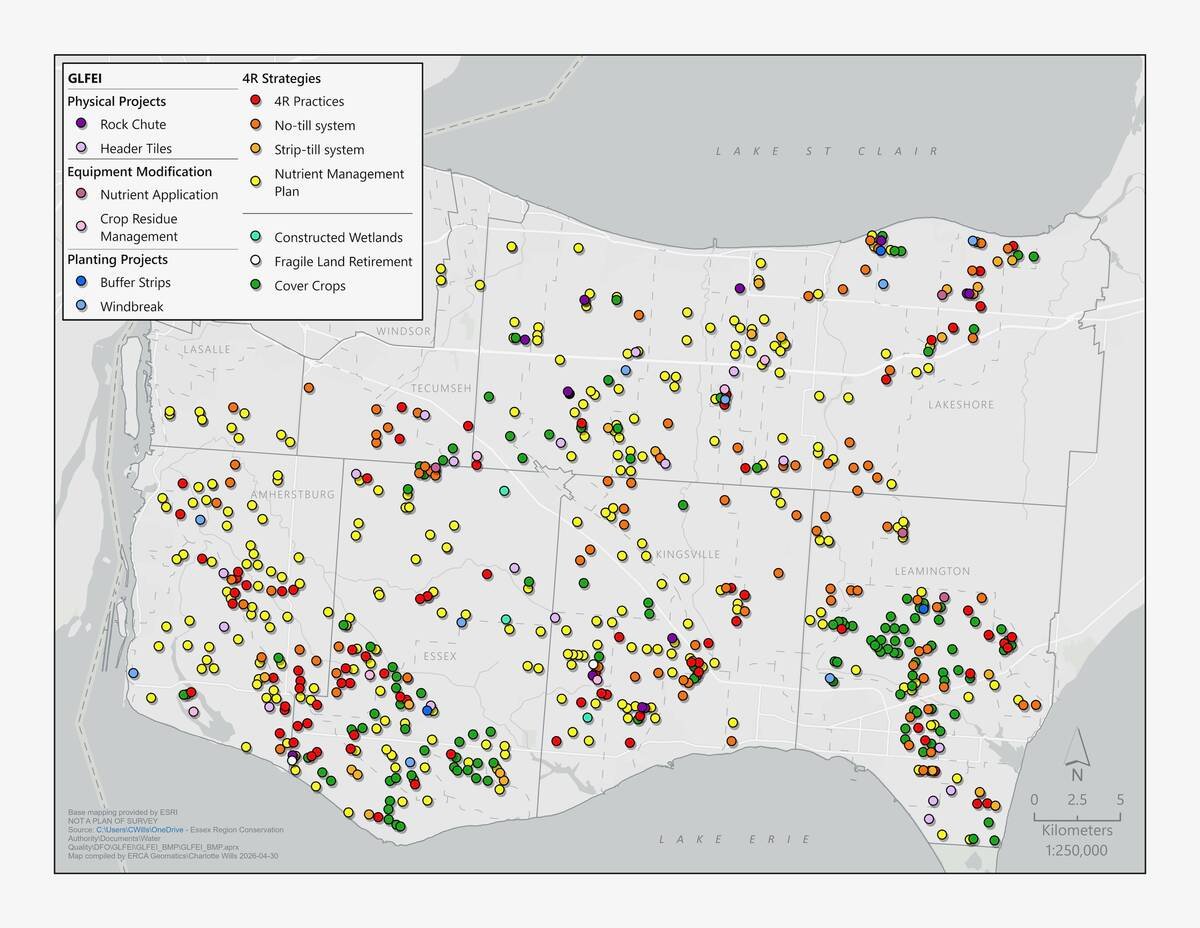
Shawn Palichuk, watershed stewardship technician for Essex Region Conservation Authority, reports farmer participation in Essex quadrupled from 39 in 2024 to 158 in 2025. The corresponding acreage increase went from 11,619 to 41,1512 acres, or approximately 12 per cent of all non-urban land in Essex.
Katie Stammler, water quality scientist and source water protection manager with Essex Region Conservation Authority, notes many of the new participants had no prior relationship with the conservation authority. Previously pointing to the region’s tile main initiative as a popular program, she has also been impressed by the growth of interest in cover crops.
“Fun fact for cover crops is we started funding them around 2018, and for the first several years we had to really work hard to get 500 acres. This year we funded over 6,000 acres and many farms reached the maximum cap. We know others likely didn’t apply, so there were more acres than that actually planted,” Stammler says.
“This is a huge change in Essex where many farmers were hesitant to use cover crops because of concerns related to the heavy clay soil.”
Harmonizing programming
The agricultural programs on offer within a given conservation authority can differ based on the needs and challenges of the region. Nutrient management has long been a focus in Essex, for example, whereas in livestock-heavy Upper Thames, Lozier says tree planting, buffer strips and similar initiatives were more typical. Funding from the Canada Water Agency has allowed the latter to close some of that gap.
“We all are also trying to support one another where there are those watershed boundaries. Previously, we may have had programs our bordering conservation authorities didn’t have. That can be hard for people farming across both. We’re trying to offer similar things where we can, and where it makes sense to do so. We can all fund cover crops at a similar rate, for example,” Lozier says.
“We are trying to co-operate to have a better broader impact.”
The post Farmers’ funding uptake surges for cover crops, other green projects appeared first on Farmtario.


