
Developers argue their plans are being misrepresented following calls for a review of the proposed 446-home subdivision.
WHY IT MATTERS
The province’s push for intensification in urban areas has left many rural communities exposed to development outside defined growth areas.
The initial property plan was for 118 executive homes under a condominium corporation, which would have overseen the roads and water infrastructure. However, when sales didn’t meet expectations, developers submitted a revised, larger-scale proposal, designed to appeal to families.
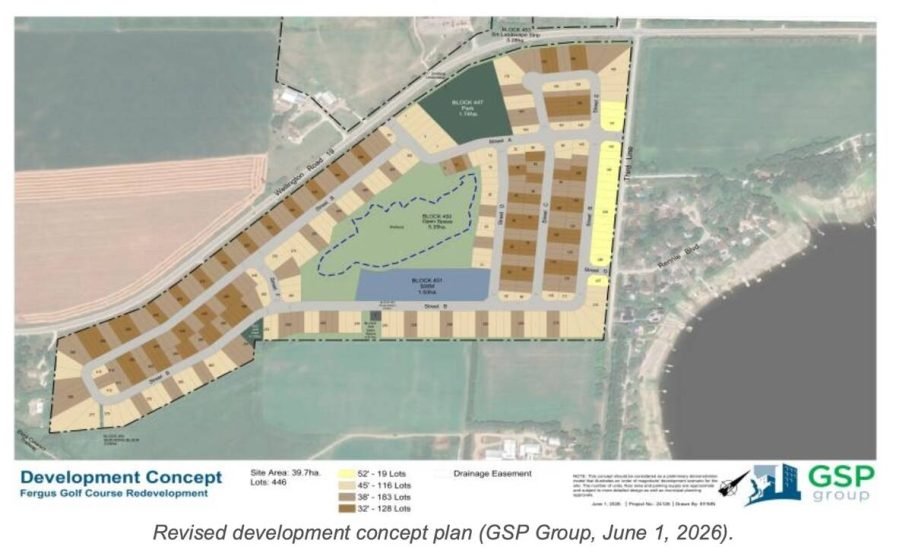
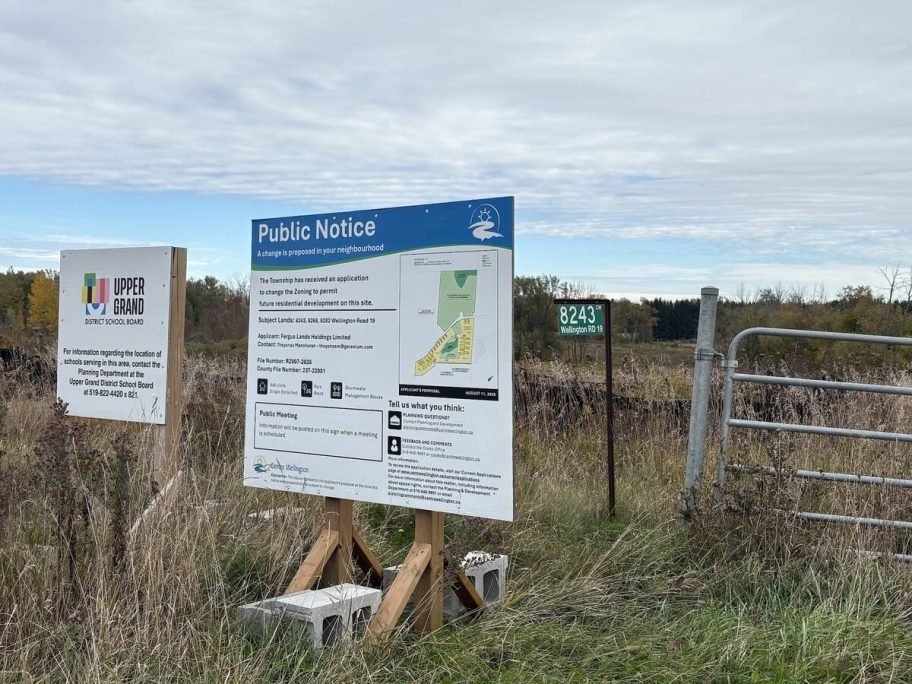
Neighbours, who formed a residents’ coalition called Fight446 Homes, are concerned the project on the former golf course on Wellington Road 19 between Fergus and Belwood, Ont., will affect local farmland and water resources.
Infrastructure concerns
Cheryl Shindruk, executive vice-president of Geranium Homes, told Farmtario that land-use and environmental studies addressed these issues.
“Our proposal is for land that has been used as a golf course since 1977, and we are not proposing to take any agricultural land out of production,” she said. “So, the idea that somehow this is a threat to, or ‘nipping away’ at farmland, it’s just not true because there’s no part of this property that’s being farmed.”
In an email to Centre Wellington council, the Fight446 Homes group and Farmtario, Shindruk responded to water concerns, saying the proposed development will not “create additional demands on existing municipal infrastructure.”
There is no proposal to connect to existing water and wastewater treatment facilities in Fergus, she reiterated.
Instead, service delivery will come from new water and wastewater treatment facilities designed to meet the site-specific needs of the development and funded by the developer in accordance with provincial and municipal regulatory requirements, she clarified.
She wrote that extensive hydrogeological investigations assessed groundwater availability and the development’s potential impact on existing water supplies. The investigations found there is enough groundwater to serve the development while continuing to meet existing residential and agricultural needs.
New system management
“The system needs to be operated and maintained going forward, and there needs to be a fee structure to do that,” she said, adding that once completed, they’d like Centre Wellington to manage the facility.
Centre Wellington mayor, Shawn Watters, said the township is hesitant to undertake that responsibility. He pointed to nearby housing developments Pine Meadows, with 195 units, and Maple Leaf Acres with 520 units, which manage their own water treatment facilities.
“My comfort level is that it be a private system and owned and operated by the folks who live in that development,” Watters said.
He’s personally not comfortable with the number of houses being proposed and is concerned they may not fit the aesthetic of nearby homes.
Watters has worked with both sides to help open lines of communication and ensure the development is in keeping with what the community would like to see.
“It’s a modern-day subdivision dropped into the middle of a field,” he said, adding that, from a development perspective, the proposal is a “one-off”.
Watters agrees the land was always slated for homes; typically, it wouldn’t have been approved without full services.
Protecting ag land
Brian O’Connor, a resident and Fight446 Homes co-founder, respects Geranium allowing the municipal application process to run its course even if it exceeds the Planning Act’s statutory timelines.
The former EastGen CEO noted that Wellington County’s agri-food value chain is significant, generating $2.8 billion in GDP annually, ranking alongside manufacturing as the top two sectors and must be protected.
“It is very important and must be protected. Yes, the Fergus Golf Course land was zoned out of agriculture in the 90s,” he said. “But it doesn’t change the fact that the proposed plan would put a subdivision of 446 homes, over three kilometres from the urban boundary, right next to an active dairy farm and in a location surrounded by prime agricultural land.”
O’Connor points to a section of the 2024 Provincial Planning Statement which states: “Planning Authorities are required to use an Agricultural system approach to maintain and enhance a geographically continuous agricultural land base and support and foster the long-term economic prosperity and productive capacity of the agrifood network.”
“Developing a subdivision surrounded by prime agricultural land does not meet this requirement, especially when Centre Wellington has already expanded the urban footprint to meet and exceed provincial growth targets,” he said.
Land use appeals
BY THE NUMBERS
- 446 single-detached homes proposed, up from 118 in the original plan
- $2.8 billion: Wellington County’s annual agri-food GDP, cited by the Fight446 Homes coalition
- Three kilometres: the subdivision’s distance from the urban boundary, according to the coalition
- 95 per cent: developer success rate at the Ontario Land Tribunal from 2021 to 2024, per a 2025 Western University thesis
- 842 acres: mostly prime farmland at stake in a separate October appeal to expand the urban boundary, the coalition says
O’Connor said the subdivision is “a classic case of urban sprawl that causes farmland fragmentation and makes it more difficult to maintain the strong level of mixed farming that Wellington County is famous for.”
He added that local municipal planners and councils are respecting this directive, noting that, in August 2026, the Ontario Land Tribunal overturned a recent plan in Hamilton converting 3,950 acres of prime agricultural land on the edge of the city to development land.
He believes this and other area developments will be an uphill battle. The community is facing a similar appeal to the tribunal in October by a different developer to further expand Centre Wellington’s updated urban plan. This would mean an additional loss of 842 acres of mostly prime agricultural land to the urban boundary.
O’Connor cited Aynsley Hovius’s 2025 Western University master’s thesis that found between 2021 and 2024, developers received some form of approval, including a settled application, in 95 per cent of cases before the Ontario Land Tribunal.
“The pendulum has swung too far in favour of the developers and must return to the middle,” he stated. “Let planning decisions be made at the local level while meeting provincial growth targets. We must protect farmland, reduce urban sprawl to ensure a healthy, sustainable food network.”


