Our XXL Lysimeter Experiment, Article 6 of 6
The first five articles were about signal. This one is about the plumbing — the rain gauges, ambient monitors and buried probes that made the rest possible, and what four years of running them taught us about long-term field MRV. The headline is not glamorous, and that is the point: most of the practical difficulty in field weathering MRV is in keeping the measurements trustworthy over years, not in the chemistry.
Rainfall: your own gauge probably under-catches
Water is what carries the alkalinity out of the soil, so the water balance underpins every export number. We measured rain two ways: the official station (DWD Nürnberg 03668) and our own on-site gauges.
The official record is the reliable one: roughly 533, 775, 691 and 548 mm for 2022 to 2025. Our on-site gauges, by contrast, consistently caught less — the tipping-bucket gauge (a Barani Design MeteoRain 200 Compact) recorded only about 53 % of the official total over its life, and the newer Ecowitt piezo gauge (a Wittboy Pro) about 83 %.
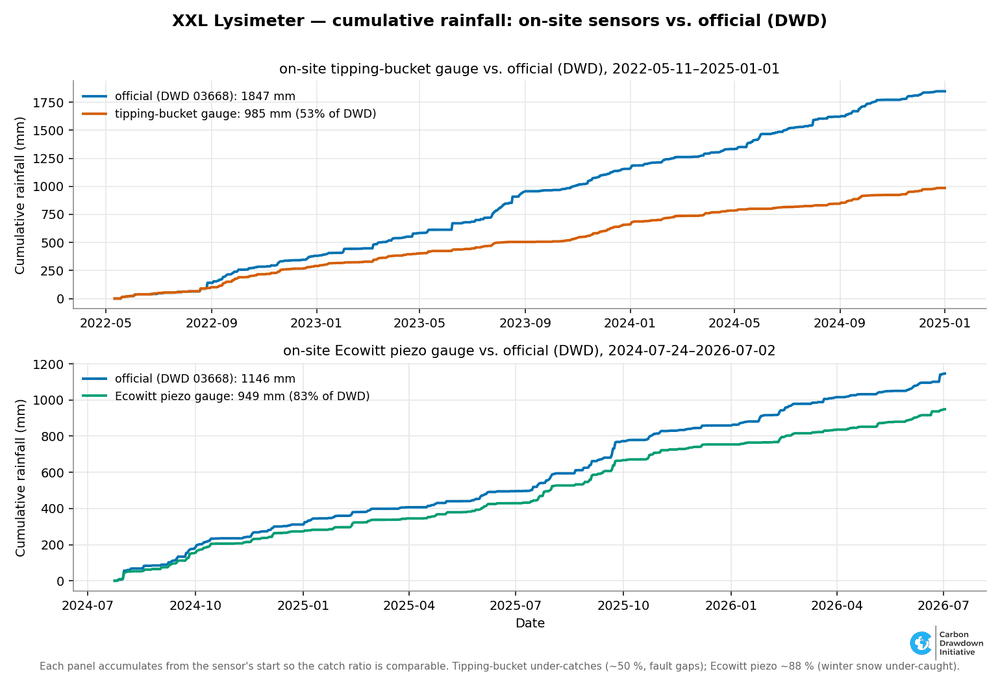
Figure 1: Cumulative rainfall, on-site gauges vs official DWD station. Both on-site gauges under-catch — the tipping-bucket badly (~53 %), the Ecowitt piezo less so (~83 %).
Under-catch is normal for tipping-bucket gauges (wind, evaporation, missed light rain, the occasional fault), but a 47 % shortfall is large enough to distort a water balance if you trusted it blindly. The practical lesson: keep an official reference series, cross-check your on-site gauge against it, and know your gauge’s catch ratio before you use its numbers in a flux calculation. We ship both series in the dataset so the choice is explicit.
Ambient CO₂: the air the soil breathes into
Our ambient monitors (Seeed SenseCAP S2103) log CO₂ at two heights. Near the ground (20 cm) the mean is about 544 ppm; at 200 cm it is about 470 ppm. The near-surface air is enriched — soil respiration leaking upward — and that gradient is a small reminder that the “atmospheric” boundary condition for a field experiment is not a single global number. It matters mostly as context here, but for any scheme that infers fluxes from CO₂ concentrations, the reference level is a real choice.
The uncomfortable arithmetic of sensor survival
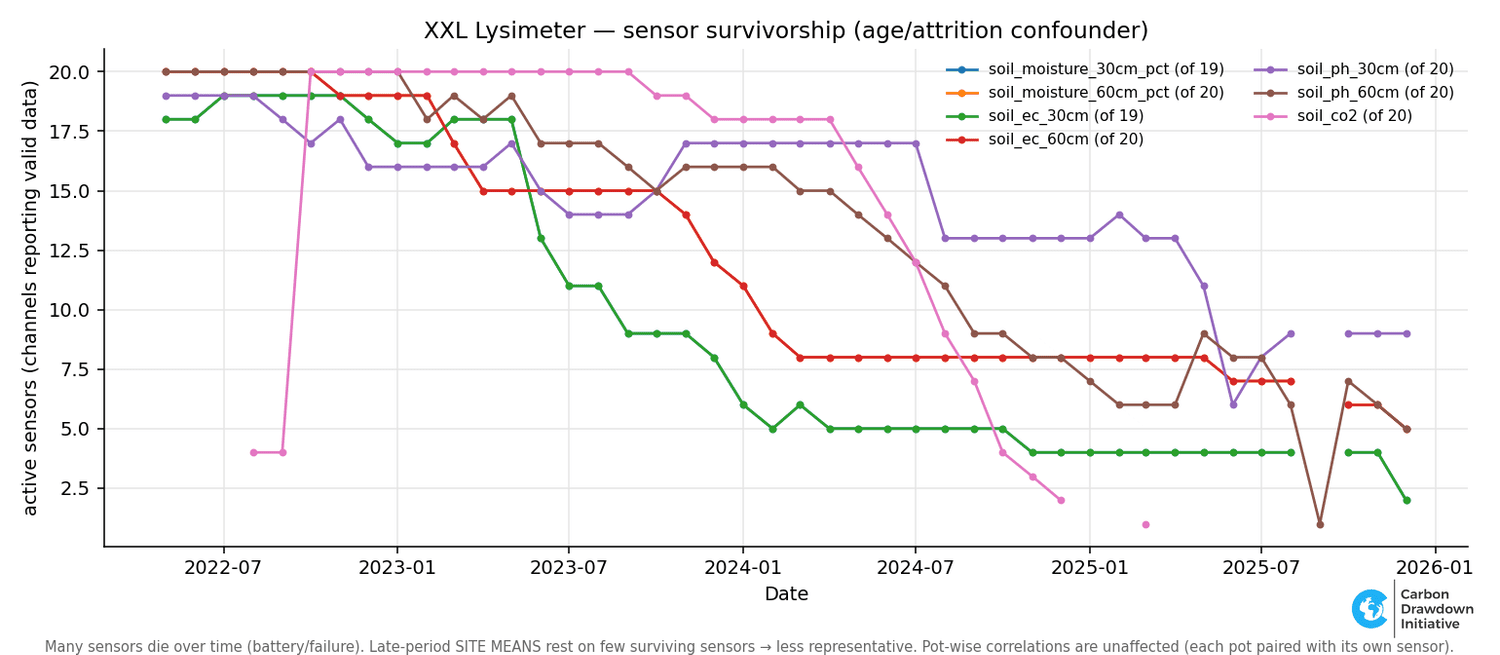
The hardest lesson is the simplest to state: sensors die. We started with a nearly full set — around 18 to 20 working channels for each buried variable. Four years later most of them are gone.
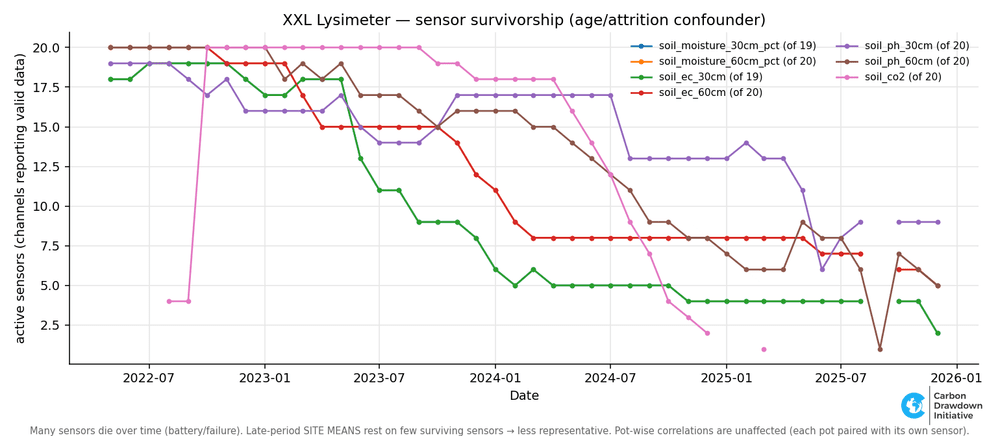
Figure 2: Active sensors over time, by variable. Most channels fail within two to three years; the soil-CO₂ sensors fall from a full twenty (one per pot, complete by October 2022) to a handful by late 2024, and to a single survivor by early 2025.
By the end of 2024 the moisture and 30 cm-EC channels were down from ~19 to 4, the 60 cm channels to about 8, and soil CO₂ from its full twenty to four by that autumn — and to a single sensor by early 2025. For the other buried variables the survivors thinned further through 2025. Batteries run out, connectors corrode, probes lose contact with drying soil — the ordinary attrition of instruments left outdoors for years.
This has two consequences we have been explicit about throughout the series:
-
Late-period site means rest on few sensors. A “site average” in year four is an average of a handful of surviving probes, not the original twenty — less representative, and worth flagging rather than smoothing over. (It is also why, when part of the experiment was repurposed in 2025, we kept only the continuing pots in the released sensor record.)
-
Survivorship is a confound to rule out, not ignore. Because sensors die non-randomly over time, a raw sensor↔leachate correlation could in principle be a time-trend artefact. We checked: after removing the common time trend, the core relationships hold (for example, 60 cm soil-EC ↔ leachate EC stays at r ≈ 0.61 partial for time, down from 0.70 raw but clearly real; soil CO₂ ↔ pH is unchanged). The signal is not an artefact of which sensors happened to survive.
What this means for MRV
None of this is a reason to distrust in-situ MRV — the earlier articles show how much these sensors reveal. It is a reason to engineer for the long run:
-
Anchor every on-site gauge to an official reference, and carry the catch ratio.
-
Over-provision sensors so the late record — usually the most valuable — still rests on several instruments, not one survivor.
-
Report coverage plainly: say how many sensors a late-period mean is built on.
-
Test time-trend and survivorship confounds explicitly before trusting a long correlation.
-
Sample the solid phase, not just the drainage. Cation retention and exchange pools, secondary clay minerals, and the fate of soil organic carbon are invisible to a leachate sampler and a gas probe — yet they decide how much of any weathering becomes durable CDR.
The series, in short
Across 1,400 days at one well-characterised site, the macro-scale weathering behaved as the chemistry predicts, the dose–response we hoped to credit stayed inside the noise, and the most useful MRV signal came not from the leachate alone but from cheap, buried, continuous sensors — read carefully, corrected for moisture and season, and never trusted past what the survivors can support. Great macro-scale performance, messy micro-scale reality — measured, for once, over years. The full data, code and figures are in the accompanying dataset; take them apart yourself.
The XXL Lysimeter dataset (2022-2026) series
-
Intro article — why a 1,400-day, daily-instrumented experiment is worth the wait.
-
Dose–response — the initial flush (the Birch effect, not weathering), the long convergence, the n = 4 power problem, and the FINE-is-a-different-rock confound.
-
The soil breathes — how temperature and soil CO₂ drive a seasonal weathering engine visible in the buried sensors.
-
A buried EC sensor as a continuous MRV proxy — the 60 cm probe tracks leachate chemistry remarkably well (and the 30 cm one does not); the long-term, in-situ extension of our EC-as-alkalinity-proxy work.
-
What the soil tells us when it breathes — reading four years of buried CO₂ sensors: the soil as a living system of warmth, water and microbes — and why even a sensor in every pot is the weathering engine, not a carbon meter.
-
Four years of buried sensors — rainfall, ambient CO₂, and the reality that most field sensors die within two to three years.
Data, code & figures:doi.org/10.5281/zenodo.21216439 (CC-BY-4.0) · github.com/dirkpaessler/carbdown_xxl_lysimeter_2022_2026